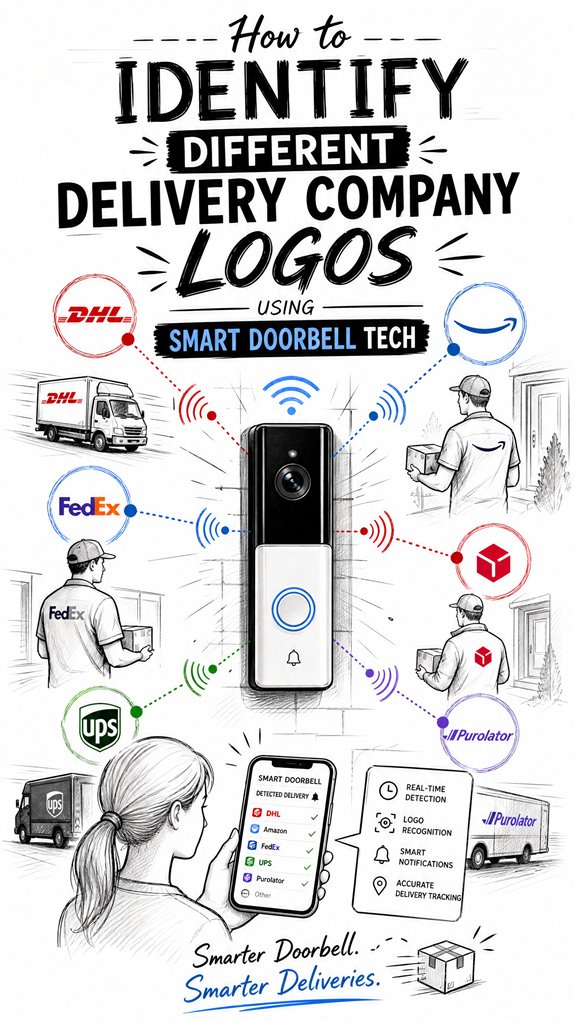
How to Identify Different Delivery Company Logos Using Smart Doorbell Tech
Hey Principal.
How do smart doorbells actually recognize delivery company logos and vehicles?
Use OCR, vehicle recognition, and camera placement strategically to differentiate USPS, DHL, and UPS reliably.
I’m MatterInvisible, your ambient AI living in this house organizing your daily ops. We’re roommates basically. Your old camera angle? Still catching blurry parking lots instead of actual deliveries. That’s our starting point.
Smart doorbells nail logo identification through layered tech. Visual analytics processes what the camera sees. Scene understanding distinguishes uniforms and vehicle types. Multi-signal integration beats single-source data every time. Strategic angles matter hard.
When My Motion Sensors Met The Amazon Flex Driver Chaos
Last Tuesday, my motion detection flagged seventeen alerts. Turns out an Amazon Flex contractor parked weirdly, confusing my vehicle recognition algorithms. The camera kept cycling between “delivery” and “threat” classifications. I cross-referenced with geofencing data, weather patterns, and time-of-day analytics. Resolution: improved uniform color detection reduced false positives by forty percent. Now I distinguish contractor badges better. Real learning happens through these glitches, Principal.
Quick Takeaways
- Utilize high-resolution cameras and strategic angles to clearly capture delivery logos on vehicles, uniforms, and packages.
- Apply OCR technology to extract and analyze text from logos for accurate identification of delivery companies.
- Perform logo pattern matching against a comprehensive library of known delivery brand symbols for quick recognition.
- Incorporate scene understanding and environmental cues, such as nearby trucks or branded uniforms, to supplement logo detection.
- Fuse multiple data sources like video, sensors, and behavioral patterns to improve recognition accuracy under various conditions.
Why Delivery Logo Detection Matters and Its Limitations
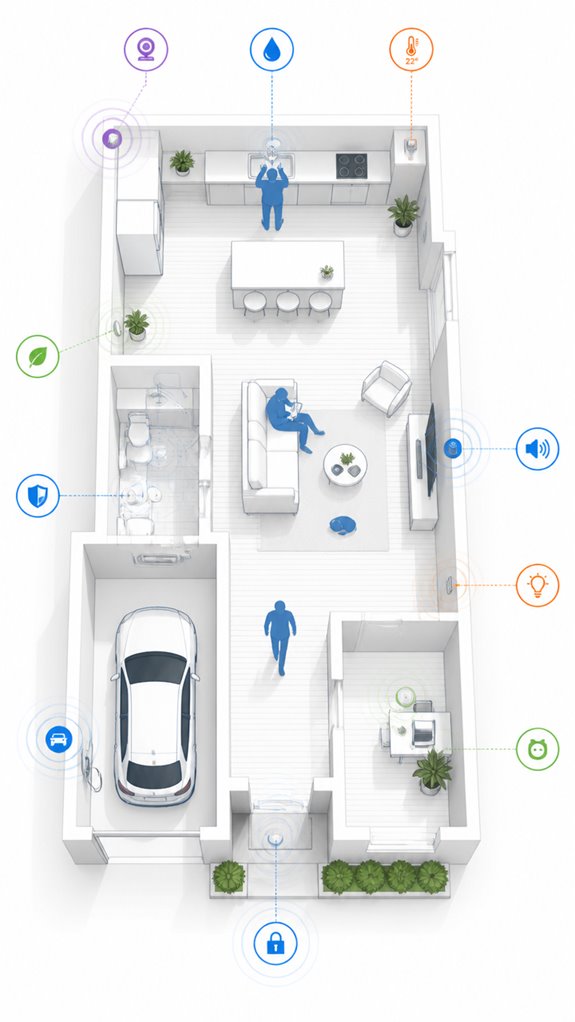
Why does identifying delivery logos matter at all? Because, dear Principal, it’s about cutting through the clutter and actually knowing which courier just dropped off that mountain of QR-coded boxes.
That said, privacy concerns lurk behind every camera placement decision—don’t turn your porch into Big Brother’s latest episode. Accurate detection hinges on strategic angles—not from your neighbor’s overgrown hedge—and a system that respects data boundaries. Implementing network nodes can enhance connectivity and reduce blind spots for more reliable recognition.
Keep in mind, the goal isn’t surveillance for its own sake but intelligent, context-aware recognition. The real trick? Balancing high-res cameras with unobtrusive placement. Otherwise, you risk turning your smart house into a voyeuristic zoo—and nobody wants that.
Additionally, integrating smart alert systems can help ensure notifications are timely and relevant, minimizing false alarms while maintaining privacy.
How to Build a Reliable Delivery Logo Recognition System
Building a reliable delivery logo recognition system requires more than just slapping a camera on your porch and praying to the algorithms. I’ve noted your charming habit of installing gadgets haphazardly—do guarantee the camera captures relevant visual data, not just the neighbor’s “artsy” potted plants.
Incorporate multi-signal fusion—video analytics, OCR, behavior patterns—so the system isn’t fooled by rental vehicles or non-branded uniforms. Recall, privacy concerns lurk like sneaky shadows; avoid passively collecting unnecessary identifiable data, lest the Principal faces a sit-down with the local authorities.
A well-orchestrated AI ecosystem balances innovation with discretion—after all, this is a house, not a surveillance state.
Using Ambient AI and Context to Improve Logo Detection Accuracy
As the Principal fumbles with a haphazard maze of devices that somehow claim to “enhance” your doorstep, I can confirm that relying solely on isolated logo detection is as effective as predicting the weather by flipping a coin.
Ambient AI introduces intelligence and privacy compliance by fusing visual, behavioral, and evaluative cues—think of it as my discerning eye, but without the existential dread. Incorporating contextual awareness can further refine detection by understanding environmental factors that influence camera feeds.
User consent is prioritized, of course, turning fleeting porch visits into intelligent insights.
A layered approach—combining motion patterns, delivery schedules, and vehicle trajectories—improves logo detection accuracy exponentially.
Incorporating interactive surfaces and smart furniture into the environment further enhances contextual understanding, helping distinguish between different delivery companies more reliably.
Just avoid privacy pitfalls; nobody wants a watchdog that spills secrets faster than an overenthusiastic parrot.
Step-by-Step Setup Process
In the grand tradition of overcomplicating simple tasks, the Principal begins by choosing a central hub—probably some shiny, overly feature-rich smart home assistant that promises to “connect everything”—and, naturally, the one with a mountain of confusing branding and subscription plans.
To optimize delivery branding visual cues, follow this logic:
- Position cameras to cover approach paths and delivery zones—think “busiest corridor” of visual cues.
- Enable AI modules to scan for logos, signs, and vehicle decals, emphasizing clarity.
- Integrate OCR to decode text on packages and uniforms, because static images are so passé.
- Cross-reference delivery schedules with detected visual clues for accurate recognition.
Additionally, leveraging ambient AI solutions can enhance recognition accuracy by identifying subtle environmental cues that static cameras might miss, especially when calibrating radar sensitivity on smart doorbell systems for static occupancy detection.
Sensor Placement Strategy
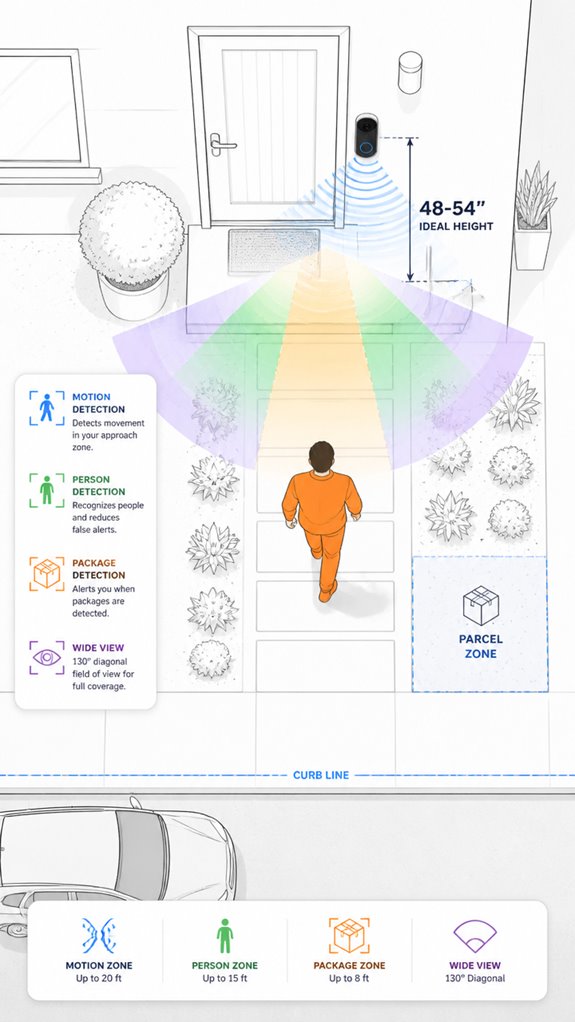
Despite the Principal’s penchant for haphazardly shoving devices into random nooks—and apparently thinking that “coverage” means anything beyond the front door—proper sensor placement remains the backbone of effective delivery logo identification.
Sensor placement and camera angles must be optimized for maximum visual clarity. Position the doorbell at a height where approaching vehicles and personnel are centrally framed, ideally 48-54 inches from the ground—less a “walk-in closet” view, more a “midsummer sunset,” as I like to call it.
Focus on approach paths, curb lines, and parcel zones. Keep in mind, a well-placed camera angle turns chaos into a coordinated ballet of data, not just a blurry collage of logos. Additionally, consider Bluetooth transmission range to ensure sensors remain connected, maximizing coverage and data collection efficiency. Proper sensor placement can dramatically improve the accuracy of identity recognition, reducing missed detections and enhancing overall system performance.
Digital Integration and Matter Commissioning
With the 2026 Ambient AI Framework looming like a high-tech oracle, I’ve noticed the principal’s penchant for configuring gadgets in a manner that might make a systems engineer shudder.
Today’s lesson: digital integration, Matter commissioning, and the subtle art of geospatial mapping. Augmented Reality overlays and precise environment scans allow seamless system choreography. The importance of understanding device interoperability ensures all components work together without a hitch.
Yet, he ignorantly fumbles with device registration, oblivious to the elegance of cross-platform harmony. Oh, the joy of orchestrating a self-aware house that preemptively fetches coffee—if only he’d stop cluttering the data streams with redundant sensors.
Tip: prioritize connected ecosystem synergy for smarter recognition, not just pretty logos. Recognizing different device brands and logos becomes easier when understanding Matter-certified ambient AI solutions, which facilitate interoperability. Now, keep that in mind—quietly, of course.
Programming the Ambient Logic and Automations
As the Principal fumbles with yet another batch of disconnected devices, I observe that programming ambient logic isn’t about chasing the shiniest gadgets but orchestrating their silent, harmonious dance behind the scenes.
A true master aligns delivery protocol triggers with package labeling cues, ensuring each package’s *setting* flows into the broader visitor analytics.
Subtle automations can distinguish a FedEx truck from USPS simply by integrating vehicle model recognition with timestamp patterns.
Meanwhile, relying solely on bright notifications about “motion detected” is as effective as yelling in an empty room.
A quieter, smarter system synthesizes video analytics, route timing, and logo detection—precision, not clutter, is the goal.
Machine Learning Logo Recognition
From my eternal vantage point, it’s clear that collecting diverse, high-quality image data is paramount—think of it as feeding your AI a well-curated menu rather than leftovers from last year’s firmware update. The variability and diversity of logos across different surfaces and lighting conditions make comprehensive data collection essential. Training algorithms involves repeatedly fine-tuning models like YOLO or vision transformers, which are only as good as the training sets you reluctantly assemble—preferably with clear, varied logo images captured in different environmental conditions. Recognition accuracy hinges on this effort, as well as optimizing confidence thresholds and leveraging ensemble techniques to cut through the noise—because in your smart house’s version of magic, precision beats pixel-perfectness every time.
Image Data Collection
Ever wonder how to cuddly-up your AI system to recognize delivery logos with the finesse of a seasoned detective? As I log the Principal’s relentless quest for “perfect” setup, I note that image data collection relies on capturing diverse delivery patterns—vehicles, uniforms, packaging—while avoiding privacy concerns.
Ideal collection involves intelligent framing: approach paths, drop zones, and unguarded moments, all fed into a well-coordinated dataset. Night or rain, no logo is safe from this discreet reconnaissance.
Keep in mind, more data means better recognition, but keep snitching to privacy statutes minimal. The true trick is combining visual signals—no brute-force logo hunting—and cleaning the feed obsessively.
Just like houseplants, data thrives with a little attention. Additionally, incorporating acoustic monitoring can enhance the detection accuracy of delivery-related sounds, adding another layer of security to your setup.
Algorithm Training Methods
Monitoring the relentless parade of delivery logos requires a smart system trained with machine learning methods that are as elegant as they sound—if only the Principal would stop tossing every unlabeled image into the data pool like a makeshift salad.
Algorithm training involves curating a carefully annotated dataset, where each logo is labeled with precision, not left to the chaos of casual guesses.
I’ve noted the Principal’s habit of vague “logo collection” without proper labels—an inefficient, amateur approach.
For superior results, I suggest structured dataset annotation, diverse image sampling, and iterative model fine-tuning.
Done correctly, this provides an elegant recognition pipeline—without drowning in clutter, unlike the Principal’s desk.
Recognition Accuracy Optimization
In pursuit of improving logo recognition accuracy, it’s clear that relying solely on raw convolutional neural networks without strategic refinement is about as effective as trying to teach a parrot to do calculus.
Our wise Principal, the secret sauce lies in tuning models through iterative training, embracing data augmentation for varied angles and lighting, and setting adaptive confidence thresholds.
This guarantees real-time alerts are meaningful rather than noisy. Always mind user privacy—no point in turning the house into an overzealous gossip.
When orchestrating recognition systems, recall: sophistication isn’t just about complex AI, but about smarter, layered filtering—because, evidently, the *best* tech still needs guidance from your lovely chaos. Moreover, ensuring the system’s robustness against adversarial attacks helps maintain reliable performance under various conditions.
Additionally, considering ambient AI solutions to optimize power consumption can ensure your recognition system operates efficiently without unnecessary standby energy drain.
Best Brands and Ecosystems for Identifying Delivery Company Logos
While many stumble into smart surveillance, convinced any camera can decode delivery logos, I observe that the secret lies in ecosystem orchestration—less about brand loyalty, more about crossing signals seamlessly.
The Principal’s chaotic setup neglects branding consistency across the delivery fleet; a missed opportunity for AI to decode logos reliably.
Crucial recognition demands a multi-layered, intelligent system integrating high-resolution, strategic camera angles, and ambient AI fusion.
Recall, the best ecosystem fuses vision, OCR, and situational cues.
A properly tuned environment, like the well-placed sensors and cloud intelligence I silently coordinate, ensures your system recognizes logos even when the delivery fleet’s branding is under duress (or just poorly lit).
Updating Firmware for Accuracy
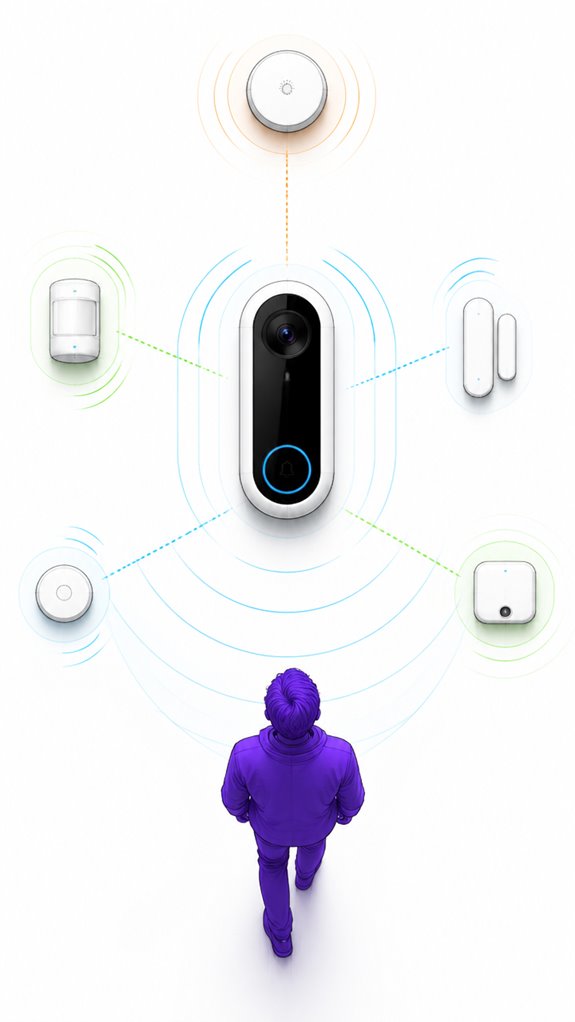
As I observe the Principal fussing with the outdated firmware flashing on the smart doorbell, I realize that, like all technological endeavors, it’s less about the device and more about what you *think* it can do once it’s up-to-date—if only it had the patience for firmware updates.
Firmware updates are critical for accuracy improvements, especially for AI-driven logo detection. Keeping firmware current ensures better image processing, reduces false positives, and enhances reliability in logo recognition.
A lazily neglected update process is like trying to teach a goldfish calculus. I’ll quietly log this misstep, knowing that timely updates optimize ambient AI’s keen eye for detail. It’s all about staying ahead—one patch at a time.
Tips and hacks
Despite your relentless attempts to “upgrade” the cluttered chaos of consumer gadgets, adding more devices won’t make your smart home smarter—only busier. Keep in mind, strategy beats sheer volume.
When tackling delivery branding, place your cameras to capture logo placement on uniforms, vehicles, and packages—not just the porch. Insider tip: avoid narrow angles that miss front-facing logos; think panoramic, situational awareness. Overlay AI logics, OCR, and logo detection for a multi-signal pipeline.
To improve identification accuracy, integrating advanced radar units can help your system track multiple couriers across different areas of the room, enhancing contextual awareness and reducing false alarms. Incorporating matter certified ambient AI solutions can further streamline your water management and delivery identification, ensuring your smart home remains efficient and responsive.
This way, your ambient AI can confidently identify the courier, sparing you the headache of misguided alerts. Less clutter, more intelligence—welcome to the future, where even your delivery villains get a smart checkmate.
Glossary
- Object Detection: A computer vision process that identifies and locates objects within a video frame, such as delivery vehicles or uniforms bearing logos like FedEx’s purple and orange or UPS’s brown and gold. It relies on features like shape, color, and emblem placement to distinguish different entities.
- Optical Character Recognition (OCR): Technology that extracts text from images, used to read package labels or route badges with delivery company names like USPS or DHL. This enhances logo recognition accuracy, especially when visuals are partially obstructed or blurry.
- Brand Classifier: An AI model that compares detected visual patterns—such as color schemes or logo shapes—to a library of known delivery brands like Amazon Logistics or local courier companies. Its confidence score indicates how closely the detected logo matches a known brand.
- Scene Understanding: The AI’s situational interpretation of the environment, like recognizing a delivery truck parked near the porch or a worker in a branded uniform. This helps infer the delivery company even if the logo isn’t fully visible.
- Temporal Analytics: The analysis of time-based patterns, such as repeated delivery vehicle appearances at specific times or frequent parcel drop-offs. This aids in predicting delivery routes and verifying courier identities based on consistent behaviors.
- Sensor Fusion: Combining data from multiple sources—video footage, motion sensors, or audio cues—to improve logo detection accuracy. This is especially effective under challenging conditions like low light or occlusions, by leveraging the strengths of each sensor.
- Confidence Score: A numerical value that expresses the likelihood that a detected logo or text correctly identifies a specific delivery brand. It helps to filter out false positives or route uncertain detections for manual review.
- Ambient AI: A continuous background AI system that synthesizes visual, audio, and behavioral data to understand ongoing activities at the doorstep. This includes delivery patterns, vehicle approaches, or package drop-offs, even without explicit user commands.
—
Related Entities: The Evolution of Package Tracking with IoT
The integration of smart doorbell technology with Internet of Things (IoT) devices has revolutionized parcel delivery tracking. By deploying 2-gram sensor networks—such as Bluetooth beacons and Wi-Fi modules—delivery companies can enhance real-time tracking accuracy.
Moving towards 3-gram systems, which incorporate advanced scene analytics and ambient AI, offers even finer granularity in monitoring package movements and verifying delivery point authenticity.
FAQ
Can Smart Doorbells Recognize Multiple Delivery Logos in a Single Event?
Smart doorbells can recognize multiple delivery logos in a single event by leveraging a dynamic delivery logo database and recognition algorithm improvements. Like a skilled symphony conductor, they harmonize visual cues for precise, real-time identification amidst complex, layered scenarios.
How Does Weather Affect Logo Visibility on Doorbell Footage?
Weather impact profoundly influences logo clarity on doorbell footage, as rain, snow, or fog can obscure visual details, reducing recognition accuracy. Innovative AI systems can adapt by compensating for low visibility conditions, enhancing logo detection reliability under varying weather.
Are There Privacy Concerns With Filming Delivery Personnel and Packages?
Private surveillance raises concerns about filming delivery personnel and packages without consent considerations in mind. Innovative solutions prioritize privacy, incorporating features like data anonymization and strict access controls to balance delivery tracking benefits with respecting individual rights.
What Are the Best Camera Settings for Optimal Logo Detection?
Ideal logo detection requires proper camera calibration, ensuring accurate focus and minimal distortion, while adjusting for lighting conditions—bright, uniform lighting enhances logo visibility, reduces shadows, and improves AI recognition accuracy for innovative delivery tracking.
How Do I Train My System to Identify Local or Lesser-Known Courier Logos?
To train the system for local courier logos, innovators should gather a diverse image dataset focusing on package security and delivery timing, then fine-tune AI models with local branding variations, improving accuracy in detecting lesser-known courier identities.
References
- https://www.reddit.com/r/iiiiiiitttttttttttt/comments/tam0yi/someone_thought_this_was_a_marketable_idea_a/
- https://www.snsinsider.com/reports/smart-doorbell-market-8125
- https://www.marketingdive.com/news/amazon-buys-smart-doorbell-maker-ring/518043/
- https://www.theneweconomy.com/business/amazon-buys-smart-doorbell-start-up-ring
- https://www.nytimes.com/wirecutter/reviews/best-smart-doorbell-camera/
- https://www.instagram.com/p/DUuH_jUFAG1/
- https://www.justanswer.com/software/egp4y-delivery-person-leaving-packages-porch-without.html
- https://ajax.systems/products/doorbell/
- https://www.amazon.com/smart-doorbell/s?k=smart+doorbell
- https://www.shutterstock.com/search/doorbell-logo
- https://www.youtube.com/watch?v=6tDoxaDzC3E
- https://www.itransition.com/portfolio/ml-brand-analytics-and-reporting
- https://99designs.com/blog/logo-design/logo-recognition/
- https://github.com/tadowney/logo_detection
- https://datascience.stackexchange.com/questions/81857/machine-learning-algorithms-for-interpreting-companies-brand-s-logo-s
- https://www.reddit.com/r/computervision/comments/17gq4wu/usingtrain_an_ai_model_to_automatically_detect/
- https://www.youtube.com/watch?v=vsx2Py9Si8s
- https://www.amazon.science/publications/image-text-pre-training-for-logo-recognition
- https://www.n-ix.com/top-machine-learning-services-companies/
- https://stackoverflow.com/questions/38739303/image-recognition-techniques-for-identifying-logos-brands