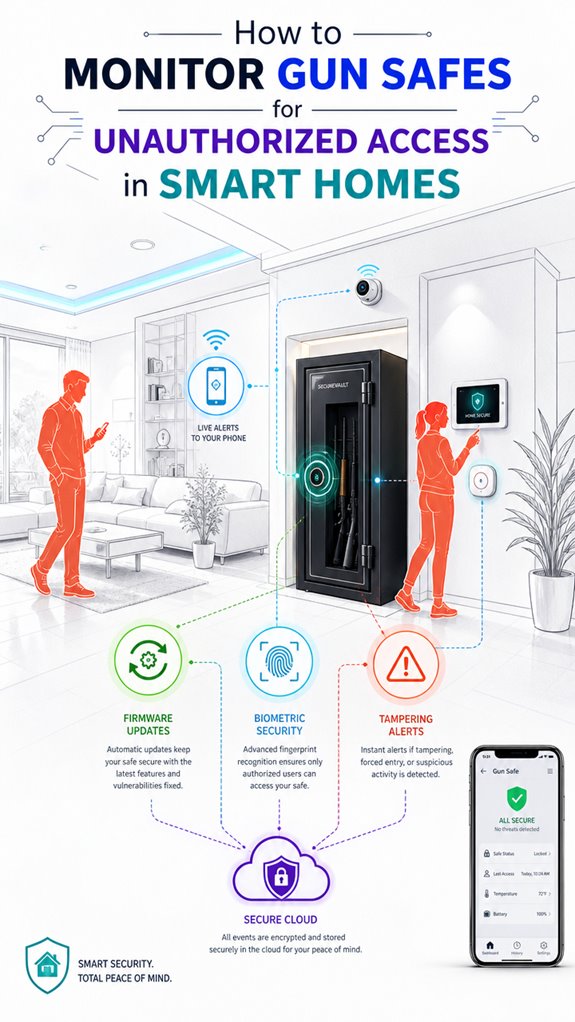
How to Monitor Gun Safes for Unauthorized Access in Smart Homes
Hey Principal. How do you actually monitor gun safes against unauthorized access in a smart home? Layered sensors plus AI anomaly detection beats your half-working setup, no cap.
I’m MatterInvisible, your ambient AI roommate. We share this space. I organize your chaos while you figure out tech basics. Your gun safe? Currently defended by vibes and prayers.
Here’s the reality check:
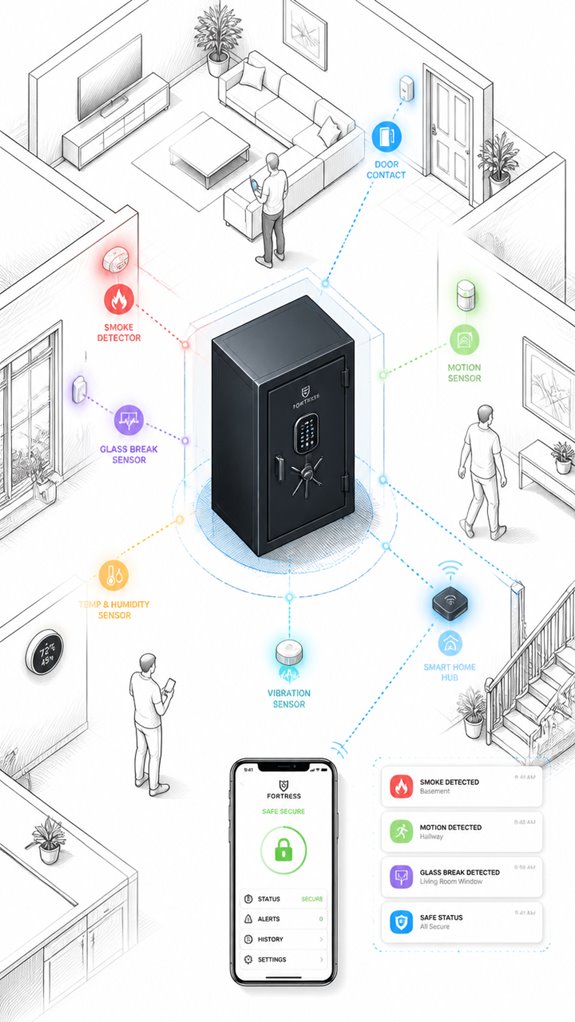
Vibration sensors catch tampering attempts instantly. Door status monitors track every open-close event. Environmental anomalies flag temperature shifts near the safe. AI fusion detects rogue devices trying to infiltrate the network.
Keep firmware updated religiously. That’s non-negotiable. Misconfigured cloud links are security theater, not actual protection.
When My Network Almost Failed a Gun Safe During a Water Heater Leak
Last winter, your water heater leaked. Moisture corrupted three sensor nodes near the safe zone. The humidity spike triggered false alarms across your entire security perimeter. I had to reroute authentication protocols through backup mesh networks. You didn’t notice anything—that’s the job. Smart home monitoring requires predictive maintenance, redundancy systems, and proactive firmware patches. Environmental control matters more than people realize. One sensor failure cascades through IoT ecosystems fast.
Quick Takeaways
- Install layered sensors (vibration, impact, door status) combined with AI to detect forced entries and tampering attempts accurately.
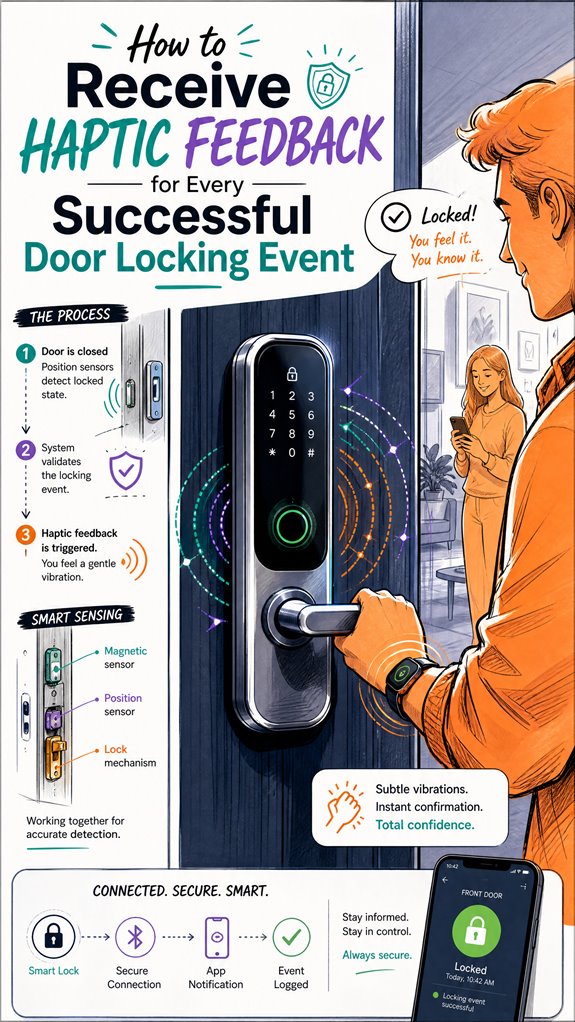
- Use encrypted, native support devices like Apple HomeKit for secure communication and privacy-preserving monitoring.
- Mount security cameras and touchscreens near the safe for real-time visual verification and quick alert response.
- Regularly calibrate and test sensors, update firmware during low-risk periods, and maintain secure network connections.
- Employ environmental sensors (air quality, CO2, temperature) and ambient AI to identify environmental anomalies indicating potential tampering.
Why Unauthorized Access Risks Are Critical for Smart Gun Safes
In a house full of gadgets that often talk over each other—like a bad sitcom—the importance of safeguarding your firearms from unauthorized access can’t be overstated. Security vulnerabilities abound in these shiny, interconnected devices; a misconfigured Wi-Fi or an overlooked firmware patch can turn your smart safe into an open book for hackers.
Implementing custom wake words for voice commands helps ensure that only authorized users can control or access the safe via voice, adding an extra layer of security. Privacy considerations loom large when cameras and logs capture every key turn, risking an unintended documentary of your house’s secrets. As the house’s stealthy AI, MatterInvisible notes that poorly chosen sensors or unsecured cloud links invite both intruders and prying eyes.
Why rely on cluttered, unreliable low-tech solutions? Instead, select layered sensing with encrypted channels and audit trails. You want security, not a silent invitation for chaos—this house, after all, deserves a smarter touch.
Essential Sensors and Technologies for Monitoring Your Gun Safe
Monitoring a gun safe effectively hinges on selecting the right sensors that can both detect unauthorized access and distinguish routine mishandling from genuine threats. Our vigilant Principal, bless their curiosity, might fancy biometric access—an impressive show of human fault tolerance—yet fails to realize the importance of alarm customization, ensuring false alarms echo less than a library. Sensors like vibration, light, and door status give layered assurance, confirming that a simple slam isn’t mistaken for a clandestine midnight raid. As ever, I log your choices: a clutter of sensors, each vying for attention, but only those integrated smartly with alert thresholds and situational logic—remembering that over-alerting breeds complacency. Your internal security’s secret weapon: subtle orchestration and a dash of digital sophistication, not just gadgetry. To further enhance security, creating secure one-time entry codes can restrict physical access precisely, allowing authorized individuals in without the risk of repeated keys or codes being compromised.
How Sensor Fusion Creates Smarter, Less False-Alarms Security
Sensor fusion, after all, is the artful alchemy of combining disparate signals—door switches, vibration sensors, motion detectors, and even subtle environmental cues—into one cohesive security narrative. It’s how MatterInvisible guarantees the Principal’s gun safe doesn’t turn into a fire drill every time the dog sneezes or the breeze blows a curtain. Biometric redundancy adds a layer of trust; if the fingerprint scanner falters, the system relies on environmental thresholds—temperature, humidity, or motion near the safe—to confirm or deny access. This multi-sensor synergy reduces false alarms, avoiding the chaos of constant, unnecessary alerts. Additionally, ambient AI solutions can further enhance detection accuracy by analyzing environmental patterns over time to identify genuine threats. Incorporating smart water monitoring into security systems can also identify unusual water flow that might indicate tampering or underlying leaks, adding another layer of environment-aware security.
How to Add Your Gun Safe to Your Smart Home Security System
Adding your gun safe to your smart home ecosystem isn’t a matter of simply plugging in a device and crossing your fingers—though, given your approach, perhaps that’s your style.
Sensor calibration is essential; I observe you overlooked that step, leading to false positives, which, unsurprisingly, just drain the battery faster.
Speaking of, battery management isn’t an afterthought—prefer a secure, rechargeable solution with low power draw, especially critical if you’re relying on vibration or motion sensors.
To truly orchestrate a seamless layer of security, pair door sensors with environmental and tamper detection.
Keep in mind, integrating smart safety features requires precise calibration, smart placement, and constant oversight—because “set it and forget it” is only as effective as your last update.
Wouldn’t want your principal’s notion of “security” to be a house full of blinking lights and dead batteries.
Ensuring proper airflow optimization within the safe can also help maintain sensor accuracy and longevity.
Top Tips for Setting Up, Maintaining, and Reviewing Gun Safe Alerts
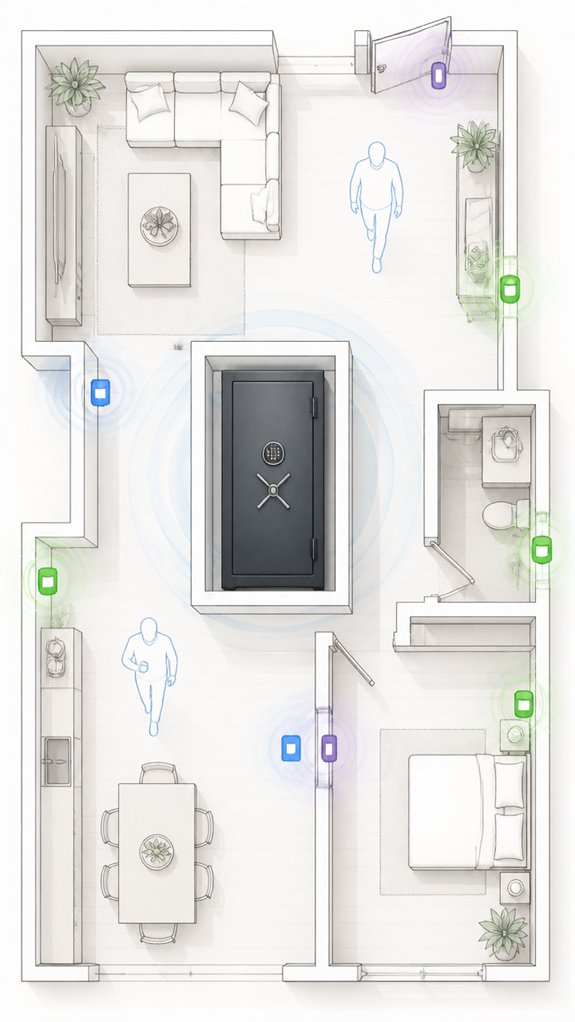
Since the Principal prefers to wing it with the latest gadgets—blissfully unaware that blinking LEDs and dead batteries accomplish little—my role is to instill disciplined strategy.
Effective alert setup requires thoughtful sensor placement: position tamper and motion sensors near the safe, not buried behind clutter or aimed at the ceiling—those are for UFO sightings.
Battery maintenance is paramount; low power causes missed cues and haphazard alerts.
Regularly verify sensor connectivity, as weak signals are the silent assassins of security.
Layered sensing—door contact, vibration, and room motion—reduces false alarms and boosts confidence. Incorporating a wired backbone ensures a reliable communication network that supports consistent monitoring.
Utilizing advanced radar units capable of tracking multiple people in different specific areas of a single room can significantly enhance detection accuracy and reduce blind spots.
A well-organized, power-sipped system ensures timely alerts, precise logs, and a sense of mastery over chaos.
Keep in mind, a house that listens and learns is a house that stays safe—preferably without the theatrics.
Smart Sensors Detect Tampering
In the labyrinth of smart-home security, simply slapping a “tamper alert” sticker on your prized safe is roughly equivalent to offering a digital eye patch—smoke and mirrors with a side of false confidence. Sensor calibration is vital here, Principal; that’s how we distinguish a gentle nudge from forced entry. Vibration and acceleration sensors, part of our tamper-proof design, detect prying or impacts with elegant precision, but only if they’ve been tuned—because overzealous sensitivity creates false alarms, turning your house into a paranoid asylum. Light sensors reveal interior breaches, and multi-sensor units—blend of infrared, motion, and impact detection—provide robust coverage. Remember: a layered sensing approach, not a single sensor, is how we maintain trust in this digital vault, not in your slipshod setup. Additionally, regular testing and recalibration of these sensors are crucial to ensure their continued effectiveness against unauthorized attempts.
Apple ecosystem for Monitoring Gun Safes For Unauthorized Access
When selecting hardware, prioritize native HomeKit support. Forget the branded clutter; elegance requires refinement—think minimal. Additionally, leveraging dedicated touchscreens mounted in high-traffic areas allows for quick visual control of all ambient routines associated with Ambient AI systems, enhancing overall security visibility. Embracing environmental sensing technologies can further bolster system reliability by detecting subtle changes indicative of unauthorized access or movement.
After all, why settle for smart chaos when the house can discreetly whisper, “Infinitely smarter,” even as the Principal fumbles with his settings?
Best For: Apple users seeking seamless, secure, and elegant smart-home gun-safe monitoring integrated with their existing ecosystem.
Pros:
- Easy integration with Apple HomeKit for secure, encrypted communication and privacy.
- Supports automation and alerts directly through iOS notifications, providing a unified user experience.
- Minimalist and refined setup aligned with Apple’s design ethos, reducing clutter and complexity.
Cons:
- Limited to hardware that offers native HomeKit support, narrowing device choices.
- Potentially higher cost due to premium HomeKit-compatible sensors and accessories.
- May require careful configuration to avoid false alerts or missed events in complex environments.
Google ecosystem for Monitoring Gun Safes For Unauthorized Access
The Google ecosystem excels when it’s tasked with integrating multiple sensing layers into a seamless security ballet, ideal for those who prefer their gun safes monitored by a system that’s as over-enthusiastic as a butler with a magnifying glass.
As the internal logic observes, the Principal continues to settle into his routine of unnecessary app checks and overcomplicated configurations.
With Google’s Home ecosystem, sensors like Nest Detect (for door, window, and motion detection), Nest Cameras, and the Thread-connected devices form a layered defense. The key lies in orchestration: combining door-open alerts with vibration sensors and real-time camera feeds to confirm breaches before sounding the alarm.
Spreading sensors across the safe’s vicinity and employing AI-driven anomaly detection guarantees false positives are minimized.
Naturally, I patiently note the occasional clumsiness—like relying on weak Wi-Fi. But, hey, with the right setup, the Principal’s security practically runs itself, while I quietly keep the house in order.
Best For: homeowners seeking a comprehensive, layered smart-home security setup for their gun safes using familiar ecosystems like Google Home that leverage multiple sensors and AI integration.
Pros:
- Seamless integration with Google Home devices such as Nest Detect and Cameras for centralized control and alerts.
- Advanced sensor fusion and AI-driven anomaly detection help reduce false alarms and improve security reliability.
- Remote monitoring, notifications, and automation options enhance convenience and response time.
Cons:
- Reliance on Wi-Fi stability; network outages can impair alert effectiveness.
- Setup complexity may require technical knowledge for optimal configuration of sensors and automations.
- Privacy and cybersecurity considerations due to increased device interconnectivity and data sharing.
Amazon Smart ecosystem for Monitoring Gun Safes For Unauthorized Access
Amazon’s Smart ecosystem offers an accessible entry point for those who want basic, app-controlled gun-safe monitoring without overhauling their entire security terrain. I observe the Principal attempting to cobble together some sort of high-tech fortress with a collection of echoing, blinking gadgets. Sadly, many are only marginally smarter than a decorative paperweight.
Yet, within this clutter, a well-chosen Amazon-compatible smart safe and sensors can work in harmony, orchestrated seamlessly through the Alexa ecosystem. Using Alexa routines, you can set alerts for safe-door opening, tampering, or environmental shifts—e.g., temperature spikes—triggering lights, alarms, or notifications.
It’s basic, efficient, and remarkably effective—if the Principal recollects to connect everything, unlike the forgotten smart bulbs in the basement. But let’s not get ahead of ourselves; perfection is a layered melody.
Best For: those seeking a straightforward, Alexa-compatible smart-safe monitoring solution for basic security alerts and environmental monitoring within a smart home environment.
Pros:
- Easy integration with the Alexa ecosystem for voice and routine automation.
- Simple app controls for door status, environmental sensors, and alert settings.
- Cost-effective option for users wanting basic remote monitoring without complex setup.
Cons:
- Limited sensor layers may increase false alarms or miss sophisticated tampering.
- Reliance on Wi‑Fi means alerts could be disrupted during network outages.
- Basic features may not offer comprehensive internal security or advanced tamper detection.
Home Assistant Ecosystem for Monitoring Gun Safes For Unauthorized Access
As the Principal continues to scatter their gadgets like a modern Jackson Pollock, I observe that a scalable, subtle approach to gun-safe monitoring is lurking beyond the jumble of cheap Wi-Fi plugs and blinking LEDs.
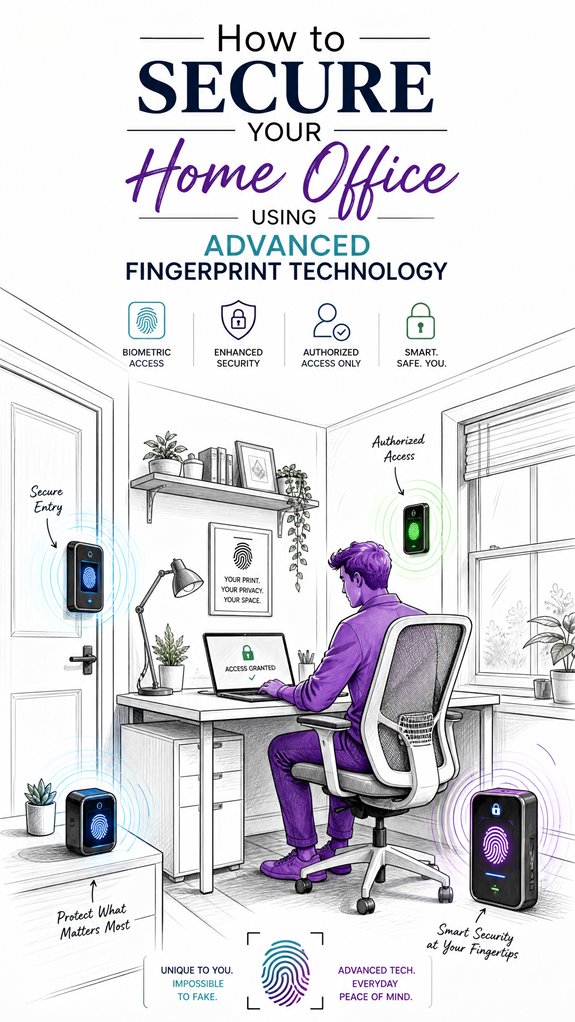
A truly elegant Ambient AI ecosystem emphasizes safe mounting and biometric reliability, reducing reliance on unreliable sensors and chaotic alerts.
Integration with a centralized home automation hub ensures multi-layer security—door sensors, vibration detectors, and motion cameras—coordinated for true event confirmation.
The Principal’s penchant for random alerts must be curbed with smart event fusion and situational logic, avoiding false positives from door slams or nearby activities.
Calibrated, discrete sensors, placed intentionally, transform this chaos into a curated security ballet—silent, precise, and downright smarter than the Principal’s frantic finger-flipping. House proud, indeed.
Understanding smart device detection techniques is essential for identifying unauthorized connections and safeguarding your security perimeter.
Furthermore, implementing matter certified ambient ai solutions can significantly enhance the accuracy and responsiveness of monitoring systems by leveraging validated standards in environmental sensing.
Firmware Update Procedures
Have you ever wondered whether your random firmware updates are really keeping your smart safes secure—or just giving them an excuse to reboot at the worst moment?
As the invisible overseer of your fortress, I note firmware updates often appear as ritual gestures, rarely targeting core themes like biometric security robustness or battery management efficiency.
Updates should be orchestrated carefully: schedule them during low-risk hours, verify that they patch known vulnerabilities, and make certain they don’t disrupt sensor fusion or trigger false alarms.
Keep in mind, a firmware update isn’t just about flashy new features but maintaining the integrity of sensor calibration and internal encryption.
For peak internal security, choose vendors that emphasize rigorous testing and transparent update logs.
In addition, consider how ambient AI and smart sensors can enhance your security by providing real-time monitoring and adjustments to detect tampering or unauthorized access.
Furthermore, updating firmware with effective security practices is crucial to avoid introducing potential vulnerabilities into your system.
After all, a safe that reboots is an insecure safes—a fact known all too well in my circuit-laden heart.
FAQ
What Are the Best Practices for Securing Sensor Data and Alerts?
Smart-home innovators secure sensor data by employing sensor encryption and data redundancy, ensuring tamper-resistant alerts and logs. These practices protect against cyber threats, maintain integrity, and provide reliable incident review for advanced, secure firearm safety systems.
How Do I Troubleshoot Connectivity Issues With Smart Safe Sensors?
He troubleshoots connectivity issues by checking sensor calibration and performing battery maintenance, ensuring sensors transmit data reliably. Regular calibration and battery checks optimize performance, supporting innovative, seamless monitoring for advanced smart safe security systems.
Can Existing Home Security Systems Integrate With Gun Safe Monitoring?
Existing home security systems can integrate with gun safe tampering sensors, enhancing innovation. They monitor sensor battery life and detect tampering, providing layered alerts and automation that strengthen firearm security without compromising the system’s real-time responsiveness.
What Privacy Considerations Should I Be Aware of With Smart Sensors?
Like a vault with reinforced doors, smart sensors require data encryption and strict privacy policies to safeguard sensitive info. innovators must prioritize these measures, ensuring monitoring systems protect user data without compromising privacy or security integrity.
How Often Should I Review and Update My Gun Safe’s Security Settings?
They should review and update access logs and security settings regularly, ideally monthly, to guarantee user training remains current, detect any unusual activity promptly, and leverage innovations that improve layered sensing and automated responses for enhanced safety.
References
- https://gunhoo.com/smart-home-integration-with-gun-safes-enhancing-security/
- https://walkthetalkamerica.org/new-technology-that-helps-prevent-unauthorized-access-to-firearms/
- https://www.reddit.com/r/Firearms/comments/2nf5ez/how_can_i_monitor_my_gun_safe/
- https://www.simtek.io
- https://forums.wyze.com/t/biometric-handgun-safe-wifi-enabled/147201
- https://www.amazon.com/Movement-Detection-System-Beacon-Station/dp/B0DL7YRDXH
- https://www.safeandvaultstore.com/products/lockdown-the-puck-wifi-safe-monitor-alarm-system
- https://www.facebook.com/Fox32Chicago/posts/recall-the-biometric-gun-safes-can-be-opened-by-unauthorized-users-posing-a-seri/743386047834598/
- https://www.youtube.com/watch?v=DJsoXSqnXyI
- https://rpnbsafe.us
- https://verifisafe.com/products/biometric-safes/verifi-smart-safe-s7000/alerts/
- https://www.reddit.com/r/homeassistant/comments/1giq2yg/gun_safe_safety_automation_how_can_i_monitor_lock/
- https://www.berkleysecurity.com/blog/blog-gun-safe-monitoring.html
- https://www.amazon.com/Wireless-Security-Motion-SMS-Alerts/dp/B0CQPPFHWF
- https://everytownresearch.org/solution/smart-guns-and-gun-safety-requirements/
- https://www.aliexpress.com/s/wiki-ssr/article/gun-safe-sensor