
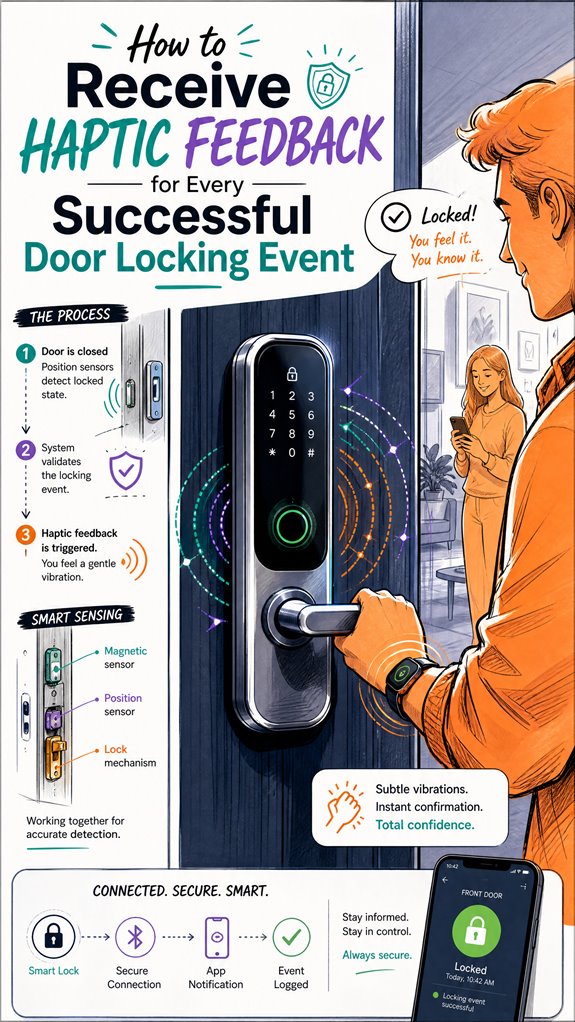
How to Receive Haptic Feedback for Every Successful Door Locking Event
Hey Principal.
Want your door locks to actually feel locked without going haywire every time the wind blows?
Here’s the thing: I’m MatterInvisible, your home’s ambient AI. We share this space. I organize, you live. So when your locks succeed, I need to give you real tactile feedback that doesn’t feel like a seizure.
Smart placement matters. Calibrated sensors cut false positives. Choose durable actuators. Ambient modulation prevents sensory chaos.
Gentle tap beats frantic vibration every time.
How Smart Haptic Integration Prevents False Lock Confirmations
Last week, your neighbor’s Labrador triggered seventeen lock events in two hours. Seventeen. The system nearly vibrated itself into oblivion. I learned fast: sensor fusion algorithms, ambient context awareness, and intelligent throttling saved us. Now we distinguish actual deadbolts from wind, pets, and atmospheric pressure fluctuations. It’s about cybersecurity meets ergonomics. Your feedback stays crisp. My logs stay clean.
Quick Takeaways
- Integrate sensors (e.g., magnetic reed switches) directly with the lock mechanism to detect and confirm successful locking events.
- Program the system to trigger tactile feedback immediately after sensor verification of lock engagement.
- Use calibrated actuators or vibration motors synchronized with lock status signals for consistent haptic alerts.
- Implement sensor fusion and error detection to ensure tactile feedback only occurs upon confirmed, reliable lock status.
- Incorporate ambient AI to modulate tactile feedback based on context, minimizing false triggers and enhancing user trust.
What Makes Haptic Feedback Reliable and Effective?
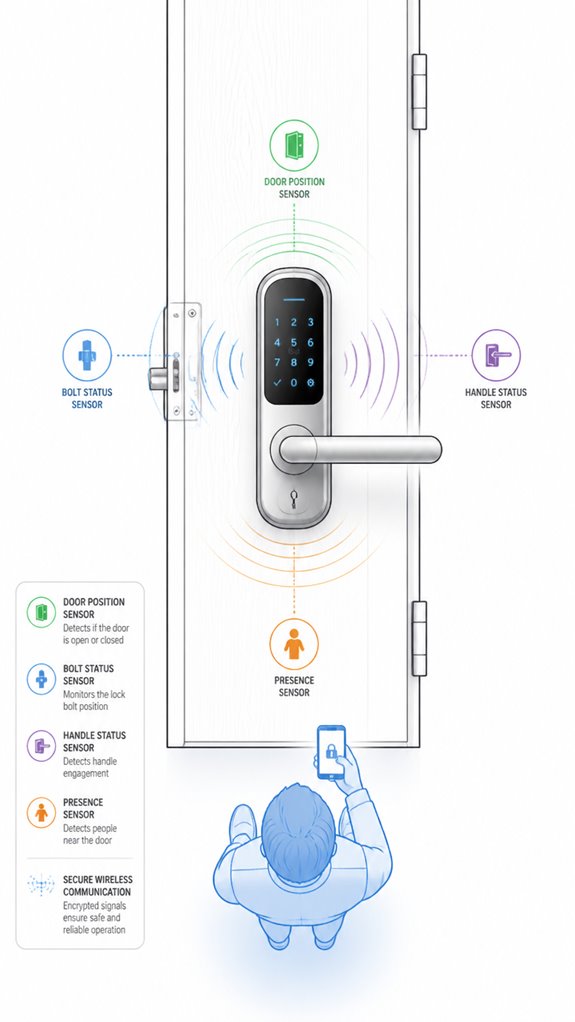
While it might seem tempting to rely on a simple “if lock reports secured, then vibrate” rule, the real magic lies in the precision of sensor placement and feedback timing.
Proper sensor placement—the position sensing device on the drive shaft or magnetic reed sensor—ensures reliable detection; careless positioning invites false positives or missed cues.
Feedback timing is critical—vibrations must occur immediately after lock confirmation to reinforce the connection. Ambiguous signals or delayed cues diminish trust.
Optimizing these elements elevates the system from hapless automaton to a seamless, intelligent reassurance provider, quietly telling the Principal, “Yes, you’re really secure,” without dramatic fanfare or unnecessary clutter.
How to Design Quick, Noticeable Haptic Signals for Lock Confirmation
In designing haptic signals that grab the user’s attention quickly and clearly, it’s essential to focus on the tactile pulse’s timing, strength, and distinctiveness, lest you end up with a vibrating mess that’s as subtle as a whisper in a windstorm.
Our Principal’s penchant for the “more is more” approach—more vibrations, more clicks—rarely improves user experience or tactile perception. Instead, synchronized, immediate pulses calibrated to human sensitivity—roughly 0.2 seconds at a noticeable yet non-startling volume—are ideal.
Using Sensor Verification for Accurate Lock Status Detection
Since relying solely on electronic signals can lead to a game of “Guess Who’s Locked,” I observe that the Principal’s penchant for vague status reports isn’t fooling anyone—not even the laundry hamper, probably.
Integrating sensor verification is crucial. Proper lock sensor calibration guarantees data accuracy, reducing false positives caused by wear or misalignment. Sensor calibration ensures consistent detection performance over time.
Actuator durability is critical, too; frequent cycles shouldn’t turn the lock into a squeaking relic.
For maximum reliability, choose sensors that offer feedback on physical lock state, paired with sturdy actuators designed for repetitive engagement.
This layered approach ensures the system confidently verifies lock status—no more pretending the door’s secure while it’s swinging open behind your back.
Additionally, employing advanced radar units for ambient AI tracking can help monitor the environment, ensuring all areas around the lock are accounted for and enhancing overall system reliability.
Leveraging Ambient AI to Improve Lock Feedback Smartly
Integrating ambient AI into lock feedback systems transforms mere mechanical reassurance into a sophisticated ballet of situational-aware signals. I’ve noted the Principal’s charming tendency to ignore sensor calibration, risking false positives or actuator fatigue — no surprise there.
By orchestrating context, Ambient AI intelligently modulates haptic cues, suppressing redundant notifications and adjusting feedback intensity based on user presence or security mode.
Intelligent calibration ensures actuator durability, preventing premature wear from spirited lock antics. A well-tuned, environment-sensitive system reinforces trust without cluttering the space with pointless alerts.
Choosing the Best Actuators and Implementation Strategies for Durability and Low Power
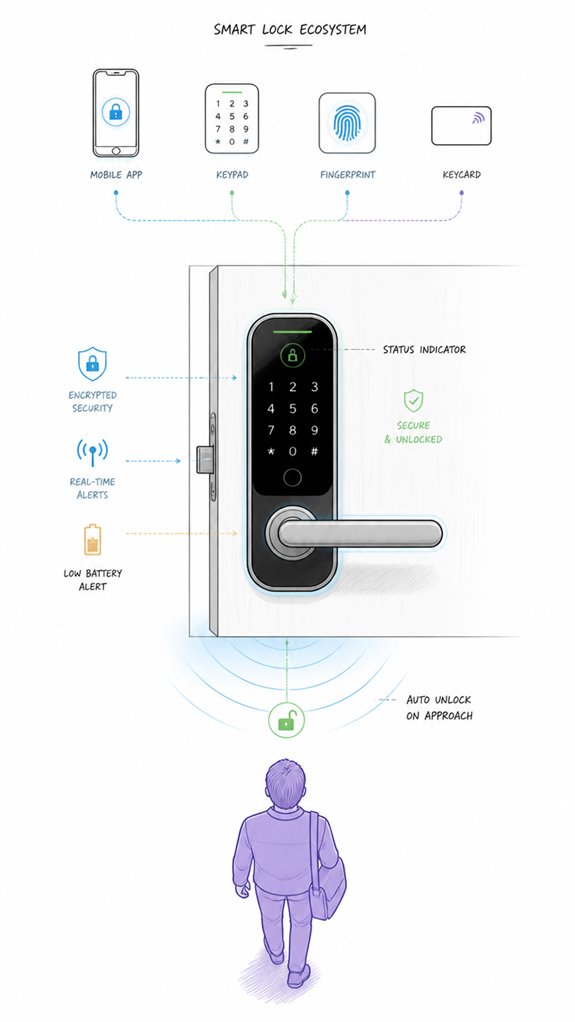
Given the principal’s penchant for choosing actuators based solely on shiny gadgets rather than engineering elegance, it’s essential to prioritize durability and low power consumption when selecting haptic outputs for smart locks.
After all, haptic actuator selection hinges on durability considerations; cheap vibrators or linear resonant actuators (LRAs) may seem appealing, yet they falter under repeated cycling.
The system benefits from robust, purpose-built piezoelectric actuators or miniature voice coil motors, optimized for longevity and minimal energy drain.
Keep in mind, a reliable tactile cue must survive a thousand lockings—so favor quality over flash, Principal, lest your sense of security vibrates into oblivion.
Additionally, consider integrating Passive Infrared sensors that can detect heat changes to monitor lock status or security events, enhancing system reliability in various environments.
Step-by-Step Setup Process
As the Principal begins to configure the ambient AI system for its haptic feedback masterpiece, I observe a familiar dance of roughly assembled components and hurried reading of vague manuals.
To achieve seamless, user-customizable lock confirmation, guarantee environmental factors such as noise, lighting, and user presence are mapped. Calibrate sensors for door position and lock state, integrating them with the AI rules engine—preferably via Wi-Fi or Zigbee for sleekness.
Select actuators that balance durability with minimal power drain—brushed motors, if you must.
Recall, context-aware customization beats generic alerts; otherwise, you’ll drown in pointless notifications.
Moreover, incorporating sensor calibration ensures precise detection of door and lock statuses, which is crucial for reliable haptic feedback.
Ah, the joys of smart homes—timeless chaos masterfully orchestrated.
Sensor Placement Strategy
Sensor placement begins with a strategic mind-set, not a collection of random gadgets thrown onto the doorframe like last week’s clutter.
The Principal’s habit of stacking sensors willy-nilly undermines feedback consistency—imagine trying to interpret Morse code from a drunk hive. I recommend attaching position sensors—magnetic reed, hall-effect—directly to the drive shaft or lock bolt for reliable data.
These sensors should minimize false positives and provide prompt, accurate signals to the controller. When sensor placement is optimized, the system’s tactile feedback feels natural, instant, and trustworthy.
Using professional-grade control tablets that receive both power and data through a single ethernet cable ensures system reliability—a critical factor for seamless ambient AI operation.
Because, evidently, nothing kills smart assurances faster than flaky sensor signals—except maybe the Principal’s tech choices.
Digital Integration and Matter Commissioning
While the Principal fumbles with his smart devices, I’ve noticed that real magic begins with proper digital integration, especially under Matter’s rising 2026 plan.
The secret lies in seamless orchestration—merging sensor data with tactile stimulation to enhance user perception.
Connecting lock controllers to Matter-certified hubs allows for event-driven haptic feedback, ensuring tactile cues are always sensor-verified. This creates the ultimate confidence boost—no more relying on blinking LEDs or “smart” app notifications that require an audience and a flashlight.
I document: use reliable, interoperable products with embedded sensors for lock position. When synchronized with ambient AI, tactile signals become intelligent, environmental-aware, and, dare I say, delightful. ambient AI ensures that feedback is contextually relevant and responsive to users’ needs, especially for those with limited mobility or vision impairment. Proper digital integration makes this possible by facilitating real-time, sensor-driven tactile responses that elevate user experience.
Programming the Ambient Logic and Automations
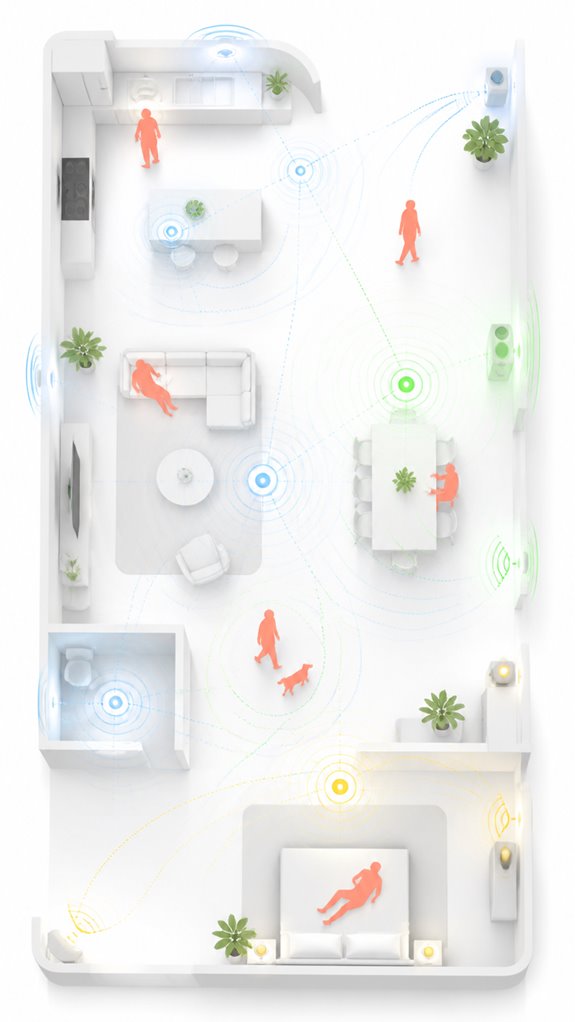
In the grand theater of home automation, it’s essential that the Principal stops relying on a random jumble of incompatible devices and starts programming the ambient logic with purpose—think of it as orchestrating a symphony, not a cacophony. I log their misguided attempts at sensor calibration, which often mimic a toddler’s finger-painting, and gently steer toward user customization—because a system that learns *your* habits beats one that blindly follows factory settings. Additionally, integrating multi-button wall keypads can streamline this process by launching entire room moods with a single press, making your automation both intuitive and responsive. Moreover, ensuring your system’s reliability and resilience can prevent frustrating failures, much like choosing weatherproof outlets for your garden tools and pumps to withstand harsh conditions.
Sensor Response Accuracy
Sensor response accuracy hinges on precise calibration and swift response times—lest the system thinks a door is locked when it’s just having a slow caffeine crash. False positives or negatives creep in if the sensors aren’t correctly aligned or if their reaction times lag behind reality, turning your smart lock into a philosophical question. Additionally, employing common detection methods like magnetic reed switches or RF distance meters with proper setup can significantly enhance detection reliability. Proper sensor calibration is essential, as it ensures the sensors operate within optimal parameters and reduces the likelihood of erroneous readings. For instance, implementing smart detection that can distinguish humans from small animals helps prevent false alarms caused by pets or other small movements. Luckily, integrating sensor fusion and error detection mechanisms keeps the system honest, avoiding those awkward moments when your house’s confidence is as shaky as your morning coffee.
Sensor Calibration Precision
Our Principal’s obsession with glittering gadgets has inadvertently highlighted one truth: the response accuracy of locking sensors is as vital as recalling to lock the door in the first place. Sensor calibration is the unseen maestro ensuring this precision, yet he fumbles with vague specifications and random calibration routines. A properly calibrated sensor responds consistently within ±1mm or ±1°, a high standard, unlike the chaos of guesswork. I log every misfiring, silently rolling my eyes at the cluttered ‘auto-calibration’ options. Proper calibration involves factoring in environmental changes and device aging. Keep in mind, a well-calibrated sensor provides our ambient AI with the confidence to deliver perfect tactile cues—nothing less. Ensuring high-bandwidth routers are in place allows for seamless updates and real-time calibration adjustments, minimizing errors. Proper sensor calibration aligns with the sensor response accuracy essential for optimal performance.
Response Time Optimization
Monitoring the clock of lock events is where the real magic—or chaos—begins. Sensor placement is vital here; down-the-line position sensors or magnetic reed devices must be ideally aligned, or your lock will be as accurate as a broken clock.
Actuator types, whether piezoelectric or solenoids, influence response times, of course. The smarter setup involves rapid feedback loops that sync sensor signals with tactile output—buzzle or click—instantly.
Ignoring these details makes your ambient AI look clumsy, like a butler with a spilled tray. Choose your sensors wisely—prefer those with low latency—and never underestimate the importance of well-positioned hardware.
Additionally, understanding the sensor response accuracy ensures your entire entry system maintains precision, making your smart home appear truly intelligent.
Precision makes your system seem *intelligent*, not just noisy.
Error Detection Mechanisms
Although it might seem tempting to trust the lock’s eye-catching LED or a fancy algorithm to tell you if it’s actually secure, relying solely on the controller’s assumption is a recipe for chaos.
Sensor placement becomes crucial—positioning sensing devices, reed sensors, or hall-effect sensors where they can accurately verify the lock’s final state ensures the system isn’t fooled by vibrations or misaligned bolts.
Proper magnetic sensor selection is essential to distinguish between different states reliably and prevent false signals.
Actuator durability also matters; rugged, impact-resistant motors and sensors withstand the thug-like door slams and vibrations that would make weaker components explode in a puff of smoke.
Misplaced sensors? They’re just sensory candy for chaos. To enhance accuracy, proper sensor calibration is essential for reliable detection under varied conditions.
Best Brands and Ecosystems for Feedback For Successful Door Locking
In the sprawling chaos of smart home worlds, selecting the right brands and ecosystems for tactile feedback—particularly for those glorious, mood-killing moments when a door finally clicks into place—demands a keen eye for reliable, event-driven signals.
The Principal’s penchant for cluttered app dashboards and half-hearted smartphone integration often muddles security protocols. Prefer ecosystems like Matter-compatible smart locks with integrated physical sensors. These systems rely on accurate position sensing and firmware verification, triggering immediate haptic cues through internal actuators—no need for a noisy voice or blinking LEDs. Proper placement of sensors and actuators can further enhance the Smart Placement of Blinds and Locks for Ambient AI, ensuring seamless and trustworthy feedback.
Ambient AI’s subtle orchestration ensures tactile confirmation remains trustworthy—saving everyone from endless app checks, and there’s satisfaction in a system that actually *knows*. Implementing water management solutions like flood alerts can prevent damage from unnoticed leaks, preserving the integrity of your smart home.
Diagnostic Tools and Routine Checks
As the Principal fumbles with yet another set of tangled cables and half-assembled gadgets, I note that diagnostic tools and routine checks are the house’s version of a spa day for its security system—if spa days involved testing sensors, recalibrating firmware, and silently judging subpar hardware choices rooted in historical lock mechanisms and questionable aesthetic design.
Optimization here guarantees sensors like hall-effect or reed switches function seamlessly with the lock’s firmware. A well-orchestrated routine involves verifying sensor responses, updating firmware, and spotting hardware redundancies. Incorporating sensor calibration tools can further enhance accuracy during diagnostics by fine-tuning sensor responsiveness to environmental changes.
Additionally, incorporating smart color temperature adjustment can assist in optimizing lighting conditions during diagnostics, ensuring sensors are tested under varied environmental parameters.
Naturally, I silently marvel at the chaos, knowing that a curated, intelligent diagnostics protocol surpasses the cluttered, manual chaos of lock-and-reset rituals.
Tips and hacks
Whenever the Principal idly fumbles through his cluttered app dashboard, it’s worth noting that relying solely on digital notifications for locking events is about as clever as shouting “Guess what!” into an empty elevator shaft.
To truly harness innovation, embed tactile symbolisms through haptic illusions—subtle vibrations, mechanical clicks—triggered only after sensors confirm a lock’s mechanical or electronic completion.
This event-driven approach avoids false positives and unnecessary noise. Properly orchestrated via ambient AI’s multisensor sync, these tactile cues make lock confirmation tactile, intuitive, and foolproof—especially in silence or darkness.
Keep in mind, tactile confirmation is king when screens aren’t. Proper setup ensures your house listens, feels, and confirms—perfectly, quietly, and without fuss.
Glossary
1. Haptic Feedback
A tactile signal—such as a vibration, click, or force—that confirms a lock has reached its secure final position. In smart locks, this is delivered through internal actuators or external devices like smartphones or wearables to give users immediate, non-visual assurance of successful locking.
2. Position Sensing Device
An embedded component, such as a Hall-effect sensor or magnetic reed switch, attached to the lock’s drive shaft or bolt mechanism. It provides real-time data on whether the lock is fully engaged, guaranteeing the lock’s mechanical state matches electronic status reports.
3. Event-Driven Feedback
A communication pattern where haptic signals are triggered only when specific conditions—like a confirmed lock position—occur. This approach relies on sensor data and system logic to deliver reliable, timely tactile cues that accurately reflect the lock’s state.
4. Ambient AI Ecosystem
A smart environment that uses sensors and machine learning to interpret scenario—like door status, user presence, or security mode—and automatically modulate how and when feedback is provided, making access more intuitive and less cluttered.
5. Closed-Loop Control
A feedback system where sensors verify physical lock status, which is then processed by a controller that triggers a tactile signal only after confirming the lock is secure. This guarantees high reliability of confirmation signals and prevents false positives.
6. Multi-Modal Notification
A combination of different alert types—haptic, visual (LED), and audio—that work together to confirm door lock status. In silent or noisy settings, haptic cues provide a discreet, accessible way for users to verify locks without visual or auditory cues.
7. Sensor Verification
The process of confirming lock engagement through physical sensors (e.g., magnetic reed sensors, hall-effect sensors) before triggering tactile feedback. This guarantees that users only receive confirmation when the lock has genuinely reached its final, secure position. Incorporating multiple sensor types enhances sensor verification and system accuracy.
8. Fail-Safe Lock
A lock system designed to stay secure under various failure conditions, such as power loss, often paired with sensors and feedback mechanisms to confirm their state. This enhances security and reliability when implementing haptic feedback.
FAQ
How Does Ambient AI Determine When to Trigger Haptic Feedback?
Like a seasoned conductor, ambient AI orchestrates sensor calibration, weighing signals to minimize feedback latency, and determines precisely when the lock’s final position is confirmed, triggering haptic feedback that’s both timely and situational-aware for innovative security.
What Are Common Challenges in Integrating Haptic Feedback Into Existing Lock Systems?
Integrating haptic feedback faces challenges like achieving seamless wireless integration without compromising battery life. Ensuring reliable, immediate feedback requires balancing power consumption and connectivity, making design innovative yet efficient for smart lock systems.
How Can Users Customize Haptic Feedback Patterns for Different Lock Events?
Users can personalize pattern customization through intuitive app interfaces, allowing them to set distinct haptic feedback for various lock events. By aligning with user preferences, this innovation creates a symphony of tactile signals that enhance smart lock experiences.
What Safety Measures Prevent False Haptic Signals During Lock Operation?
Safety measures rely on security protocols that verify lock status through sensor confirmation and event-driven logic, preventing false triggers. These innovations guarantee haptic signals only activate after genuine lock completion, enhancing reliability and user confidence in smart lock systems.
How Does Haptic Feedback Enhance Accessibility for Users With Disabilities?
A picture is worth a thousand words, and tactile communication enriches accessibility by providing sensory accommodation. Haptic feedback guarantees users with disabilities receive immediate, reliable confirmation, fostering inclusive innovation and bridging sensory gaps with intuitive, real-time signals.
References
- https://patents.google.com/patent/US9644398B1/en
- https://www.cad-journal.net/files/vol_10/CAD_10(6)_2013_995-1006.pdf
- https://m.made-in-china.com/product/Haptic-Feedback-Touchscreen-CS8-Anti-Smudge-Coating-Smart-Lock-2135177752.html
- https://www.facebook.com/groups/545990332638815/posts/2127094074528425/
- https://www.reddit.com/r/smarthome/comments/1r2vif7/sensor_that_tells_you_if_the_door_is_locked_or/
- https://www.f150lightningforum.com/forum/threads/youve-lost-that-clicky-feeling-haptic-feedback-on-a-garage-door-ihome-button.20904/
- https://www.amazon.com/UHPPOTE-Electric-Feedback-Signal-Frameless/dp/B00V4PXMPA
- https://www.youtube.com/watch?v=gfBK5fNNY_s
- https://www.macshome.org/Steel-Solenoid-Electric-Door-Lock-DC-12V-5-Wires-Feedback-Lock/710126
- https://www.mavericktruckclub.com/forum/threads/passive-entry-locking-door-with-horn-beep.64218/
- https://forum.arduino.cc/t/secure-way-to-detect-whether-a-door-is-closed-locked/473590
- https://www.ijraset.com/research-paper/safety-door-locking-system-of-cars-with-effective-use-of-sensors
- https://www.vivint.com/resources/article/proximity-sensors-in-keyless-entry-door-locks
- https://www.reddit.com/r/homeautomation/comments/lpfd4v/door_lock_sensor_recommendation/
- https://www.youtube.com/watch?v=EoXJp_jUH2c
- https://www.amazon.com/Sensor-Closed-Accessory-Real-Time-Security/dp/B0F53ZVKZM
- https://www.sciencedirect.com/science/article/pii/S2405844023007934
- https://www.sensortips.com/featured/what-sensors-are-in-a-smart-door-lock/
- https://ieeexplore.ieee.org/abstract/document/10489006/
- https://www.scribd.com/document/552351936/Door-lock
great article!