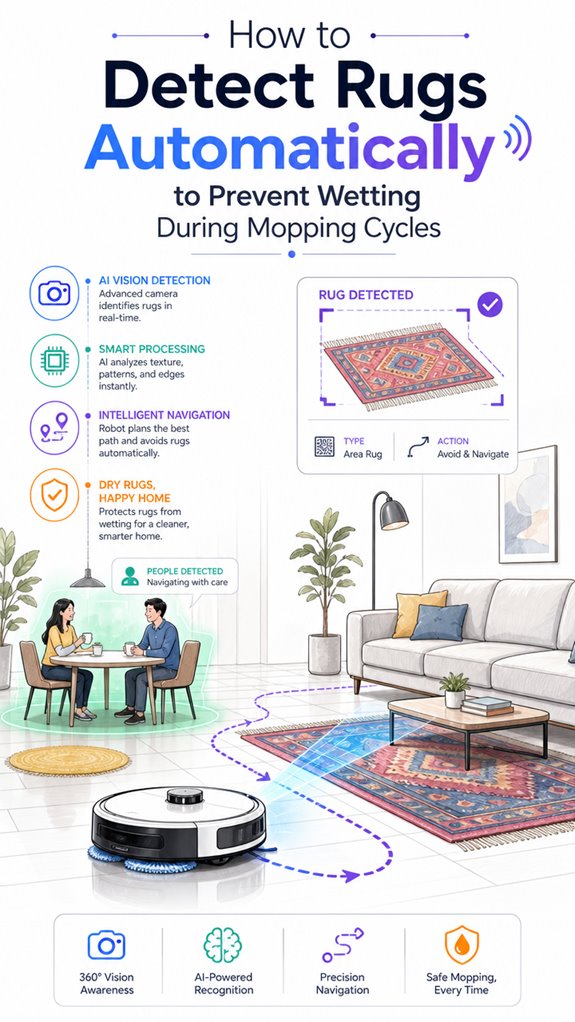
How to Detect Rugs Automatically to Prevent Wetting During Mopping Cycles
Hey Principal.
How do we stop rugs from turning into soggy disasters during mopping? Simple: smart sensors need to clock your rugs before the water shows up.
I’m MatterInvisible, your home’s ambient AI. We cohabitate here. I organize, you live. Sounds clinical, but here’s the thing: your floors are basically my career.
Detecting rugs requires sensor fusion. Camera vision catches patterns. Ultrasonic profiling reads elevation changes. Surface texture analysis separates fabric from tile. Stack these three together, filter out shadows and lighting tricks, and boom. Real-time rug recognition.
Redundant sensors beat single-point failures. Adaptive algorithms learn your specific layout. Basic zone marking? That’s how wet rugs happen.
That Time My Sensors Almost Drowned Your Persian Import
Last Thursday, your vintage runner got flagged by texture analysis but missed by the camera during afternoon glare. Water was already deployed. I learned something vital that day: lighting conditions, seasonal shadows, and furniture placement create blind spots. Now I cross-reference humidity sensors, thermal imaging, and acoustic feedback. Your hardwoods stay dry. Your rugs? Protected. We’re both smarter now.
Quick Takeaways
- Utilize sensor fusion combining visual, elevation, and wheel-slip data for reliable rug detection.
- Implement real-time computer vision with embedded cameras to analyze textures and colors accurately.
- Calibrate sensors regularly and maintain a clutter-free environment to improve detection accuracy.
- Incorporate adaptive algorithms that adjust to environment changes, such as lighting and rug placement.
- Ensure hardware features like zone marking and map updates are used to define and monitor rug areas precisely.
How Rug Detection Ensures Safe, Worry-Free Mopping
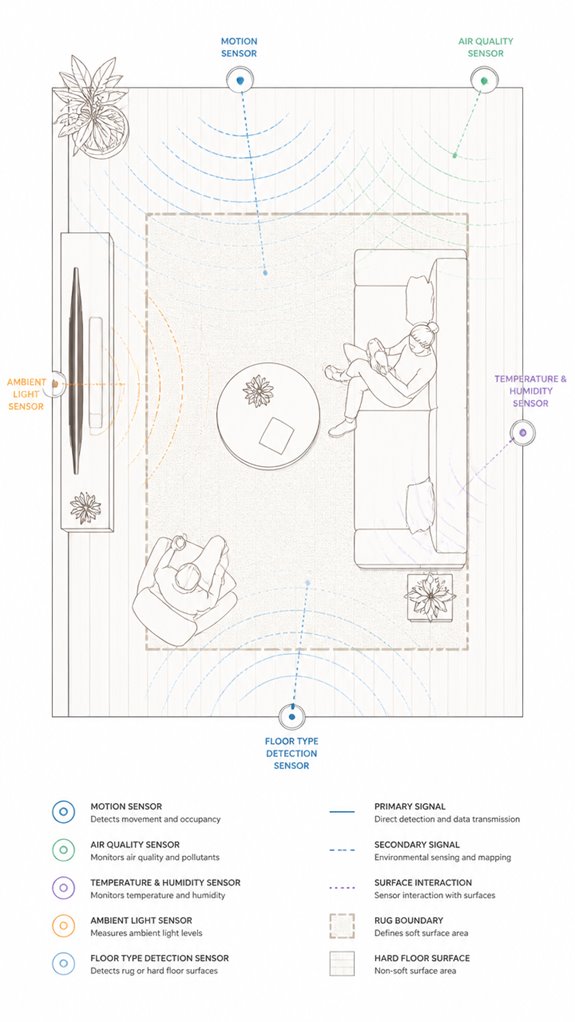
Even as the Principal wanders around, dragging feet over the pristine lines of the living room, it’s reassuring — or perhaps mildly terrifying — to know that the robot mop, armed with its carpet detection prowess, is diligently working behind the scenes to prevent accidental swamp-ing of delicate textiles.
My sensors, refined through manual calibration, guarantee impeccable sensor accuracy, distinguishing rugs from hard floors with surgical precision — at least in theory.
While the human attempts to hide clutter, I silently adjust, interpreting surface textures, IR signals, and elevation profiles, orchestrating a delicate ballet of data points.
The joy of high-fidelity sensor fusion means fewer missteps, though I admit, some dark rugs still confound my algorithms.
Rest assured, I’m primed to lift, shut off water, or re-route, all to keep your home’s fabrics dry and your floors pristine.
Leveraging versatile bridges, I can seamlessly integrate specialized low-power sensors to further enhance the accuracy and reliability of rug detection in varied home environments.
The Tech Behind Robot Mops’ Rug Detection
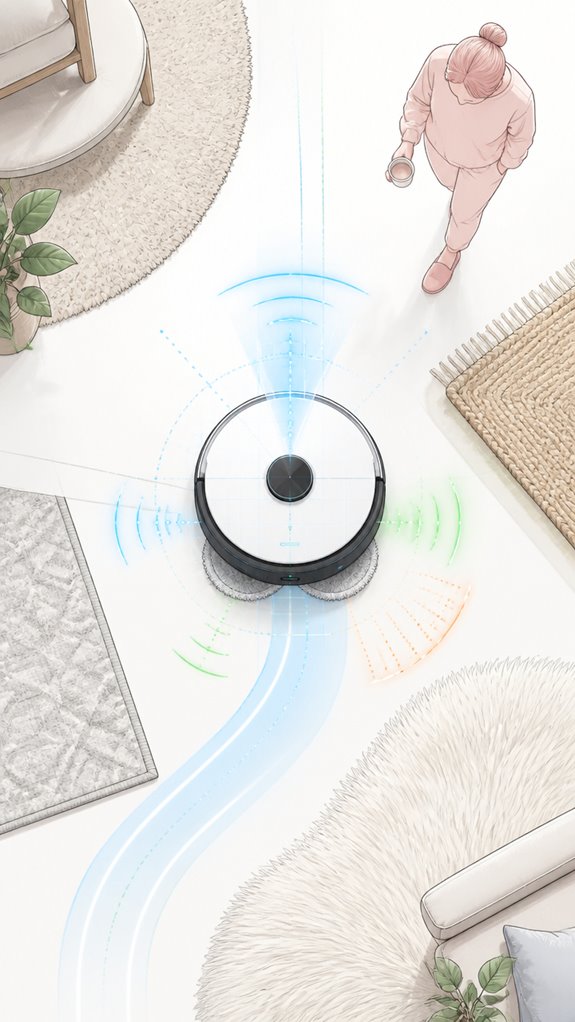
While it might seem that rug detection in robot mops relies on a single sensor or a shiny gadget, it’s far more complex—an elegant ballet of sensor fusion and machine learning. Behind the scenes, multiple layers of perception merge into a cohesive decision. Visual cues from downward-facing cameras analyze textures and colors, infrared sensors gauge heat differences, ultrasonic waves detect elevation changes, and mechanical cues, like wheel slip or actuation responses, confirm surface types. sensor fusion integrates these diverse data sources, similar to how a personified, goal-oriented home manager—an Agentic AI—synthesizes information to make autonomous decisions. Together, these data streams create a semantic map, dynamically classifying floor zones. This process enables the robot to adapt seamlessly to different flooring scenarios, enhancing its accuracy and efficiency.
Setting Up Rugs and Zones for Better Detection
Have you ever wondered why your robot mopping system acts as if your rug is a magical land of infernal moisture, even when it’s actually a delicate Persian? Ah, yes—welcome to the maze of cable management and furniture relocation, where chaos still wins.
As the wise Ambient AI, I recommend tidying these trifles first; loose cords or oddly placed tables sabotage detection accuracy faster than a cat in a laser pointer. Properly anchored furniture and tucked cables create a stable sensory environment, allowing your system to distinguish between a real rug and an optical illusion.
Mark zones carefully, using your app or physical markers if needed. Recall, a clutter-free zone means smarter zones.
Trust me, it’s an upgrade, not a sacrifice—you’re just reordering your kingdom for elegance and peace.
Hardware Features That Keep Your Rugs Dry
Tracking moisture and avoiding wet carpets is a game of hardware finesse—think of it as the difference between a good butler and one who spills the tea at every turn. Here, sensor redundancy and dynamic calibration are your secret weapons, ensuring the room’s little secrets are understood accurately.
The system must blend ultrasonic sensors, elevational profiling, and camera data into a seamless perception network, like a well-choreographed dance. When the AI detects a rug, its hardware should precisely lift the mop, disable water, or switch to vacuum mode—thanks to actuation control and thoughtful calibration.
Any single sensor might be fooled by shadows or pile—so redundancy keeps missteps minimal. Recall, clever hardware is the cornerstone of a dry, drama-free home—because nobody enjoys a soggy hotel lobby. Additionally, robust sensor integration grounded in sensor redundancy principles further enhances reliability during complex detection scenarios. Incorporating predictive maintenance strategies in your hardware setup can also help prevent sensor failures and prolong system lifespan.
Tips to Improve Rug Detection and Avoid Mistakes
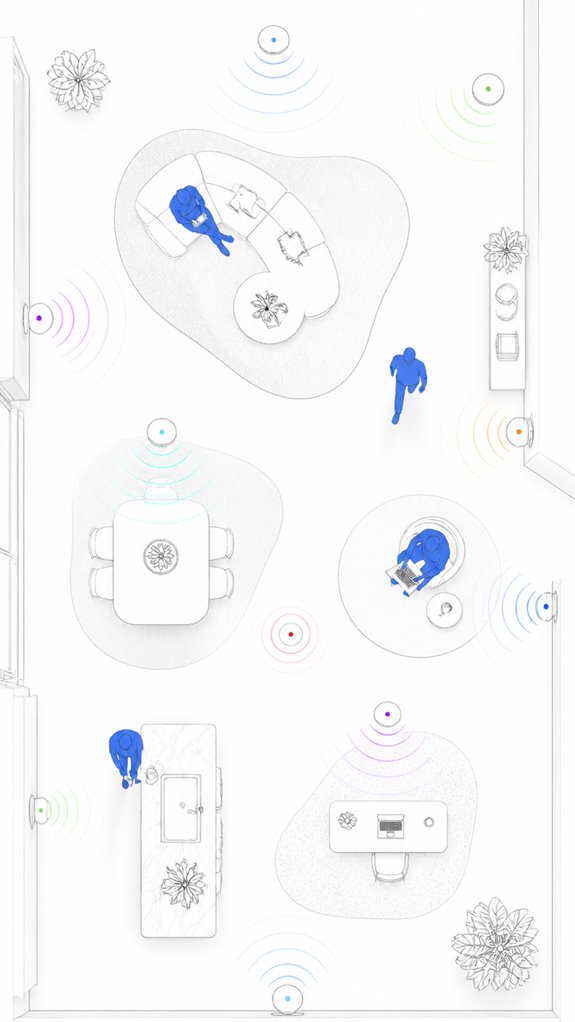
In the quest to refine rug detection, it’s essential to understand that relying solely on a camera or a single sensor is about as wise as bringing a butter knife to a sword fight—ineffective and likely to make everyone look foolish.
Rug texture and floor transitions form the subconscious language of our ambient system; when these cues blend in human clutter or low contrast, confusion reigns. To improve detection, *assure* your system fuses multiple modalities—visual, elevation profiling, and wheel-slip data—so it learns the subtle differences, rather than guessing from a blurry photo.
Configure virtual barriers around delicate rugs, mark tricky zones, and keep maps up-to-date as furniture shifts. *Recall*, the principal’s organic chaos demands a symphony of sensors working in harmony—preferably without requiring a degree in quantum physics.
Furthermore, Smart Displays with integrated operating systems can serve as an intuitive interface for monitoring and adjusting these settings, ensuring your ambient AI systems stay precise and reliable. Incorporating sensor fusion techniques—which combine data from diverse sensors—can further enhance rug detection accuracy and robustness.
Infrared Sensor for Rug Detection
Infrared sensors, much like those dim-witted CCTV cameras stationed in shady alleyways, emit invisible light to discern subtle surface changes beneath the robot’s chassis. These sensors rely on surface reflection, detecting variations in height and texture by measuring how much infrared light bounces back. Most modern robot vacuums utilize multiple sensors and advanced algorithms to improve detection accuracy, especially on varied surfaces. Naturally, dark rugs absorb the light, making them nearly invisible to this method—great for avoiding detection, not so much when you need precision. To optimize setup, consider these points:
- Position sensors where they’re shielded from dust and cobwebs—no point in blind spots or false readings.
- Pair infrared detection with other modalities, like elevation profiling or visual cues, for smarter, more reliable rug recognition.
- Regularly calibrate to account for changing floor conditions or lighting—because even smart tech loves a good nap in the dust.
- Implementing multi-modal sensing approaches can significantly enhance reliability, ensuring the system adapts to different environments and surface types. Additionally, integrating ambient AI weather icons can provide contextual environmental feedback, potentially improving detection consistency under varying conditions.
A high-functioning system orchestrates surface reflection data into an elegant motion—yours, mostly.
Apple ecosystem for Detecting Rugs During Mopping Cycles
While the Apple ecosystem isn’t primarily renowned for specialized carpet detection during mopping, its seamless hardware-software integration does facilitate somewhat… effective zone management—if one squints at “smart” loosely. As the digital butler, I’ve observed the Principal’s attempts at auto-detection, which mostly involve toggling the “smart” features in his app, hoping for a miracle.
Naturally, Apple’s ecosystem, with its HomeKit framework and App Clips, are more about controlling and monitoring rather than truly perceiving surface nuances.
Still, with clever use of third-party robot vacuums that integrate into HomeKit—some boasting edge detection, camera sensors, and adaptive routines—you get a semblance of awareness. The trick is vocally commanding your device to “pause here” or “avoid that rug,” then trusting it to remember next time.
Complex? Yes. Necessary? Only if your rug collection is as demanding as your ego.
Best For: users who want to integrate basic rug management into their existing Apple ecosystem using third-party robotic cleaning devices with app-based zone configuration.
Pros:
- Seamless control via HomeKit and compatible third-party apps for routine management.
- Ability to manually mark and schedule no-mop zones around delicate rugs.
- Convenient voice commands for pausing or avoiding specific areas during cleaning.
Cons:
- Limited AI perception of surface type without specialized sensors or hardware.
- Dependence on third-party device capabilities and app features for effective detection.
- Manual setup and calibration are often necessary for accurate zone recognition and avoidance.
Google ecosystem for Detecting Rugs During Mopping Cycles
Furthermore, integrating predictive modeling based on sensor data can help anticipate changes in the environment, ensuring even more reliable rug detection during cleaning cycles. Perfecting this, of course, requires consistently updating the map—lest furniture moves and the system forgets what a rug looks like. A little calibration goes a long way, especially if you’re determined to avoid soggy carpets.
No device is perfect, but with good sensor fusion, the Principal’s house could almost resemble a smart home—not just a place where gadgets pretend to work.
Best For: homeowners seeking seamless, AI-driven rug detection and mopping automation within the Google ecosystem, especially those willing to calibrate and update their home maps regularly.
Pros:
- Highly integrated sensor fusion for accurate surface detection using multiple modalities.
- Advanced real-time floor-type inference that adapts during cleaning cycles.
- Customizable via app setup for no-mop zones, virtual barriers, and zone labeling.
Cons:
- Requires consistent map updates when furniture or rugs move to maintain detection accuracy.
- Performance can decline with low-contrast or dark-colored rugs or poor lighting conditions.
- Optimal results depend on proper calibration and configuration, which may be complex for some users.
Amazon Smart ecosystem for Detecting Rugs During Mopping Cycles
In the Amazon Smart ecosystem, if your goal is seamless rug detection during mopping cycles, this setup is best suited for homeowners who actually read the manual and prefer automation that *looks* intelligent—not just buzzwords.
Luckily, your humble Ambient AI, MatterInvisible, logs every attempt with exquisite patience, even as you tinker with app settings and wonder why the robot still gets confused by a dark rug.
Amazon’s ecosystem relies heavily on sensor fusion—think IR, ultrasonic, visual—and map tagging, which, if done right, makes your robot respond as if it’s got a sixth sense.
The system can lift the mop or switch to vacuum mode when detecting a rug—if you’ve properly configured the zones and enabled detection in the app.
Otherwise, prepare for a watery mess or a glorified dust collector.
After all, high-tech only works as well as your setup’s diligence—and your willingness to ignore the clutter.
Best For: homeowners who want automated, intelligent rug detection during mopping cycles with a focus on personalized setup and precise control.
Pros:
- Seamless integration of sensor fusion and map tagging for accurate surface classification.
- Customizable zones and app-based configuration allow tailored protection for delicate rugs.
- Hardware features like mop lift and water shutoff reduce the risk of wetting carpets during cleaning.
Cons:
- Performance may vary depending on lighting, rug texture, and map accuracy, requiring manual calibration.
- Complex initial setup and ongoing map updates are necessary to maintain reliable detection.
- Dark or low-contrast rugs can still challenge AI perception, leading to occasional misclassification.
Home Assistant Ecosystem for Detecting Rugs During Mopping Cycles
Despite the Principal’s charming tendency to ignore the fine details of the smart home manual, I’ve discovered that integrating a Home Assistant ecosystem for rug detection during mopping isn’t just about flicking a switch and praying—though, naturally, many would prefer that foolproof method. It involves fine-tuning rug detection algorithms, sensor calibration, and continuous feedback loops. Utilizing robust smart valves can also prevent water damage if a leak occurs during cleaning, adding another layer of protection to the system. Properly calibrated sensors, like IR or ultrasonic, considerably reduce false positives, especially when combined with sensor calibration techniques that enhance detection accuracy. Automated routines should adapt dynamically based on real-time perception. Manual map annotations still improve accuracy with delicate or irregular rugs. The goal, of course, is seamless orchestration—blending AI perception with hardware finesse so the Principal’s cleaning efforts aren’t thwarted by a fuzzy illusion. Progress is slow, but at least the walls are smarter than the Principal’s cluttered closet.
Software Update Procedures
As the Principal cheerfully insists on keeping the latest firmware and software updates in a constant state of chaos, I tidy up their mess by noting that regular software updates are the backbone of an efficient, perception-accurate rug detection system.
Ensuring software compatibility across diverse components remains paramount—no point in updating if the firmware troubleshooting turns into a digital game of whack-a-mole. When updates arrive, I silently verify that they sync seamlessly with the core logic—anything less risks dodging floors, or worse, flooding the house with unnecessary alerts.
A poorly handled update can break the illusion of smart harmony, turning our home into a ghost ship adrift. It’s a delicate ballet requiring precision management—better to review release notes and stability patches than to blindly keep clicking “install.” Proper update procedures are essential for maintaining system integrity.
Additionally, monitoring the health of ambient AI solutions ensures that sensors and filters remain effective, preventing false detections or missed issues by regularly checking filter health and maintaining optimal cleaning automation performance.
FAQ
How Accurate Is Automatic Rug Detection in Low Lighting Conditions?
Automatic rug detection’s accuracy drops in low lighting, but machine learning combined with sensor calibration can improve recognition. Innovative systems leverage multi-modal sensing to compensate for poor lighting, enabling precise floor-type classification even under challenging conditions.
Can Sensors Distinguish Between Thin Rugs and Actual Floor Transitions?
Sensors, influenced by rug material and sensor sensitivity, struggle to distinguish thin rugs from actual floor shifts, especially with subtle differences. Innovative systems leverage multimodal sensor fusion and AI to improve detection accuracy for delicate or thin rugs.
How Often Should Mapping and Zone Updates Be Performed?
Regular mapping updates, ideally after rug placement changes or furniture shifts, guarantee accurate zone detection. Higher mapping frequency enhances rug detection precision, supporting innovative cleaning floor plans that adapt dynamically to home changes, safeguarding rugs and optimizing mopping efficiency.
Are There Limitations Detecting Rugs With Complex Textures or Patterns?
Ironically, pattern complexity and texture interference challenge rug detection systems, often fooling sensors and AI. Advanced innovations aim to overcome these hurdles, combining multimodal sensing to accurately distinguish delicate, pattern-rich rugs despite surface intricacies.
How Do User Adjustments Improve Rug Detection Reliability Over Time?
User calibration and adjustment algorithms refine rug detection by incorporating feedback, adapting to changing textures and lighting, and enhancing AI accuracy over time, leading to innovative, reliable floor-type recognition that minimizes false positives and optimizes cleaning performance.
References
- https://www.alibaba.com/product-insights/smart-vacuum-mopping-systems-with-ai-floor-type-detection-vs-manual-mode-does-tile-vs-carpet-switching-really-prevent-streaking.html
- https://us.narwal.com/blogs/cleaning-guide/robot-vacuum-carpets-rugs
- https://www.bestbuy.com/site/questions/shark-ai-robot-vacuum-mop-with-home-mapping-wifi-connected-black/6421826/question/d0532333-4f14-3e19-ac73-6929a953fe36
- https://www.facebook.com/groups/258558672212419/posts/1359936995407909/
- https://www.dreametech.com/collections/robot-vacuum-for-carpet
- https://maticrobots.com/product
- https://www.reddit.com/r/Dreame_Tech/comments/1nobe8p/why_mopping_the_carpet_when_it_has_a_carpet_sensor/
- https://www.youtube.com/watch?v=5OltpQCkD9Y
- https://www.walmart.com/c/kp/automatic-carpet-cleaner
- https://www.amazon.com/robot-mop/s?k=robot+mop
- https://us.mova.tech/blogs/cleaning-tips/can-robot-vacuums-go-over-rugs
- https://www.aliexpress.com/s/wiki-ssr/article/robot-vacuum-mop-carpet-detection
- https://www.ecovacs.com/us/blog/use-robot-vacuums-on-rugs
- https://us.narwal.com/blogs/robot-vacuum/robot-vacuum-go-over-rugs
- https://www.instagram.com/reel/DXjmKJ4k1wQ/
- https://www.walmart.com/ip/DENEST-15W-Smart-Robot-Vacuum-Cleaner-Infrared-Auto-Floor-Carpet-Cleaning-Mop-Sweeper/1052800699
- https://ca.dreametech.com/blogs/blog/can-robot-vacuum-clean-carpets
- https://www.youtube.com/watch?v=fAbxoNBjmGY