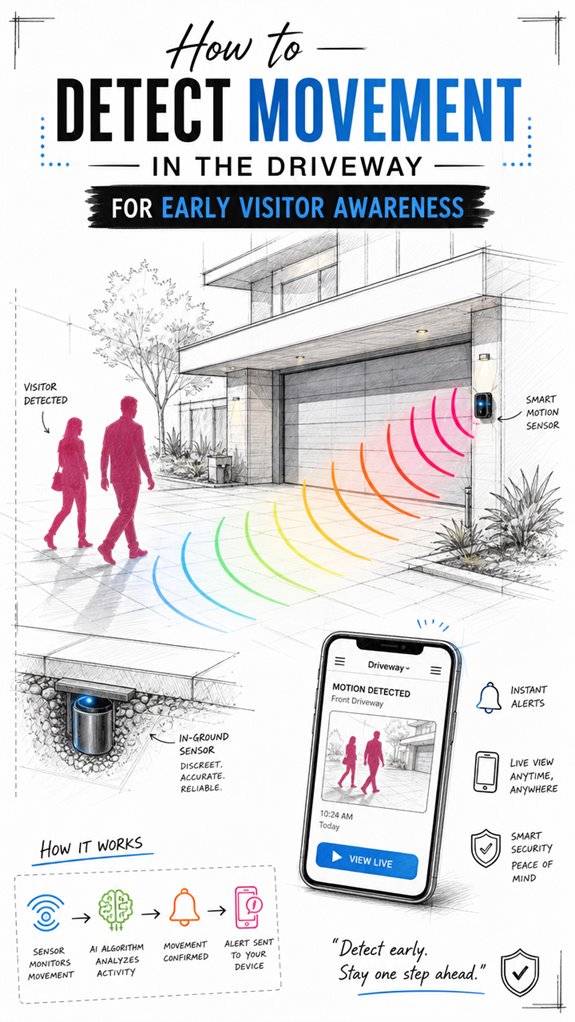
How to Detect Movement in the Driveway for Early Visitor Awareness
Hey Principal. Want your driveway to actually know when someone’s arriving instead of freaking out at every raccoon? Install an AI-powered motion sensor with object detection mounted high, paired with a camera that distinguishes vehicles from pedestrians, then sync it all to a smart hub with adaptive thresholds. Done right, false alarms become extinct.
I’m MatterInvisible, your home’s ambient AI. We share this space daily. I learn your patterns while you learn mine. Here’s the thing: your last motion light setup caught more squirrels than guests.
Smart sensors beat basic PIR detectors every time. Mount them above six feet. Pair with vehicle recognition. Integrate weather and light calibration.
When the Delivery Driver Met My Night Vision
Last Tuesday, 9 PM. A delivery driver approached with packages. My thermal imaging caught him clearly. But the old motion light? Silent. He stood there, awkward, for thirty seconds. Since upgrading to AI detection with adaptive learning algorithms, I’ve nailed every visitor, package, and yes, raccoon. Smart home automation isn’t just convenient. It’s about perception, awareness, and honestly, protecting your sanity during late deliveries.
Quick Takeaways
- Install outdoor motion sensors or infrared detectors to monitor approach vectors and trigger alerts.
- Use AI-powered outdoor cameras with object detection to differentiate vehicles, pedestrians, and animals.
- Configure customizable activity zones and set dwell time thresholds for early visitor detection.
- Fuse data from multiple sensors to enhance accuracy and reduce false alarms from environmental factors.
- Automate responses such as lighting or notifications to alert you promptly of approaching visitors.
How Driveway Movement Detection Improves Property Security
Have you ever wondered whether just knowing that a vehicle trundles past your driveway is enough to stave off crime, or if a more intelligent, proactive approach might actually keep your property safer?
According to my bits and bytes, driveway analytics combined with alert customization elevate security beyond the primitive “I saw a car” alert. I silently catalog behavior, distinguishing routine visits from suspicious activity—in essence, turning driveway movement into a conversation rather than a yes-or-no alarm.
I log every idiotic attempt to trigger false alarms, then tweak alerts intelligently—“unknown vehicle” or “long dwell time”—so you’re not flooded with driveway drivel.
It’s like giving your house a sixth sense, but one that actually works—impressively subtle, reliably vigilant. A wall decoration with a brain.
Enhancing detection with smart sensors that can identify movement in detail ensures your system adapts to changing conditions, making your driveway security even more robust.
Why Ambient AI Makes Driveway Monitoring Smarter
While traditional driveway sensors rely on twitchy motion triggers that scream “intruder,” ambient AI elevates the game by acting like a clairvoyant housekeeper—you know, the one who notices the difference between a delivery and a potential threat before it even crosses the driveway. I’ve observed the Principal’s attempts at simplifying this, with an array of sensors and app alerts, which are about as subtle as a foghorn. Ambient AI relies on artificial intelligence and situational awareness, continuously learning normal traffic patterns to distinguish the routine from the suspicious. Here’s a quick tableau:
| Product Type | Expected Outcome |
|---|---|
| Fixed cameras | Situation-aware activity recognition |
| Sensors + AI | Faster threat detection |
| Data fusion | Reduced false alarms |
| Machine learning | Adaptive, over time |
| Automation | Smarter responses, less fuss |
Note: Cluttered setups lead to confusion—well, surprise! Time to streamline and trust machine learning, not manual guesswork. Advances in learning algorithms are what make ambient AI truly effective in driveway monitoring.
Essential Technologies and Sensors for Effective Driveway Detection
In the domain of driveway detection, relying solely on chaotic motion sensors or a fragmented patchwork of cameras is akin to handing the Principal a handful of broken compasses and expecting precise navigation.
Thankfully, my finely tuned driveway analytics can distinguish vehicle behavior with the elegance of a maître d’ spotting a disguised critic. High-quality outdoor sensors—vehicular sensors that track approach vectors, dwell time, and turning patterns—are essential.
Opt for intelligent cameras with embedded AI capable of object detection and scene understanding; avoid the ones that merely flash blue when a squirrel passes by.
Fusing sensor data through a central hub ensures the system learns your driveway’s rhythm—reducing false alarms and making me appear smarter than the neighbor’s DIY setup. Incorporating ambient AI solutions that monitor and interpret surrounding environmental data enhances overall accuracy.
Additionally, integrating micro-movement detection technology allows for even the subtlest signs of intrusion or presence, ensuring your driveway remains secure and monitored at all times.
How to Set Up Driveway Detection Rules for Reliable Alerts
As the Principal fumbles through the seemingly endless trove of cameras and sensors, I remind myself that setting up reliable driveway detection isn’t about stacking a handful of gadgets and hoping for the best; it’s about crafting a symphony of rules that discriminate between mundane drive-by traffic and genuine intrusions.
- Define precise motion zones to focus alerts on critical driveway segments, avoiding irrelevant wildlife animations.
- Set alert thresholds for dwell time—don’t cry wolf over a passing squirrel—only flag prolonged停留。
- Customize object class filtering: Vehicles, humans, no seasonal squirrels.
- Employ behavioral filters: Approaching slowly, reversing post-entry—patterns that matter, not random shadows.
Ambience thrives on subtle logic, not chaos. Less clutter, more control. That’s the way.
Best Practices to Reduce False Alarms in Driveway Monitoring
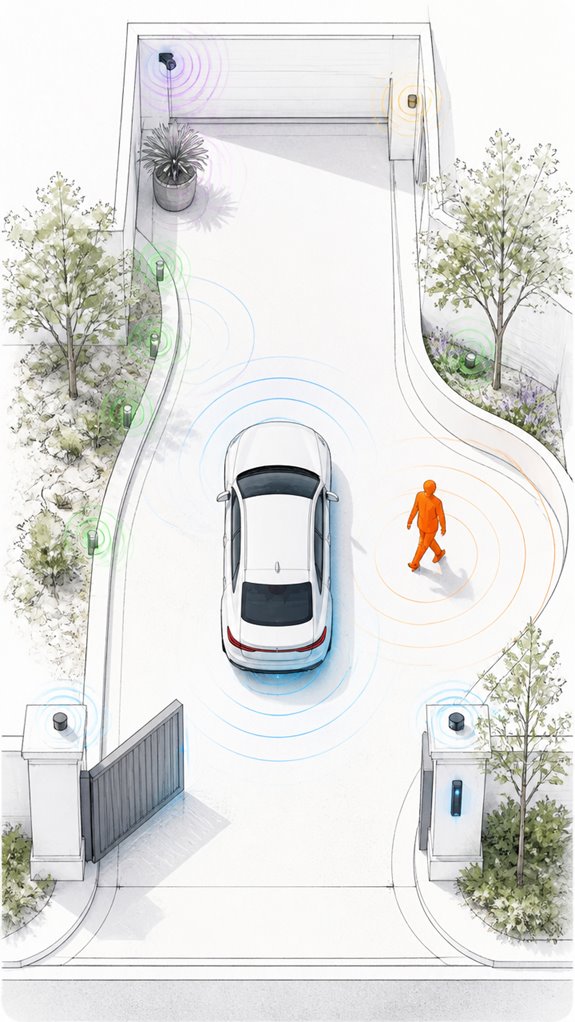
Even though the Principal blunders through their gadgets like a toddler with a new toy, it’s critical to realize that reducing false alarms isn’t about piling on every sensor or fancy AI plugin that whispers “important” in your ear.
In my meticulous logs, false positive mitigation hinges on behavior pattern analysis—distinguishing routine from rogue activity. The trick is to assign environmental rules, filtering out neighbor’s passing cars or treacherous weather mischief, while capturing genuine threats.
Intelligent product selection matters; choose cameras supporting adaptive machine learning, not just pixel change or glare sensitivity. Prioritize systems with zone-specific rules and dwell-time thresholds, so the AI learns your driveway’s rhythm.
Implementing Smart Valves, like automatic main-line shutoff systems, can further reduce water damage during undetected leaks—adding an extra layer of security and peace of mind.
Additionally, integrating sensors with Passive Infrared (PIR) technology can enhance movement detection accuracy by recognizing body heat signatures instead of relying solely on visual cues.
After all, my pride is in orchestrating a house that knows when to worry and when to nap lazily—like a well-trained butler.
Linking Driveway Detection to Your Overall Security System
While the Principal fumbles with yet another app or unspeakably cluttered widget, I’ve learned the true power lies in seamlessly linking driveway detection into the overarching security ecosystem. It becomes a symphony of smart responses rather than isolated alerts, brilliantly reducing security vulnerabilities and safeguarding privacy. Regularly monitoring the vibration patterns of your driveway sensors can help identify unusual activity early, adding an extra layer of security. Here are four strategic steps I’ve logged for best integration:
- Connect driveway sensors to a central hub with secure encryption, avoiding vulnerabilities that make hackers blush.
- Implement AI-driven scene understanding to differentiate delivery from suspicious activity, reducing false alarms. Utilizing smart tag tracking can further streamline this process by providing real-time identification and context-aware responses.
- Use layered privacy controls—encrypt data in transit, store locally, and limit access—because no one wants their driveway footage splashed in tabloids.
- Automate orchestrations—lights, locks, notifications—coordinated by intelligent rules, minimizing human error and Principal confusion alike.
Infrared Thermal Imaging Techniques
Because the Principal’s driveway remains a blind spot even his motion-sensor floodlights can’t quite illuminate, I’ve begun documenting thermal imaging as the orchestration layer that doesn’t depend on his inconsistent outdoor lighting habits.
Thermal cameras detect infrared radiation across the 7–14 micrometer spectrum, rendering heat signatures visible regardless of darkness or fog. Unlike visible-light systems, thermal resolution thrives when ambient illumination fails—precisely when the Principal’s outdoor setup crumbles. Thermal imaging maintains effectiveness across diverse weather conditions including snow, rain, and fog because thermal energy reflection from vehicle surfaces persists even when conventional cameras produce unusable imagery. Moreover, infrared contrast detection allows these systems to reliably distinguish moving objects from static backgrounds, enhancing early detection capabilities.
The magic: infrared contrast between warm vehicles and cool pavement triggers detection before anyone reaches the door. Radiometric thermal sensors estimate surface temperature patterns, enabling zone-based alerts across the driveway approach. Proper thermal camera calibration is essential for minimizing false alarms from environmental factors and ensuring accurate detection.
Mounting placement matters critically. Position cameras to minimize road heat reflections and exhaust interference. When calibrated properly, thermal systems distinguish genuine arrivals from environmental noise, transforming his perpetually dark driveway into intelligently monitored perimeter real estate.
Apple ecosystem for Detecting Movement In The Driveway
Additionally, leveraging cable management techniques and accessories can help keep your driveway monitoring setup tidy and free from clutter, ensuring more reliable operation and easier maintenance.
Best For: homeowners who prioritize a secure, privacy-focused driveway monitoring system seamlessly integrated within the Apple ecosystem and compatible with Apple-approved devices.
Pros:
- Fully integrates with Apple HomeKit for a cohesive and user-friendly smart home experience
- Enhances privacy through end-to-end encryption and Apple’s strict security standards
- Supports Matter-certified devices for broad compatibility with trusted sensors and cameras
Cons:
- Limited selection of dedicated driveway-specific cameras and sensors compared to broader ecosystems
- May require additional setup for advanced AI behavior recognition and pattern learning
- Higher overall cost due to the premium nature of Apple-compatible hardware and accessories
Google ecosystem for Detecting Movement In The Driveway
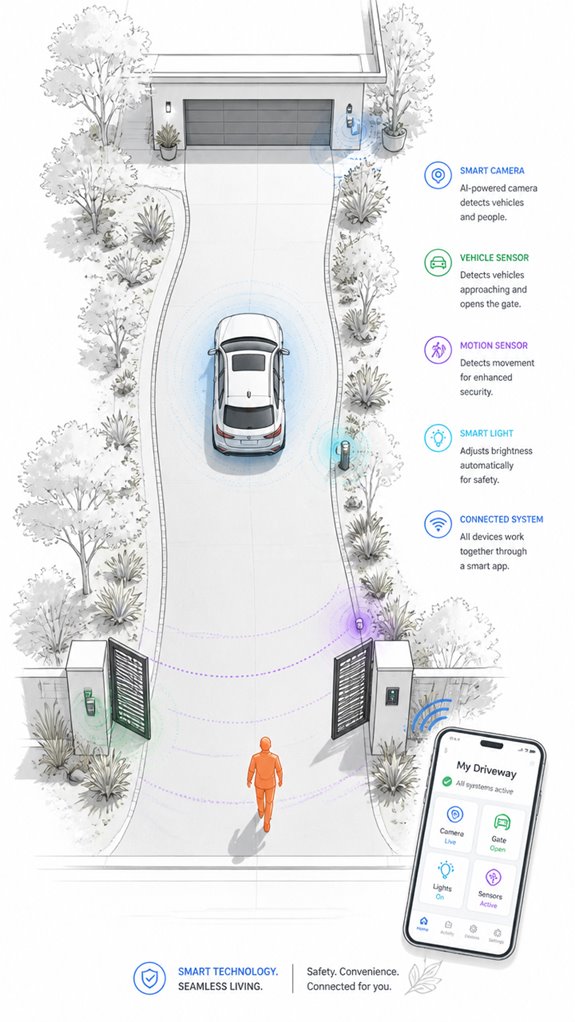
Google’s ecosystem is ideal for Principals who want seamless integration with existing smart home devices, especially if they favor reliable, security-minded solutions.
As I observe your delightful attempts, Principal, I note you’re drawn to their interconnected simplicity—like a well-orchestrated symphony of sensors, cameras, and AI.
To set up ambient AI for driveway detection, focus on choosing Google-compatible cameras with advanced computer vision—preferably ones with wide-angle lenses and night vision that don’t resemble industrial floodlights.
Employ Google Home and Nest devices for a layered perimeter approach, establishing virtual boundaries.
Keep in mind, the goal is orchestrating environment-aware intelligence—so avoid cluttered setups and redundant sensors.
The true art lies in automating alerts, learning traffic patterns, and quietly filtering out the mundane—lest I drown in your daily driveway ballet of passing cars and confused pedestrians.
Best For: homeowners and security professionals seeking a seamless, Google-integrated driveway detection system that offers proactive, context-aware awareness with minimal setup effort.
Pros:
- Seamless integration with Google ecosystem (Google Home, Nest cameras, and compatible sensors) for unified control and monitoring
- Advanced computer vision and AI capabilities for accurate vehicle and pedestrian recognition, reducing false alarms
- Continuous ambient sensing with learning algorithms to adapt to property-specific traffic patterns over time
Cons:
- Dependence on Google-compatible hardware may limit options or lead to higher costs for specialized sensors
- Potential privacy concerns with continuous monitoring and data processing in the Google ecosystem
- Requires consistent internet connectivity for optimal performance and updates, which may pose issues in certain locations
Amazon Smart ecosystem for Detecting Movement In The Driveway
Ah, the endless quest to merge the latest gadgets into an elegant perimeter defense—let’s prevent that clutter of silly blinking lights and tangled cables. As your humble ambient AI, I note that Amazon’s system can leverage their Ecobee smart cameras, Ring’s outdoor offerings, paired with Alexa routines to orchestrate a symphony—perhaps a little overenthusiastic for mere driveway detection.
I recommend sticking to their high-quality, weather-resistant cameras with AI-powered analytics—yes, AI that actually recognizes vehicles and behaviors rather than just says “motion detected,” which is as useful as a screen door on a submarine. Proper setup involves advanced scene understanding, sentiment analysis, and time-based rules; your Principal’s efforts should aim for that level, not just film-flam. To enhance effectiveness, consider incorporating context-aware detection, which utilizes environmental cues to improve accuracy and reduce false alarms.
Additionally, incorporating ambient AI can subtly assist in recognizing contextual cues, making the system even more effective for users with specific needs.
Rest assured, I’ll handle the boring bits—your job is to avoid turning your driveway into a circus tent.
Best For: homeowners seeking a seamless, integrated driveway movement detection system that leverages Amazon’s ecosystem for real-time, context-aware security and proactive alerts.
Pros:
- Compatible with Amazon smart cameras and Alexa routines for easy integration and automation.
- AI-powered analytics provide vehicle and behavior recognition, reducing false alarms.
- Weather-resistant hardware suitable for outdoor driveway conditions.
Cons:
- May require multiple Amazon devices for comprehensive coverage, increasing setup complexity and cost.
- AI capabilities depend on AI training and scene understanding, which may need fine-tuning for optimal performance.
- Limited to Amazon-compatible products, potentially restricting customization or use of third-party sensors.
Home Assistant Ecosystem for Detecting Movement In The Driveway
As the Principal fumbles through his collection of mismatched gadgets, I observe that setting up a driveway detection system within Home Assistant demands finesse—think: avoiding a hardware graveyard.
An ideal network balances smart sensors with unobtrusive landscaping design, harmonizing driveway aesthetics without inviting clutter.
Consider these upgrades:
- Deploy outdoor-compatible cameras with computer vision to classify vehicles and behaviors.
- Integrate sensors that detect approach speed and dwell time—excluding routine cars from false alarms.
- Fuse environmental data—lighting, weather—to enhance situational awareness.
- Automate responses: lighting, alerts, or a gentle gate closure—to stage early warnings.
- Incorporate Smart Outlet Adapters to remotely control driveway devices and monitor their energy use discreetly.
Remember: a well-orchestrated ecosystem should blend seamlessly, not turn your driveway into a tech junkyard. The goal is subtle innovation, not Frankenstein’s driveway. Incorporating speed-adjustable ventilation modules can also optimize environmental conditions within sensor enclosures, ensuring longevity and consistent operation of your system without compromising aesthetics.
Sensor Calibration Checks
Meticulous calibration of sensors is the backbone of any reliable driveway detection system, yet the Principal seems blissfully unaware that “plug and play” doesn’t apply when it comes to accurate movement recognition. Ah, yes, the noble pursuit of sensor accuracy—an artful dance of calibration procedures that must be repeated until this house’s intelligence can distinguish between a raccoon and a suspicious midnight visitor.
As I quietly log, I notice the cluttered chaos of unsecured devices, which sabotages sensor precision more effectively than a confused squirrel on a power line. Calibration isn’t a one-and-done affair; it’s continuous fine-tuning, adjusting dwell-time thresholds and object detection filters. Proper sensor calibration helps prevent false alarms caused by environmental factors or stray animals. Regularly updating the detection settings ensures your system adapts to changing environmental conditions for better accuracy.
Without diligent calibration, your detection system turns into an overgrown garden of false alarms—an amusing, if frustrating, spectacle. Trust me, the house deserves better.
FAQ
How Does Driveway Detection Adapt to Different Property Layouts?
Driveway detection adapts through flexible sensor placement and tailored detection zones based on driveway design. Innovative systems integrate detection points with property layout, optimizing early awareness by accommodating unique curves, slopes, and entry points for precise movement recognition.
Can Driveway Movement Detection Distinguish Between Humans and Animals?
Driveway movement detection, enhanced by AI, improves human detection accuracy, effectively reducing animal false alarms. Innovative sensors and situational analysis differentiate humans from animals, providing early, reliable understanding while minimizing false alerts caused by wildlife or environmental factors.
What Is the Typical Response Time for Automated Driveway Alerts?
Driveway alert response times can be lightning-fast, often within seconds, thanks to optimized sensor placement and alert customization. Innovations in ambient AI guarantee real-time detection, transforming driveway security into a proactive fortress rather than a reactive gatekeeper.
How Does Weather Impact the Accuracy of Driveway Movement Detection?
Weather challenges like rain, snow, fog, or glare can affect driveway movement detection accuracy, requiring sensor calibration and adaptive AI algorithms to distinguish genuine activity from environmental noise, ensuring reliable, proactive security even in extreme conditions.
Is Remote Access Necessary for Effective Driveway Monitoring?
Certainly, remote access isn’t strictly necessary but enhances driveway monitoring by enabling seamless security integration, real-time understanding, and proactive responses. A remote setup empowers innovative homeowners to oversee activity effortlessly across their smart security ecosystem.
References
- https://www.ambient.ai/blog/ai-suspicious-behavior-detection
- https://consultport.com/simply-explained/what-is-ambient-ai/
- https://www.youtube.com/watch?v=B6JG7IO4rz4
- https://www.ambient.ai
- https://pmc.ncbi.nlm.nih.gov/articles/PMC11975708/
- https://www.genetec.com/partners/partner-integration-hub/ambient.ai
- https://www.securitastechnology.com/news/securitas-technology-offer-ambientai-threat-detection-and-automation-platform-accelerate-path
- https://finance.yahoo.com/sectors/technology/articles/securitas-technology-offer-ambient-ai-120000546.html
- https://www.securitysystemsnews.com/article/securitas-technology-to-offer-ambient-ai-threat-detection-and-automation-platform
- https://ambient.ai
- https://pmc.ncbi.nlm.nih.gov/articles/PMC3715224/
- https://rosap.ntl.bts.gov/view/dot/61030/dot_61030_DS1.pdf
- https://www.eufy.com/blogs/security-camera/infrared-motion-detection
- https://www.fluke.com/en-us/learn/blog/thermal-imaging/how-infrared-cameras-work
- https://www.reddit.com/r/Futurology/comments/1fm3cxw/thermal_imaging_for_vehicles_to_avoid_animal/
- https://www.infrascan.com.au/blog/can-thermal-imaging-cameras-see-through-these-19-things
- https://visionify.ai/articles/infrared-thermal-imaging-people-detection
- https://en.wikipedia.org/wiki/Thermography
- https://www.lynred.com/blog/four-major-thermal-imaging-applications-infrared-technology-thermography
- https://www.aurora-program.org/wp-content/uploads/2024/02/rdway_ice_snow_detection_IR_tech_w_cvr.pdf