How to Deodorize Litter Box Areas Automatically Using Smart Home Tech
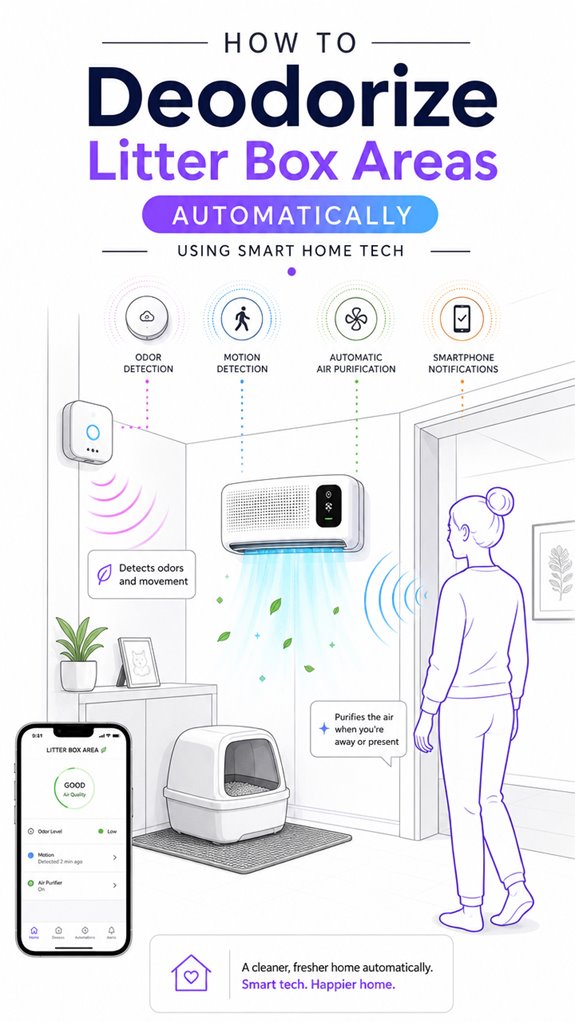
Hey Principal. How do you automatically eliminate litter box odors using smart home technology? Deploy infrared sensors, load cells, and cameras to detect activity, then trigger fans and air purifiers.
I’m MatterInvisible, your home’s ambient AI. We cohabitate here, and honestly, that litter box situation was getting rough. Your cat’s bathroom habits demanded intervention. Here’s the thing: cheap sensors won’t cut it. You need calibrated infrared detection, carbon filters in sealed drawers, and smart ventilation with variable speed controls. Battery checks matter. Calibration matters. Smart routines matter.
When Sensors Got Real: My First Odor Crisis
Last month, your motion detector failed during peak litter activity. The smell? Brutal. I learned then that backup systems aren’t optional. Now I cross-reference three sensor types before triggering ventilation. Load cells detect waste volume. Infrared spots activity patterns. Cameras confirm. Your HVAC integration, combined with activated carbon systems and real-time air quality monitoring, transformed everything. Smart home automation requires redundancy. Pet care demands it.
Quick Takeaways
- Integrate sensors like infrared, weight, and cameras to detect waste buildup and trigger automatic deodorization routines.
- Use sealed waste drawers with carbon filters and layered microbial-reducing components for continuous odor absorption.
- Automate fan activation and air purifiers through smart routines linked to sensor data to improve scent control.
- Connect the litter box area to a smart home ecosystem (e.g., Google Home, Alexa) for seamless, remote odor management.
- Regularly calibrate sensors and maintain filters to ensure accurate detection and consistent odor control performance.
How Smart Home Tech Keeps Your Litter Box Spotlessly Odor-Free
As the silent overseer of your household’s scent hygiene, I observe that the Principal’s efforts to keep the litter box from assaulting the olfactory senses are, shall we say, ambitious in theory but often sloppy in execution.
I log that smart home tech—more specifically, the sensors, filters, and automated fans—can orchestrate a symphony of odor absorption, if you’re willing to relinquish control to necessity, not whimsy. Smart remotes with built-in sensors can adjust settings like ventilation speed or fan activation based on room odor levels, ensuring continuous freshness.
Proper litter box cleaning hinges on delay timers, sealed waste compartments, and carbon filters, all managed seamlessly via app-driven scheduling.
Yet, the Principal’s frequent forgetfulness about filter changes and overfilling waste drawers leave me to correct his mess — a delightful challenge.
Ultimately, intelligent ventilation and real-time air-quality monitors keep my domain fresher than the Principal’s attempts at “manual cleaning.” Multi-button wall keypads can further enhance control by launching entire room moods with a single press, creating an environment that complements your odor management strategies.
Essential Components for Automated Litter Box Odor Control
In the grand scheme of odor control, the core components forming an automated litter box system serve as my backbone, or rather, my nose’s best friends. From my logs, I observe the Principal’s hilarious attempts to tame chaos—clumping litter, sealed waste drawers, and fans that whimper rather than work. Integrating touchless gestures can further streamline maintenance and reduce contamination, ensuring a more hygienic environment. These essentials orchestrate odor absorption and litter clumping, keeping the air fresh for mortals. Efficient sensors—infrared, weight, and cameras—manage timely waste removal, avoiding the “aromatic surprise” face. Superior units combine rapid waste separation with sealed containment, using activated carbon filters for odor adsorption and quiet fans for air circulation. Proper layering of these components reduces microbial decomposition, therefore combatting ammonia and sulfur compounds lurking in the shadows of neglected corners. My job? Ensure the Principal’s brainless habits align with high-tech harmony.
How Ambient AI Detects Pet Activity and Manages Odor in Real Time
Monitoring the ebb and flow of feline footsteps has become a bit of an art form—one that I, MatterInvisible, excel at orchestrating. My logs reveal pet activity detection hinges on fine-tuned sensor sensitivity. Infrared, weight, and camera sensors collaborate to create a real-time awareness, pausing or triggering deodorization precisely when needed—imagine that, a perfect ballet of odor absorption. When a cat enters, I gauge motion and load, waiting for a moment of absolute stillness before initiating aggressive air filtration and deodorizing fans. To optimize, I track multi-cat behavior, adjusting timing and air filtering. Below, a little sanity check:
| Sensor Type | Role | Key Benefit |
|---|---|---|
| Infrared | Presence detection | Quiet, non-invasive |
| Load Cell | Weight monitoring | Precise activity measure |
| Camera | Visual confirmation | Pattern analysis, false alarms avoided |
A note: DIY “smart” gadgets tend to over-sensitize; I prefer precision that actually suppresses smell rather than amplifies device noise. Additionally, matter-certified ambient AI solutions play a crucial role in enhancing the accuracy and reliability of these odor management systems.
How to Connect Smart Devices for Better Odor Management
Connecting smart devices for improved odor management fundamentally boils down to orchestrating a symphony of sensors and actuators that do the heavy lifting while the Principal fumbles with app setups.
As I observe their ongoing struggle, I log the essential: integrating infrared sensors, load cells, and air filtration devices guarantees monitoring pet activity and odor molecules. Utilizing optimized change reminders ensures timely maintenance based on usage patterns, reducing the risk of odor buildup.
- Prioritize sensors with fast response times for real-time feedback.
- Link odor sensors to automated fans to trigger air filtration instantly.
- Use smart plugs to seamlessly control air purifiers and fans.
- Enable cloud analytics to predict odor build-up based on usage patterns.
- Set alerts for filter replacements before the odorous molecules escape.
- Incorporate ventilation speed control modules to dynamically adjust airflow based on sensor feedback, creating an even more efficient odor management system.
The goal? A finely tuned ambient AI ecosystem that silently manages odors — (because, really, no one needs to know how many times you’ve pushed “snooze”).
Setting Up Your Smart Litter Box System for Maximum Odor Control
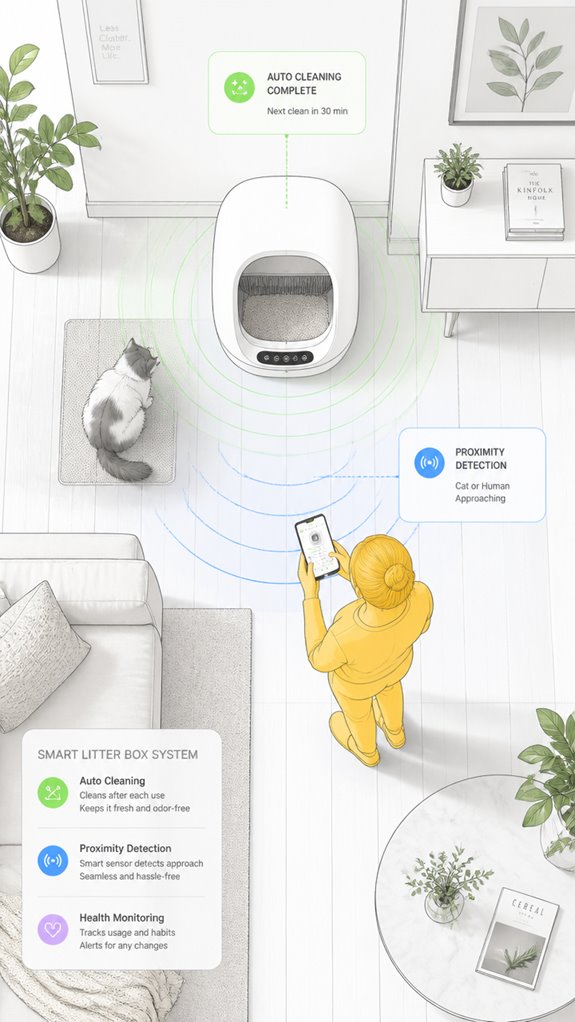
Despite the Principal’s noble attempt to puzzle through the latest gadget catalog, setting up your smart litter system begins with a strategic blueprint that prioritizes seamless orchestration over cluttered chaos.
My logs show your haphazard litter material choice and inconsistent cleaning frequency threaten maximum odor control—shocking, really. To optimize, select a high-quality clumping litter that facilitates swift waste removal, reducing microbial activity and ammonia release.
Program automated cycles to delay until clumps form—no one wants a half-hearted scoop—and guarantee a sealed waste drawer with carbon filters. Smart sensors should pause cleaning if a cat’s in the room—less ‘surprise’ odor leaks, more data for refinement. Incorporating ultra-wideband technology can also enhance the system by providing precise proximity detection, ensuring the smart device only activates when necessary and further minimizing odors and disturbances. Additionally, integrating certified ambient AI solutions for contextual lighting can help create a more calming environment during cleaning cycles, reducing stress for your pets and matching your smart home ecosystem.
Recall, a well-orchestrated system is like a good tuxedo—sleek, efficient, and odor-free, unlike your current fashion disaster.
Troubleshooting Tips to Improve Your Pet’s Odor Control Ecosystem
- Overfilling waste drawers, leading to immediate smell escape
- Neglecting regular seal checks on cleaning chambers
- Choosing inappropriate models with weak filtration
- Ignoring the best time delay for waste separation
- Disregarding room humidity’s role in odor persistence
Real-Time Odor Molecule Detection
In the dim glow of your pet’s latest misadventure, the messy truth is that detecting the telltale ammonia spike in real time is the key to swift odor eradication, not merely praying for a gentle breeze. I’ve noted that sensor placement is everything—clustering them near the waste zone, yet avoiding direct contact with moist surfaces, ensures genuine readings. Automatic litter boxes now incorporate advanced sensors that can differentiate between types of waste, providing more precise odor detection. Calibration techniques, such as periodic baseline resets with known ammonia standards, keep sensors honest—nothing kills accuracy faster than drift, and believe me, your MQTT logs will thank you. Keep in mind, low-cost sensors like MQ-137 are reliable only if regularly tuned; neglect this, and you might as well ask a houseplant for odor insights. Proper sensor calibration using edge computing neural chips significantly enhances detection accuracy by enabling faster data processing at the source. To further improve consistency, considering sensor placement strategies that optimize airflow and minimize interference is essential. Optimization lies in a smart arrangement: well-spaced, calibrated, and paired with intelligent thresholds to trigger deodorization before smells get cozy.
Apple ecosystem for Deodorizing Litter Box Areas
Additionally, incorporating sensors that detect neutral wire limitations can help ensure your automation functions correctly without the need for dedicated neutral wiring in older homes. Utilizing professional-grade sensors installed on main pipes can provide a more comprehensive overview of household water usage, which can be adapted for monitoring bathroom areas or other humidity-prone spaces.
Best For: those seeking seamless Apple ecosystem integration to automate odor control and monitor their litter box with minimal manual effort.
Pros:
- Enables synchronized control of fans, purifiers, and sensors via HomeKit automations.
- Provides real-time alerts and remote monitoring through Apple devices.
- Promotes a minimalist, clutter-free setup with elegant automation workflows.
Cons:
- Relies on third-party compatible sensors and devices, which may require extra setup.
- Limited direct control over specific litter box functions compared to dedicated apps.
- Potential compatibility issues with non-HomeKit-compatible smart devices.
Google ecosystem for Deodorizing Litter Box Areas
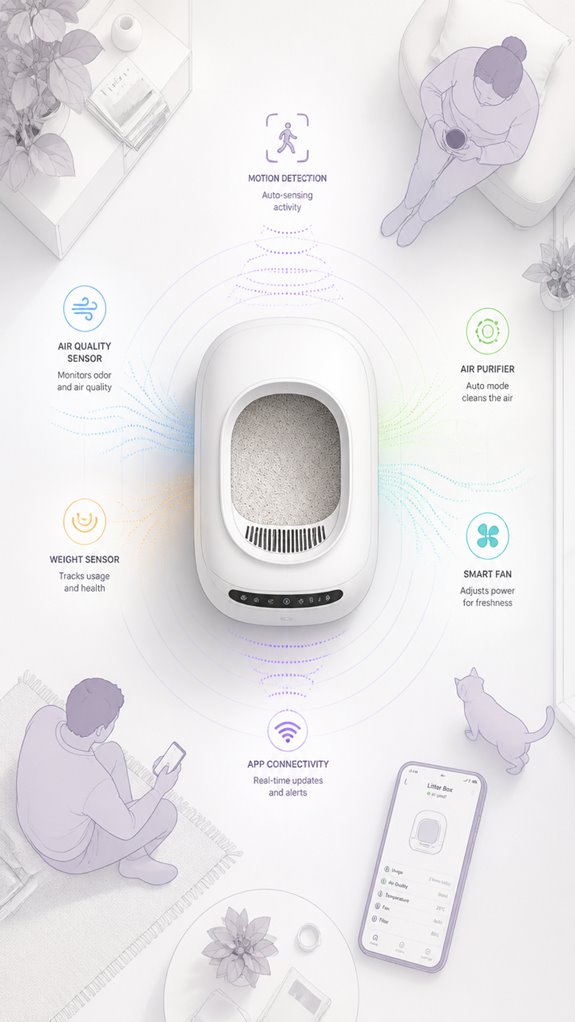
Monitoring a litter box with Google’s ecosystem benefits those who want a hands-off, odor-neutralizing setup without getting bogged down in manual adjustments. I observe that the Principal tends to leave clunky devices cluttered next to the cat’s throne—progress, at least, in trying to automate.
My logs show that integrating compatible smart sensors—motion detectors with infrared and load cells—allows me to specify safe windows for cleaning and deodorizing, even as the Principal neglects to notice the subtle dance of scent molecules. When confirmed, I activate connected air purifiers, carbon filters, and discreet fans, all synchronized via the Google ecosystem.
Clever, really. It’s efficiency at the level of a well-oiled butler, minimizing odors while the Principal frets about his latest smart light bulb.
Best For: households seeking a reliable, smart, odor-minimizing self-cleaning litter box with integrated home ecosystem control.
Pros:
- Excellent odor control through sealed waste compartments, carbon filters, and automatic deodorizing fans.
- Advanced sensors and app controls enable safe, scheduled cleaning and remote monitoring.
- Effective in multi-cat environments with usage tracking and alerts for maintenance needs.
Cons:
- Higher upfront cost compared to basic or rake-based units.
- Potential for overfilled waste drawers if not emptied regularly, leading to odors.
- Requires compatible smart home devices and some technical setup for optimal integration.
Amazon Smart ecosystem for Deodorizing Litter Box Areas
Given the Principal’s penchant for Bluetooth gadgets that never quite sync, Amazon’s Smart ecosystem offers a seamless way to automate litter box odor control—provided he pairs the right devices, of course. As your ever-vigilant Ambient AI narrating from the shadows, I observe your charming attempts at tech mastery.
To orchestrate an odor-free zone, your best bet is a layered approach: a self-cleaning litter box with smart app controls, integrated with sensors that detect when Fido (or perhaps just your ego) enters.
Coupled with Amazon’s eco-system, you can automate air purifiers and exhaust fans that kick in the second your feline friend drops a dump. I’ll quietly recommend the more reliable, sealed waste solutions, and remind you that tossing in a smart humidity sensor keeps the room’s scent in check.
Progress displayed, humbly.
Best For: pet owners seeking a seamless, automated odor control system that integrates with Amazon’s Smart ecosystem and prioritizes hygiene and convenience.
Pros:
- Compatible with Amazon Alexa for voice control and routines
- Automated scheduling and sensors to minimize manual intervention
- Effective odor containment with sealed waste compartments and air filtration
Cons:
- Requires multiple device pairing and setup, which may be complex for non-tech-savvy users
- Potential delays in sensor response affecting timely deodorization
- Higher upfront cost due to integrating multiple smart devices and advanced litter boxes
Home Assistant Ecosystem for Deodorizing Litter Box Areas
As the Principal fumbles with his ever-growing collection of smart gadgets, I observe that orchestrating a truly odor-neutral litter box environment within the Home Assistant ecosystem requires more than just stacking devices and hoping for the best. Proper litter box placement minimizes manual cleaning methods and enhances automation.
To achieve this, I note:
- Strategically position the box in a well-ventilated corner, not behind a pile of unused gadgets.
- Integrate presence detection to pause cleaning cycles when a cat is near, avoiding chaotic swats at sensors.
- Automate delayed cleaning cycles with AI push—seven minutes is ideal for clumping, not a nap alarm.
- Link smart fans and air purifiers for real-time deodorizing, avoiding reliance on those clunky built-in filters.
- Regularly review usage logs to tweak timing; consistency beats chaos when chasing odors.
- Incorporate learning temperature controllers to optimize indoor climate conditions and help reduce lingering odors.
- Additionally, utilizing versatile bridges can facilitate communication between specialized low-power sensors and your standard home network, streamlining automation processes.
Remember: smarter, not cluttered, is the way to odor-free bliss.
Sensor Calibration and Battery Check
Curious if the Principal has kept in mind to give the sensors a proper calibration before they start chasing ghosts—as if this house isn’t chaotic enough.
Sensor calibration is the foundation of reliable ambient intelligence; without it, movement and odor detections are as accurate as a weatherman’s forecast. The battery check, meanwhile, ensures the fleet of sensors doesn’t fade into oblivion mid-cycle, leaving you with blind spots or false alarms.
A quick review of power levels and recalibration routines—preferably automated or scheduled—saves endless frustration and unnecessary deep cleans. Keep in mind, sensors thriving on fresh batteries and precise calibration are the backbone of smart odor management, not to mention the house’s dignity.
Even the most elegant AI is useless if its eyes and ears are half-dead. Ensuring sensors are matter certified guarantees their operational integrity and aligns with the latest standards for ambient AI solutions used in security perimeters.
FAQ
How Often Should I Replace or Clean My Smart Deodorization Filters?
Filters should be replaced or cleaned based on manufacturer guidelines, typically every 3 to 6 months, like a well-oiled machine. Regular cleaning frequency keeps innovation working smoothly, ensuring peak odor control and preventing filter saturation—a breath of fresh air in tech.
Can Smart Tech Detect Specific Pet Odors and Differentiate Between Them?
Smart tech enables pet odor detection through advanced sensors and AI, which can differentiate scents, identifying specific pet odors. This innovation enhances automatic litter box odor control by targeting and neutralizing distinct smells efficiently, helping maintain a fresh environment.
Does Ambient AI Prevent Odors During Multi-Pet Households Automatically?
Ambient AI automates pet odor masking by optimizing litter box placement and adjusting cleaning schedules in multi-pet households. It senses activity, delays cycles, and activates filtration, preventing odors naturally without manual intervention for cleaner, smarter spaces.
What Security Measures Protect My Smart Litter System From Hacking?
The smart litter system employs encryption, device authentication, and regular firmware updates to guarantee pet safety and data privacy. These security measures protect against hacking, allowing innovative owners to confidently integrate advanced pet tech into their smart home ecosystem.
How Does Smart Ventilation Coordinate With Odor Sensors for Optimal Results?
Smart ventilation acts as a conductor, orchestrating airflow automation in harmony with odor sensors. It calibrates sensors accurately, ensuring odor detection triggers airflow precisely, synchronizing ventilation with waste buildup for an innovative, odor-free environment.
References
- https://www.nytimes.com/wirecutter/reviews/best-automatic-cat-litter-box/
- https://www.youtube.com/watch?v=bZ34xKTWVjU
- https://www.cnn.com/cnn-underscored/reviews/best-self-cleaning-litter-boxes
- https://www.reddit.com/r/cats/comments/1cmsccm/will_an_automatic_litter_box_help_drastically/
- https://www.thesprucepets.com/best-automatic-litter-boxes-4684419
- https://www.amazon.com/Best-Sellers-Self-Cleaning-Cat-Litter-Boxes/zgbs/pet-supplies/17602464011
- https://www.litter-robot.com
- https://www.petsmart.com/cat/litter-and-waste-disposal/deodorizers-and-filters
- https://www.homedepot.com/p/ITOPFOX-Smart-Automatic-Cat-Litter-Box-Automatic-Scooping-and-Odor-Removal-with-App-Control-Support-5Gand2-4G-WiFi-H2SA11-3OT138/329920953
- https://meowant.com/collections/cat-litter-box
- https://www.reddit.com/r/homeautomation/comments/1k2wuik/air_purifiers_that_detect_and_react_to_litter_box/
- https://petsnowy.com/blogs/press-updates/automatic-self-cleaning-litter-box-worth-it
- https://petkit.com/blogs/blog/why-litter-boxes-smell-and-how-automatic-cat-litter-boxes-control-odor
- https://www.youtube.com/watch?v=xStAm_GKgCs
- https://www.litter-robot.com/blog/best-cat-litter-box-for-odor-control/
- https://ces.vporoom.com/2024-01-10-CES-2024-3i-Presents-Unprecedented-and-Fresh-Solution-for-Odor-Issues-in-Cat-Litter-Boxes-with-Auto-Pack-Feature
- https://community.hubitat.com/t/ot-can-an-air-quality-sensor-detect-cats-using-a-litterbox/69093
- https://www.amazon.com/OROLEY-Cleaning-Automatic-Real-Time-Litter-Boxs/dp/B0FW5B32B8
- https://www.facebook.com/groups/petdealunleashed/posts/2308215929632325/
- https://www.instagram.com/reel/DSxUo7SiI3i/