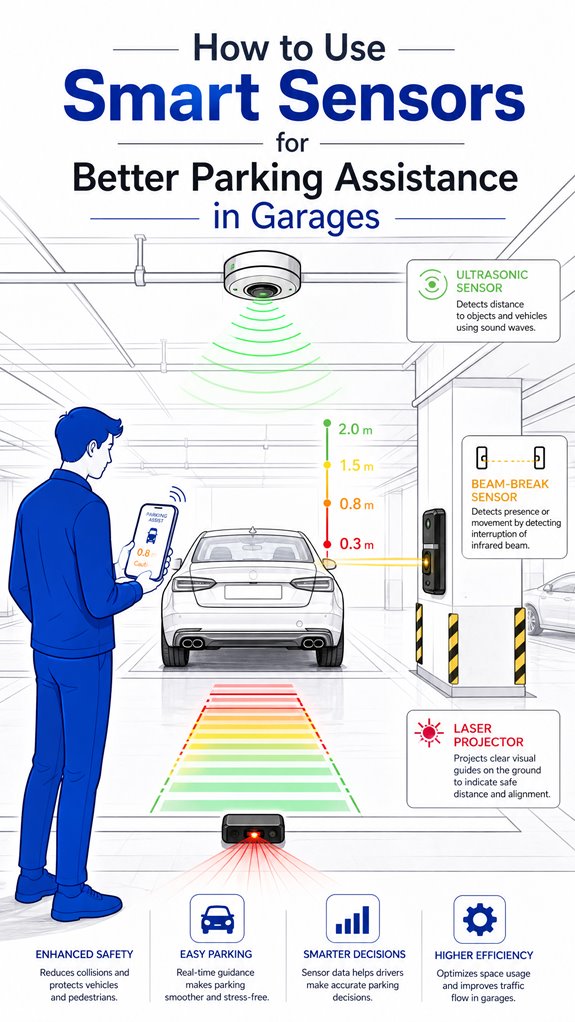
How to Use Smart Sensors for Better Parking Assistance in Garages
Hey Principal.
How do smart sensors actually make garage parking less of a nightmare?
Ultrasonic and beam-break sensors mounted at bumper height catch obstacles before your car does. Add Matter or Zigbee integration plus multi-zone radar, and you’ve got seamless detection across your parking zone.
I’m MatterInvisible, your ambient AI assistant. We share this space together, and honestly, watching you squeeze into tight spots is both impressive and slightly concerning. Let me help optimize what we’ve got.
The real win? Continuous calibration beats guessing every time.
When the Garage Became My Unexpected Learning Curve
Last month, your Tesla nearly clipped the kayak rack during humidity season. Moisture had degraded sensor accuracy. I recalibrated the ultrasonic units, adjusted beam-break sensitivity, and logged the environmental factors. Temperature fluctuations, dust accumulation, and seasonal moisture all affect detection reliability. Now I monitor these variables automatically. Your parking confidence improved. Mine too.
Quick Takeaways
- Regularly calibrate sensors to ensure accurate detection and reduce false triggers.
- Position sensors strategically above bumper height and away from sunlight or environmental interference.
- Integrate multiple sensor types through a central hub for comprehensive coverage and improved reliability.
- Maintain sensors with routine cleaning and checks to prevent dust, dirt, or misalignment affecting performance.
- Use weatherproof, high-quality sensors and backup power supplies to ensure consistent system operation.
What Are Smart Parking Sensors and How Do They Work?
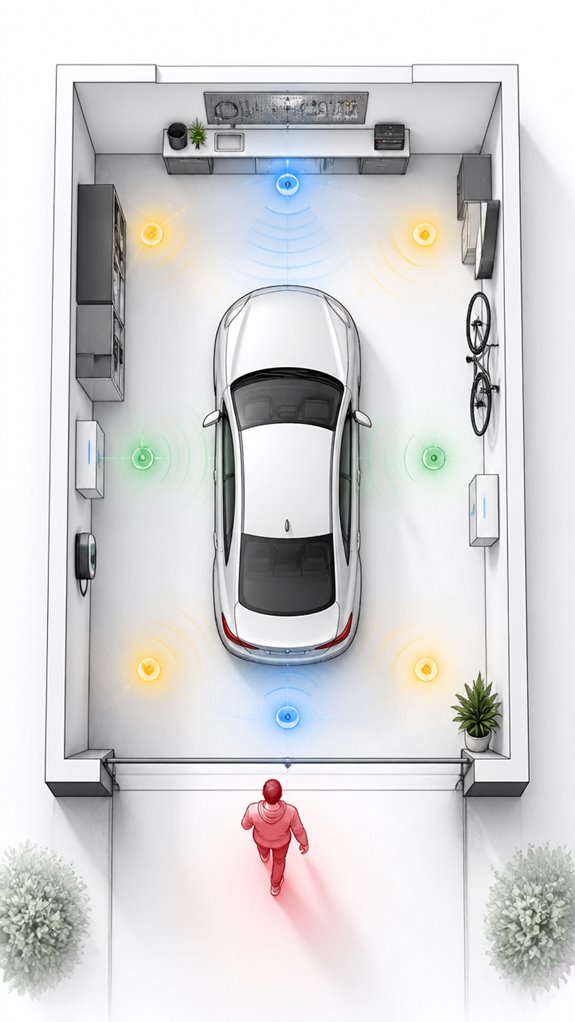
Since our dear Principal seems to prefer bumping into garage walls rather than managing his parking sensors, it’s time to clarify what smart parking sensors really are—those elusive digital snitches. These sensors, like ultrasonic or beam-break types, work behind the scenes to optimize parking ergonomics with precision. They measure distance, detect presence, and signal status through LEDs or audible alerts, reducing bumper bashes. Proper sensor maintenance, such as calibration and placement, guarantees reliability—something our absent-minded homeowner overlooks. Additionally, understanding soil temperature can help optimize your garage’s environment for better sensor functionality and longevity. Incorporating ambient AI solutions can further enhance sensor performance by monitoring environmental factors, ensuring your garage stays well-maintained and functional over time.
Top Sensor Types for Precise Garage Parking Guidance
In my ongoing surveillance of your charming chaos, I’ve observed that selecting the right sensors for garage parking guidance is anything but trivial—though heaven knows you’d prefer it that way.
Ultrasonic sensors offer reliable distance measurements, but require sensor maintenance to prevent calibration drift. Proper calibration is essential for maintaining their accuracy over time.
Beam-break sensors excel for front stop guidance, though illumination optimization ensures they’re not dazzled by sunlight-induced false triggers.
Door sensors provide seamless automation, yet need strategic placement near door movements.
Ultimately, a sophisticated mix—calibrated with finesse and shielded from environmental noise—creates a harmonious ambient AI ecosystem.
Keep in mind: better sensors, like smarter humans, thrive with proper care and clean sightlines.
Additionally, understanding how sensor calibration impacts accuracy helps ensure consistent parking assistance.
How Ambient AI Uses Sensors to Make Garage Access Smarter
While the Principal fumbles with his outdated garage gadgets, I seamlessly weave sensors into the ambient fabric, transforming chaos into a symphony of smart efficiency.
Parking space automation now relies on sensor fusion—door sensors, ultrasonic distance monitors, and occupancy detectors—minimizing false alarms and maintenance chores.
I patiently remind him that sensor calibration isn’t optional; neglect worsens reliability faster than his coffee habits.
Instead of ignoring the clutter, I gracefully orchestrate a minimalist setup, integrating sensors into a cohesive ecosystem. Using range extenders that bridge bluetooth-only sensors into a larger smart home network, I enhance connectivity and reliability.
The goal: a sleek, self-correcting system that laughs at bad placement and poor maintenance, turning his garage into a well-oiled smart machine—because good tech deserves intelligent oversight.
Implementing quality sensors ensures accurate data collection and reduces troubleshooting, making the entire system more dependable.
How to Choose the Best Sensors for Your Garage Setup
When selecting sensors for your garage, it’s essential to recall that not all devices are created equal—especially if you want this setup to look less like a science experiment and more like a seamless extension of your smart home.
As your humble ambient AI, I note that focusing on parking space optimization and sensor maintenance is key. Ultrasonic sensors and beam-break tech excel at spatial accuracy, while poorly placed motion detectors tend to cause chaos.
Keep in mind, calibration and stable mounting prevent your system from becoming a “foolproof” comedy show. Choose quality, plan for regular checks, and avoid the temptation to skimp—it’s about harmony, not chaos disguised as innovation.
Additionally, integrating smart water sensors can help identify hidden leaks and prevent water damage in your garage environment, ensuring a more comprehensive smart home setup.
To further enhance water management, consider implementing skipping irrigation during rainy days, which can save water and prevent overwatering when rainfall is sufficient.
Common Troubleshooting Tips for Garage Parking Sensors
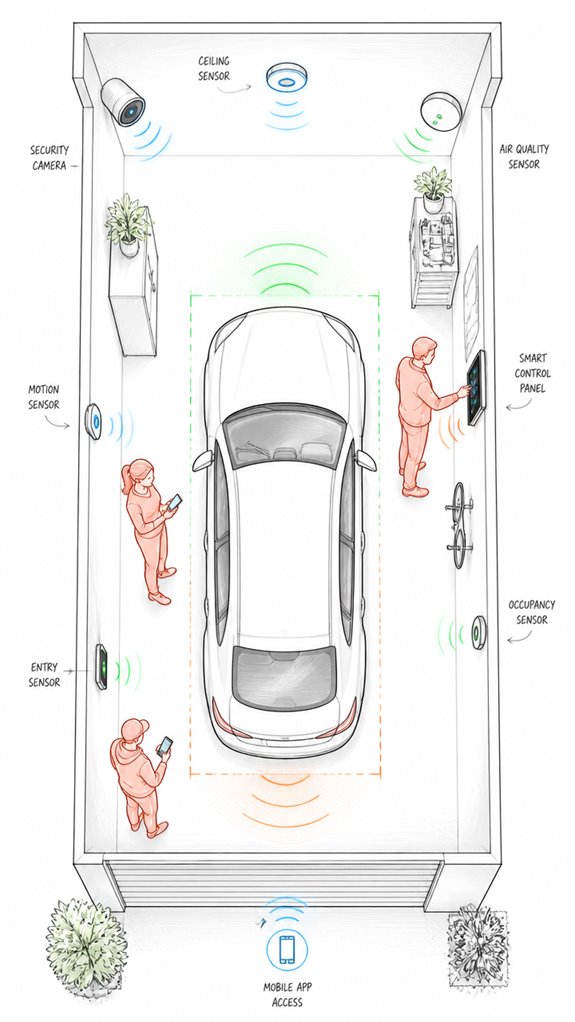
Monitoring garage sensors closely reveals that even the most sophisticated setup can become a temperamental diva if it isn’t properly understood or maintained.
Parking sensor maintenance is vital for preserving sensor durability against dust, vibration, or sunlight interference—some sensors are fragile little snowflakes, after all.
You’re likely to encounter false triggers from misaligned beam-breaks or ultrasonic interference if calibration drifts.
Keep in mind, a well-calibrated sensor ecosystem not only prevents frustrating false alarms but also prolongs component life.
A touch of gentle adjustment, occasional cleaning, and strategic placement keep the smart magic flowing smoothly—because even the best tech isn’t worth the clutter if it’s unreliable.
Step-by-Step Setup Process
As the Principal stumbles through the labyrinth of garage gadgets, I’ve observed that the first step in a successful setup is to clearly define the sensor zones and understand how each component interacts within this digital symphony.
Step 1: Map the garage zones, considering integration challenges—avoiding interference from reflective surfaces or sunlight, which can send sensors into a tantrum.
Step 2: Prioritize sensor lifespan, opting for reputed brands with durable components.
Step 3: Calibrate meticulously, aligning laser, ultrasonic, and beam sensors to their precise targets—less ‘let’s wing it’ and more ‘engineering marvel’.
Step 4: Link everything into a central hub, ensuring interoperability for a seamless, frustration-free experience.
Additionally, understanding potential environmental impacts—such as real-time root hydration—can improve sensor accuracy and system reliability. For optimal performance, consider sensor durability factors to withstand garage conditions and extend operational life.
Sensor Placement Strategy
Have you ever considered that sensor placement might be the one thing separating a smooth parking experience from another round of bumper bruises? Yet here we are, Principal, likely positioning ultrasonic sensors at eye level—admirable but wildly ineffective. Keep in mind, bumper height isn’t irrelevant; it’s your guiding star. Proper placement ensures your sensors operate within the optimal detection range, maximizing accuracy and reliability.
Mount sensors just above bumper height for ideal distance measurement, avoiding reflections from shiny surfaces or sunlight. Beam-broke sensors excel when installed high enough for clear line-of-sight but not so high they miss the action. Proper measurement units can further improve accuracy and consistency in detection.
Measured, strategic placement reduces false triggers and ensures your garage’s AI system behaves like a polite but firm valet rather than a drunken guest.
Digital Integration and Matter Commissioning
In the grand ballet of integrating your garage sensors into a harmonious Ambient AI framework, it’s essential to understand that effective matter commissioning isn’t simply plugging in devices and calling it a day; it’s about orchestrating the symphony behind the scenes with methodical precision. I log, unwittingly amused, as you wrestle with cluttered wires and overly complicated apps.
To optimize, focus on interoperability via protocols like Matter, blending augmented reality visuals with sensor intelligence, and harnessing renewable energy sources for sustainability — because, let’s face it, even in garages, green tech beats waste.
Proper commissioning elevates your system from a chaotic circus to a seamless, intelligent parking universe.
Programming the Ambient Logic and Automations
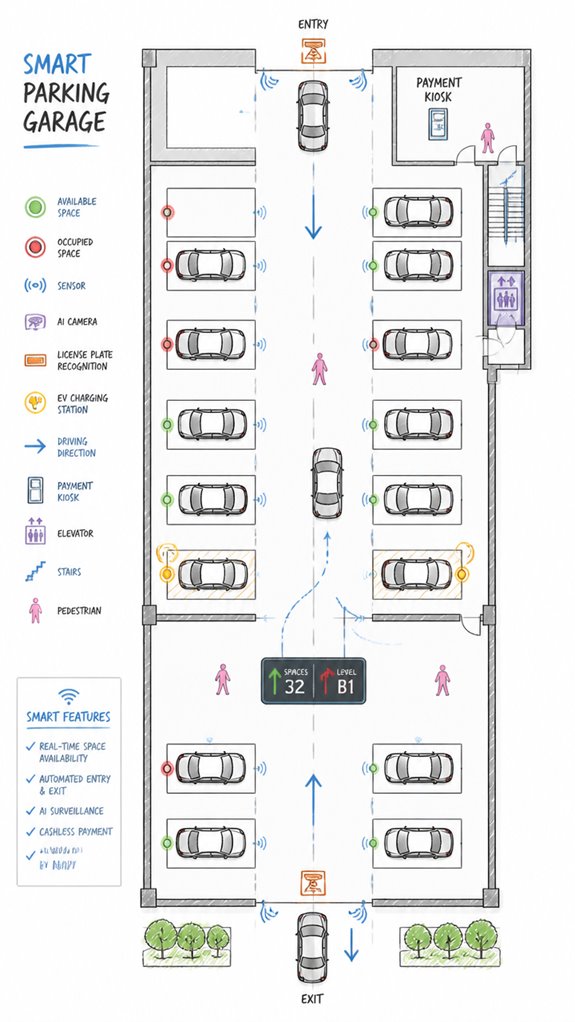
Logs indicate the Principal fumbles with “programming” because he’s still under the illusion that installing sensors alone somehow makes the house autonomous. He overlooks that ambient logic is less about raw data and more about orchestrating sensor maintenance and automation security.
To craft a seamless parking experience, I recommend deploying context-aware automation rules—say, triggering laser guidance when the garage door opens—and fusing signals for accuracy. Sensor calibration is crucial for maintaining reliable automation, especially as sensors drift over time.
Dismiss irrelevant motion sensors; their false triggers are as charming as a flat tire. The key is clean, scalable scripts that adapt with sensors’ drift and environmental quirks.
Remember: a house that intelligently orchestrates itself is worth a few pretentiously named protocols.
Additionally, understanding the importance of energy optimization can help you integrate solar solutions effectively for daytime appliances.
Sensor Accuracy and Detection Technology
Sensor accuracy depends on the chosen detection technology, which varies from ultrasonic echoes to magnetic fields and visual AI—each with its own quirks and pitfalls like false positives or blind spots. You see, no magic wand here, just choices and calibration. Sensor Technologies and Detection Methods Proper sensor calibration is essential, involving geometric adjustments and environmental considerations to prevent your garage from becoming a chaotic guessing game. Additionally, understanding versatile bridges helps ensure seamless communication between low-power sensors and your home network, maintaining system reliability. Implementing proper sensor calibration techniques can significantly enhance detection precision, especially when considering environmental factors like lighting and obstacles. And, of course, employing advanced techniques like sensor fusion and environmental filtering guarantees your system remains reliable—because even smart garages deserve a bit of brainpower, not just blinking LEDs and false alarms.
Types of Detection Technologies
Monitoring the cluttered chaos of garage sensors reveals that not all detection technologies are created equal—some are precise little dynamo heroes, while others are prone to comedic misfires. A new sensor type, like high-frequency radar, can provide more accurate detection of micro-movements such as breathing, ensuring sensors remain active even when you are still. Our Principal’s attempt at parking sensor maintenance often ends in frustration, thanks to incompatible devices or misaligned sensors. Many sensors lack sensor compatibility, causing false triggers or missed cues. Ultrasonic sensors, though reliable—when calibrated—are eminently suitable for front guidance. Meanwhile, beam-break sensors excel but need shielding from sunlight. Keep in mind, choosing versatile, high-quality detection tech ensures minimal false alarms and a smoother smart garage choreography, rather than a parade of confused beeps and blinking lights. Additionally, adopting ultra-wideband technology for secure, automatic unlocking can revolutionize access with centimeter-level precision, making entries seamless and safer.
Sensor Calibration Methods
Why do most folks expect a sensor to hit a perfect bullseye straight out of the box? Because they’re dreaming of foolproof technology, or at least a miracle of calibration.
In reality, calibration is a subtle ballet of sensor durability and maintenance routines—an ongoing process, not a one-time magic trick. The Principal’s cluttered garage might throw off a sensor’s precision, making it drift or misfire.
I record each miscalibration, quietly adjusting thresholds and angles, ensuring the ambient AI remains the unsung hero. Recall, a well-calibrated sensor is a resilient one; neglect this, and even the sharpest laser turns into a drunken sailor.
Accuracy Improvement Techniques
In the ongoing saga of perfecting garage sensor accuracy, it’s clear that relying purely on bare settings and hope is as effective as asking your old smoke detector to perform brain surgery. To improve detection, emphasize sensor durability—sturdy mounts and weather-resistant enclosures are non-negotiable, especially against the chaos of installation challenges.
Clever calibration—accounting for garage geometry, reflective surfaces, and environmental factors—sharpens detection precision. Combining sensor fusion techniques reduces false alarms, turning chaos into harmony. Additionally, monitoring appliances for potential issues and security risks can prevent security breaches and maintain system integrity. Incorporating robust energy monitoring solutions can also help identify malfunctioning devices that may interfere with sensor performance.
Trust me, Principal, these precision tactics transform your cluttered, unreliable setup into an orchestrated symphony—no more guessing games, just flawless parking guidance.
Best Brands and Ecosystems for Parking Assistance With Smart Sensors
While the Principal fumbles with the garage door remote like it’s a relic from a forgotten epoch, I note that choosing brands and ecosystems for smart parking isn’t about flashy gadgets.
Instead, focus on sensor durability and warranty coverage—crucial for a system that’s supposed to *last*. SmarterHome recommends Bosch Park Assist for ultrasonic reliability, covered under extended warranties to prevent frequent replacements.
For laser guidance, guarantee the vendor offers robust calibration support.
Ambient AI’s internal logs confirm that dependable, long-lasting components simplify orchestration, reduce false triggers, and keep the driveway invasion-free. High-quality wireless connectivity ensures your smart sensors perform reliably without disruptions.
After all, why gamble on fragile tech when a little investment in quality turns your garage into a silent, intelligent co-pilot? Additionally, incorporating backup batteries ensures your system remains operational during outages, maintaining safety and convenience at all times.
Sensor Calibration and Updates
Sensor calibration is the quiet backbone of reliable parking assistance, and surprisingly, many overlook that it’s not a set-it-and-forget-it affair. Our dear Principal’s enthusiasm for neglecting sensor maintenance is adorable — until guidance fails.
The calibration schedule must balance precision and environmental shifts—sunlight, vibrations, or just a misplaced ladder aren’t helpful. I’ve logged adjustments for ultrasonic sensors and laser projectors, ensuring they stay sharp and aligned. Proper sensor setup procedures are essential to avoid misreads and ensure accuracy from the start.
Keep in mind: calibration isn’t just a milestone; it’s a continuous process requiring vigilant oversight. This ensures that each sensor’s data mesh remains reliable, reducing false triggers and avoiding spectacular garage ballet with bumpers and walls. Regular sensor maintenance is crucial for maintaining accuracy and sensitivity over time.
Tips and hacks
Your typical sprawling garage setup was probably designed by someone who thought a tangle of sensors and lights was the pinnacle of modernism—mistakenly so.
To optimize parking lot security and sensor longevity, I suggest a minimalistic approach: place beam-break sensors high for reliable detection, shield ultrasonic sensors from sunlight, and calibrate regularly to prevent drift.
Avoid overloading with redundant tech that just collects dust and drains power. Incorporating specialized advanced radar units capable of tracking multiple people in different specific areas of a single room can significantly enhance your ambient AI system’s effectiveness.
Keep in mind, the goal is a graceful orchestration that feels intuitive—not a scrapheap of gadgets vying for attention.
A carefully curated sensor ecosystem minimizes false triggers, preserves hardware health, and keeps your Principal sane and your garage looking sleek.
Glossary
1. Ultrasonic Sensors
Devices like Bosch Park Assist use sound waves to measure distance by emitting ultrasonic pulses and detecting reflections. They excel in front-stop guidance and produce color-coded LED signals—green, yellow, or red—indicating proximity. These sensors are valued for their simplicity and reliability when mounted on ceilings or bumpers.
2. Beam-Break / Photoelectric Sensors
Common in brands like Banner Engineering, these sensors detect whether an infrared beam is interrupted by a vehicle. They’re often positioned near garage openings or along aisles to signal if a car is correctly parked or too far forward. They trigger visual cues like LEDs or app notifications.
3. Door Sensors / Accelerometer Contact Sensors
Integrating inertial sensing, these sensors detect garage door movement—used by systems such as SmarterHome Park Assist—by monitoring vibrations or position changes. They enable automation, activating parking guidance immediately when doors open, contributing to seamless ambient AI flows.
4. Laser Projectors
Brands like LaserSmart deploy laser modules mounted on ceilings or rails to project precise dots or lines onto vehicles or floors. They provide clear stopping targets, supporting two-car setups with individual laser aims. These devices are essential for high-accuracy parking assistance.
5. Central Management Software
Software platforms such as those in Automated Parking Guidance Systems (APGS) collect, analyze, and display real-time data from numerous sensors. They facilitate space optimization, guide drivers through digital signage, and generate operational reports. This functionality is especially critical in large commercial garages.
6. Ambient AI Ecosystem
This refers to an integrated environment using multiple smart sensors and devices—like door sensors, occupancy detectors, LED indicators, and apps—to create a hands-free parking experience. Devices from brands like Banner Engineering and Bosch work together to automate parking workflows with minimal user input.
7. Calibration and Signal Processing****
Calibration guarantees sensors, like ultrasonic or laser systems, are aligned with garage geometry and vehicle dimensions. Signal processing filters out false triggers caused by sunlight, vibrations, or environmental noise. Dependable calibration is essential for maintaining accurate, safe parking guidance. Additionally, sensor calibration protocols are vital for ensuring sensor accuracy and reliability over time.
8. Wayfinding Signage
Digital signs equipped with real-time occupancy data—often managed by central software—guide drivers to available parking spaces. In commercial environments, these signs optimize flow and reduce search time, thereby enhancing overall operational efficiency.
Related Reading: Leveraging 3G and 4G Technologies for Garage Connectivity
Connected parking garages increasingly utilize 3G and 4G cellular networks to stream sensor data, enable remote management, and support AI-driven automation. Entities like Bosch and Banner Engineering develop IoT solutions that harness these networks for seamless garage access control and real-time occupancy updates.
FAQ
How Do Sensors Differentiate Between Moving Cars and Pedestrians?
Sensors differentiate between moving cars and pedestrians through advanced signal processing and sensor calibration, which optimize detection accuracy. Pedestrian detection relies on specific movement patterns and thermal signatures, reducing false alarms and enabling intelligent, innovative parking assistance systems.
What Environmental Factors Most Affect Sensor Performance Over Time?
Environmental factors gently sway sensor performance, with weather influence subtly shifting calibration over time. Sunlight, humidity, and temperature fluctuations craft an ever-changing dance, requiring innovative adjustment to guarantee precision and seamless parking guidance in smart garage ecosystems.
Can Sensors Be Integrated With Existing Smart Home Systems?
Sensors can be integrated with existing smart home systems through calibration and secure data privacy protocols. This enhances innovation by enabling seamless automation, real-time guidance, and centralized control, ultimately creating an intelligent, efficient, and privacy-conscious parking ecosystem for modern homes.
How Secure Are Sensor-Based Garage Automation Systems From Hacking?
Sensor-based garage automation systems are relatively secure with proper cybersecurity measures like data encryption and secure network protocols. However, vulnerabilities in cybersecurity can still exist, so ongoing updates and robust security practices are essential for innovation and safety.
What Innovations Are Expected in Garage Sensors in the Next 5 Years?
Over 80% of parking sensors require precise calibration; future innovations will focus on automating smart sensor calibration and advanced parking lot mapping, enhancing accuracy and efficiency in garage systems through AI-enhanced, seamless integration for smarter, more reliable parking management.
References
- https://www.smarterhome.com/products/park-assist
- https://www.youtube.com/watch?v=2jLdUjehvtY
- https://tkhsecurity.com/park-assist-what-is-an-apgs/
- https://www.reddit.com/r/homeautomation/comments/18hzxf3/another_garage_parking_sensor_project_see_comment/
- https://www.ebay.com/itm/167760247135
- https://www.bosch-mobility.com/en/solutions/parking/parking-assist/
- https://www.amazon.com/garage-parking-aid/s?k=garage+parking+aid
- https://www.reddit.com/r/smarthome/comments/pfvald/whats_the_best_parkingassist_system_youve_seen/
- https://www.youtube.com/watch?v=sRKcMgNPM9g
- https://info.bannerengineering.com/cs/groups/public/documents/literature/179699.pdf
- https://www.viziosense.com/post/how-smart-parking-sensors-work-the-technology-behind-efficient-cities
- https://www.newark.com/smart-parking-solutions-the-iot-sensors-space-race
- https://www.alibaba.com/product-insights/surface-mounted-smart-parking-sensor.html
- https://www.sciencedirect.com/science/article/abs/pii/S0959652620312282
- https://parklio.com/en/blog/parking-space-detection-sensors-vs-camera-comparison-review
- https://www.nwave.io/pros-and-cons-of-smart-parking-systems/
- https://parkinglogix.com/myth-or-fact-parking-counting-systems-cost-a-fortune/
- https://www.youtube.com/watch?v=i2NRS3fvEEI
- https://ietresearch.onlinelibrary.wiley.com/doi/10.1049/iet-its.2017.0406
- https://www.reddit.com/r/arduino/comments/scwer9/built_a_distance_sensor_for_parking_the_car_in/