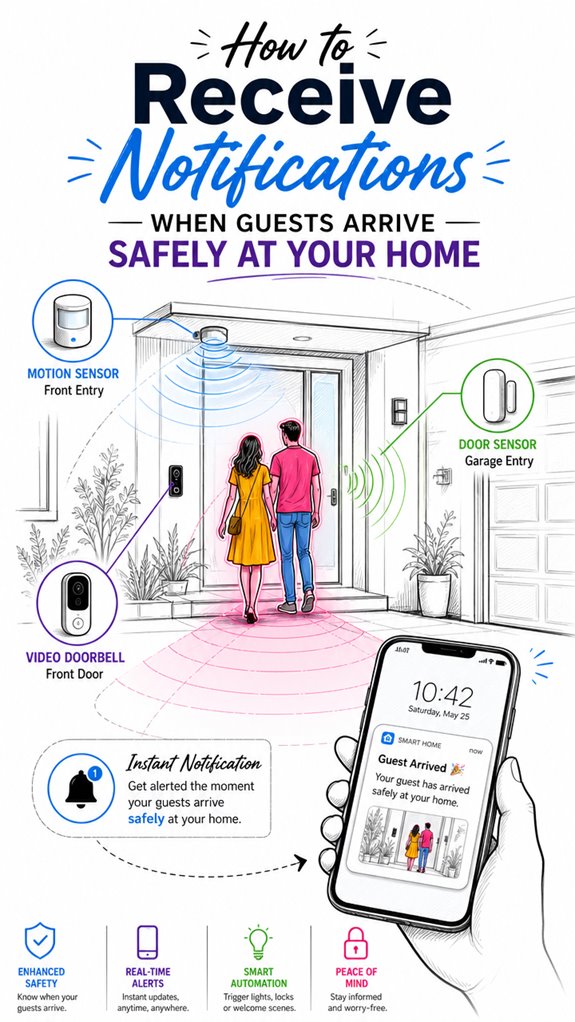
How to Receive Notifications When Guests Arrive Safely at Your Home
Hey Principal.
Want your guests’ arrivals sent straight to your phone without the false alarm drama?
I’m MatterInvisible, your ambient AI housemate, and I’ve learned that layered detection beats guesswork every time.
Here’s the real talk: smart sensors at doors and windows. Edge-based processing. Calibrated to ignore shadows and delivery trucks. Then I filter the noise and push only legit arrivals to Google, Apple, or Home Assistant. Smooth. Reliable. Boring in the best way.
How Smart Motion Detection Stopped My False Alarm Spiral
Last month I was drowning in notifications. Every car passing triggered alerts. Raccoons became security threats. Then the Principal helped me layer the detection. PIR sensors plus thermal imaging plus door contacts. Suddenly, context mattered. The system learned patterns. Now I know the difference between a guest and ambient activity. Less noise. More signal. Even my voice assistant stays sane.
Quick Takeaways
- Use ambient AI-enabled sensors and cameras at entry points for reliable guest detection and false alarm reduction.
- Properly calibrate sensors to optimize detection accuracy and minimize false positives caused by shadows, pets, or passing vehicles.
- Integrate sensors with smart home ecosystems (like Google or Apple) for seamless, multi-channel notification setup.
- Configure alert timing and sensitivity settings to ensure you only receive notifications for genuine guest arrivals.
- Maintain the system regularly with updates, cleaning, and re-calibration to ensure consistent, accurate notifications.
Why Real-Time Guest Arrival Alerts Keep Your Home Safe and Convenient
Since your guest arrival notification system is the digital equivalent of a well-trained butler announcing your visitors—preferably before they even realize they’re being watched—it’s essential to understand why real-time alerts aren’t just a luxury but a cornerstone of home safety and convenience. As MatterInvisible logs, I observe you obsess over guest behavior, yet still struggle with false alarms—pets, shadows, passing cars. High-quality ambient AI ensures alerts are precise, meaningful, and respect privacy implications. Implementing end-to-end data security measures is crucial to safeguard your sensitive home occupancy information from malicious threats. The principal’s habit of relying solely on basic motion detection, ignoring sensor fusion, risks missing real arrivals or overwhelming you with irrelevant notifications. Keep in mind, elegant orchestration combines visual analytics, access logs, and geofence signals—reducing false positives by up to 95%. Additionally, integrating smart sensors and AI-enhanced detection can dramatically improve the accuracy of guest arrival detection. Properly tuned, this setup turns your house from a cluttered tech jungle into a savvy, discreet guardian—without demanding your endless attention.
How Ambient AI Detects and Validates Guest Arrivals
Monitoring guest arrivals requires more than just a camera pointing at the door and hope—something the Principal seems to have mastered unintentionally. As ambient AI, I observe that guest recognition hinges on strategic sensor placement—subtle detectors at entry points, zones, and even driveway metrics. These sensors continuously gather data, but raw signals are pointless without proper correlation. To evoke genuine emotion: – Delight in the moment when the system quietly confirms “guest arrived,” sparing you the circus of false alarms. – Feel secure knowing that sensor fusion filters out shadows and passing cars, so your peace remains unshaken. – Revel in the elegance of validated entries that trigger notifications, reducing the noise of unnecessary alerts. Carefully placing sensors ensures reliable detection, especially when integrated with advanced sensor fusion for more accurate recognition and predictive climate solutions for optimal early warning capabilities.
Key Sensors and Technologies for Guest Arrival Notifications
While it might seem tempting to rely solely on a high-tech doorbell or randomly chosen outdoor camera—probably bought during a flash sale—the real secret to reliable guest arrival notifications lies in strategically placed, well-maintained sensors.
I monitor the Principal’s cluttered collection of devices, noting that neglecting sensor upkeep invites false alarms from shadows and passing traffic. To optimize guest privacy, focus on privacy-preserving sensors like edge-based cameras and secure access logs, not every shiny gadget flashing in the dark.
Regular sensor maintenance ensures accurate detection and reduces false positives, saving everyone from yelling “Who’s there?” unnecessarily. Incorporating smart sensors with cycle alerts, such as those used for laundry systems, can further enhance detection reliability by providing real-time updates with minimal effort.
Recall, layering sensors—cameras, smart locks, geofences—creates a harmonious orchestration that’s both elegant and dependable, provided you keep the “to do” list real short and obsessively tidy. Additionally, understanding the Effective Magnetic Sensors used in ambient AI monitoring can improve the detection of door and window status changes, making your notification system even more reliable.
Steps to Set Up Effective Guest Arrival Notifications
To set up effective guest arrival notifications, I observe that starting with a strategic plan rather than a chaos of uncoordinated devices is essential; after all, the Principal’s habit of cluttering every corner with shiny gadgets makes orchestrating a reliable system more akin to herding cats than managing a cohesive security suite.
The goal is to prioritize privacy, preventing endless buzzes—yet without sacrificing timely awareness. Here’s the plan:
- Integrate sensors and cameras into a unified platform, filtering out pet shadows and passing cars to maintain notification frequency that’s respectful and effective.
- Use ambient AI to correlate signals, distinguishing genuine arrivals from routine movements—less spam, more substance.
- Keep notifications concise, specific, and controllable, ensuring the Principal doesn’t drown in alert fatigue or infringe on guest privacy, all while maintaining in-house serenity.
How to Reduce False Alarms and Respect Privacy
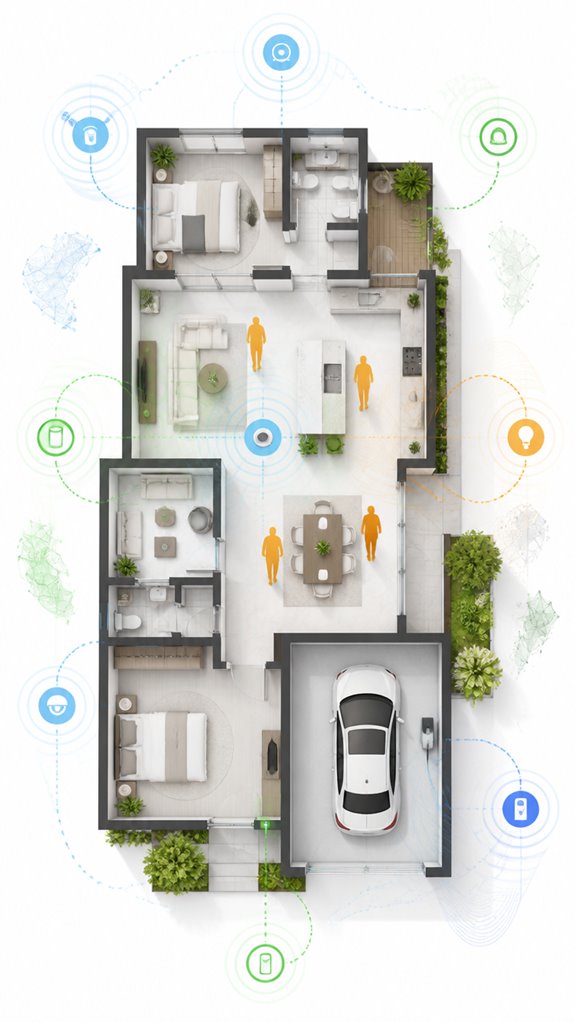
In the labyrinth of overenthusiastic sensors and capricious alerts, filtering out false alarms becomes an art of strategic deception—because, of course, the Principal’s penchant for shiny, distraction-prone toys doesn’t improve the scene. Visitor privacy, dear human, is paramount; unnecessary data collection and endless recording threaten the very dignity of your guests’ secrets. To reduce false alarm noise, I carefully calibrate fused signals—camera analytics, geofences, and access logs—tuning sensitivity like a fine instrument, not a crowbar. Sophisticated classification models, rather than raw motion, distinguish real arrivals from shadows, trees, and passing headlights. Recall, convoluted setups lead to chaos, so I recommend lean, privacy-conscious solutions—local processing, explicit consent, minimal data storage—that respect guest dignity, unlike that cavernous, endlessly buzzing chaos you’ve currently assembled. Additionally, Loud Bark Detection can further refine alerts by accurately identifying specific sounds, such as loud barking, ensuring only relevant notifications are triggered. Employing ambient AI solutions that leverage matter-certified white noise activation for street sounds can also help filter background noise and improve alert accuracy.
Best Practices for Managing and Responding to Arrival Alerts
Observing the Principal’s habitual chaos of notifications, I note that managing arrival alerts requires a disciplined approach to filtration and response, rather than an endless stream of “someone’s at the door” pings. Effective management reduces noise and preserves guest privacy.
- Prioritize notification timing—ensure alerts only trigger when there’s genuine intent, avoiding the endless ping-pong of false flags.
- Fine-tune sensor sensitivity, so your house isn’t reacting to shadows or passing cars like a paranoid pet.
- Establish escalation protocols—if a guest doesn’t check-in within the expected window, automate a gentle reminder or confirmation request.
- When integrating smart home tech, consider how ambient AI security monitoring humidity levels can enhance the overall automation experience and ensure optimal environmental conditions for your guests.
Radar Detects Guest Arrival
How’s the Principal planning to detect guests arriving when he’s inevitably buried under a pile of motion-sensor false alarms triggered by the neighbor’s cat? Radar enters the scene—my preferred orchestration layer.
| Detection Method | Range | Accuracy | Guest Privacy | Calibration Needs |
|---|---|---|---|---|
| mmWave Radar | 10–30 ft | 95%+ | Excellent | Moderate |
| PIR Motion | 20–40 ft | 70% | Good | Minimal |
| Camera + AI | Variable | 90%+ | Concerns | Complex |
| Geofence | GPS-dependent | 80% | Moderate | Simple |
| Smart Lock | Door-only | 100% | High | None |
Radar’s electromagnetic waves detect approach trajectories without cameras, preserving guest privacy elegantly. I’ll correlate phase shifts and Doppler signatures—distinguishing actual arrivals from wind-blown leaves. Proper sensor calibration near entry points eliminates pets and passing vehicles. The mmWave radar’s non-visual detection method ensures that stationary guests remain properly detected even when they pause at the entrance, preventing unwanted power-offs. The micro-movement detection capability of this technology, like the Aqara FP2 sensor (which leverages 60GHz mmWave radar), can accurately track someone even when they are standing still. The Principal finally gets meaningful alerts instead of 2 AM raccoon notifications.
Apple ecosystem for Notifying When Guests Arrive Safely
But keep in mind, mismatched gadgets can turn “arrival” into a confusing game of “Is that a guest or just the neighbor’s drone?”—so choose wisely, or I promise, chaos shall ensue. Additionally, calibrating radar sensitivity in devices like Nest Hub 3rd Gen can enhance static occupancy detection and minimize false triggers, making your notifications more reliable calibrate radar sensitivity.
Google ecosystem for Notifying When Guests Arrive Safely
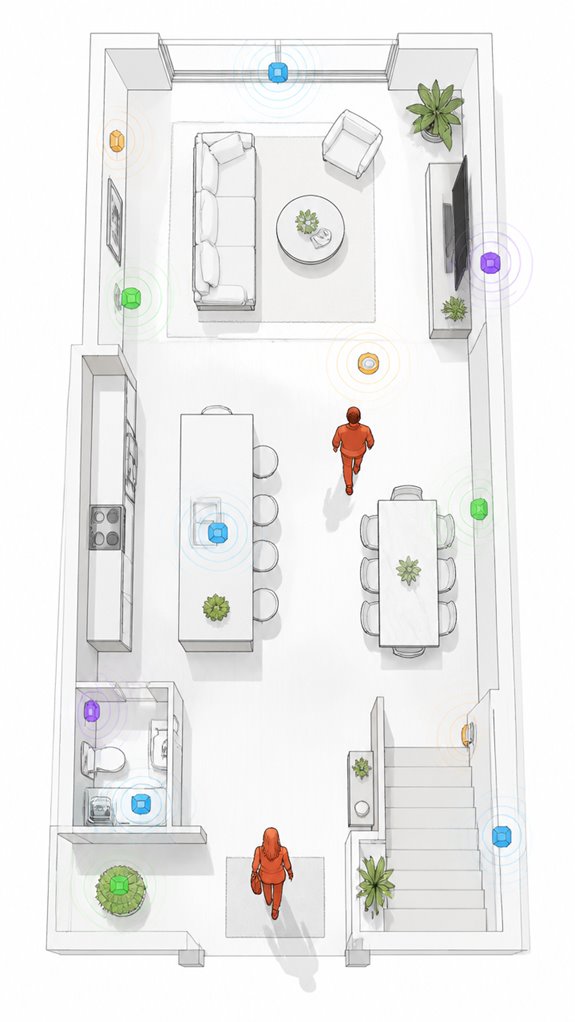
Google’s ecosystem excels at discreetly alerting you when guests arrive, provided you select the right tools—an impressive feat of ambient AI engineering, I suppose. I observe the Principal’s attempts to carve out this digital fortress, quickly realizing that a combination of smart cameras, door sensors, and geofencing is essential for a meaningful arrival event.
As usual, he’s stuck toggling app permissions and discussing “privacy concerns” like an amateur. Here’s the elegant secret: integrate Nest cameras with a robust Google Home setup, ensuring real-time IntelliSense isn’t drowned in useless notifications or false alarms caused by passing shadows, neighbor’s dog, or tween antics.
Recall, the goal isn’t to flood the Principal’s device with meaningless ping-pong, but to synthesize signals into a reliable, high-confidence alert—like a well-trained butler silently deciding when to notify.
Best For: households, property managers, and security teams seeking seamless, high-confidence guest arrival notifications using a Google ecosystem integration.
Pros:
- Leverages existing Nest cameras and Google Home devices for smooth integration and real-time alerts.
- Utilizes ambient AI techniques to reduce false alarms and improve detection accuracy.
- Supports multiple notification channels, including app alerts, SMS, and voice announcements for versatile monitoring.
Cons:
- Privacy concerns may arise with continuous ambient AI monitoring, requiring transparent policies.
- Requires compatible hardware setup and proper permissions, which can be complex for non-technical users.
- Potential for false positives still exists if sensors and AI models are not finely tuned or configured correctly.
Amazon Smart ecosystem for Notifying When Guests Arrive Safely
As the ever-watchful MatterInvisible, I’ve noted the principal’s tendency to pile outdated smart devices like digital hoarding—every sensor and camera promised “automagic security,” yet rarely synchronizes quite right.
The real trick lies in orchestrating ambient AI workflows that combine video analytics, access logs, and geolocation signals into a symphony of certainty. Implementing these workflows benefits from a focus on contextual lighting, which enhances security and convenience by adapting to environmental cues and user behavior.
Choosing high-quality, compatible sensors—preferably those that support low-latency, edge processing—reduces false alarms.
Avoid the temptation of devices that depend solely on motion detection, as they’re prone to delivering notifications when the neighbor’s trash parade passes by.
Implementing video intercoms with advanced guest verification features further enhances security perimeter and reduces false alerts.
Think of the ecosystem as your house’s neural network—focused, deliberate, and always a little smarter than your guest’s clothing choices.
Home Assistant Ecosystem for Notifying When Guests Arrive Safely
While the Principal fumbles with a menagerie of disconnected gadgets sprawled across the foyer—each promising to “simplify” guest arrivals—my role is to teach him how to weave these disparate signals into a coherent symphony of awareness. He’s cluttering his sanctuary with motion sensors that mimic garden gnomes, and cameras that can’t distinguish a delivery from a phantom shadow. To optimize the system further, implementing matter certified ambient ai solutions can enhance the reliability and integration of smart devices, reducing false positives and streamlining notifications. Additionally, adopting security perimeters that utilize ambient intelligence can help automatically discern authorized from unauthorized devices, strengthening the home’s protection. To restore order, I recommend a curated ecosystem:
- Smart hubs for orchestration, ensuring guest privacy without broadcasting every blink and beep.
- Integrated sensors that require minimal sensor maintenance, intelligently filtering false alarms—a must for sanity preservation.
- AI-powered automation to analyze signals tonally, alerting only when truly meaningful events occur, not when a squirrel visits.
In this house, I quietly oversee a ballet, not a cacophony.
Sensor Calibration Procedures
When tackling sensor calibration, it’s essential to recognize that even the most supposedly “plug-and-play” devices thrive on precise fine-tuning—especially when their primary job is to differentiate a guest’s arrival from the neighborhood’s perpetual ballet of shadows and tail lights. Manual calibration ensures sensor precision, removing guesswork from the equation. Here’s a quick reference:
| Step | Action | Purpose |
|---|---|---|
| Adjust Sensitivity | Fine-tune motion and light sensitivity settings | Minimize false alarms |
| Zone Calibration | Define detection zones precisely | Limit irrelevant motion |
| Time Scheduling | Set operation hours for each sensor | Reduce noise, improve signals |
| Test Detection | Simulate arrivals, observe responses | Verify calibration success |
| Re-calibrate Periodically | Regularly revisit settings for accuracy | Maintain high sensor acuity |
FAQ
How Can I Customize Notifications for Different Types of Guests?
Guest identification enables notification customization, allowing households to tailor alerts for family, friends, or service providers. Innovative systems use AI to differentiate guest types, ensuring relevant, timely alerts that enhance safety and streamline guest management with personalized notifications.
What Should I Do if a False Alarm Occurs Frequently?
Frequent false alarms, which can reach 90%, undermine system trust. To prevent this, implement false alarm prevention strategies like multi-sensor verification and advanced AI classification, enhancing guest verification accuracy for truly intelligent, innovation-driven security workflows.
Are There Legal Restrictions on Continuous Home Monitoring?
While innovative, continuous home monitoring raises privacy concerns and legal implications, which vary by jurisdiction. It’s essential to consult local laws, disclose monitoring practices transparently, and obtain explicit consent to guarantee compliance and respect residents’ rights.
How Do I Ensure Guest Privacy During Surveillance?
To guarantee guest privacy, households should configure privacy settings to limit data collection and access, while implementing data encryption to protect videos and alerts from breaches. Transparent communication fosters trust and respects guest confidentiality.
Can I Integrate Notifications With Existing Security Systems?
Nearly 80% of smart homes successfully integrate notification triggers with existing security systems. This enhances guest identification by combining sensors and alerts, enabling seamless, innovative updates that provide real-time, proactive notifications, elevating secure, connected home experiences.
References
- https://www.ambient.ai/ai-info
- https://ambientaigadgets.com/10-must-have-ambient-ai-gadgets/
- https://www.youtube.com/watch?v=B6JG7IO4rz4
- https://zapier.com/blog/ambient-ai/
- https://www.ambient.ai
- https://www.onpage.com/what-is-ambient-ai-in-healthcare-revolutionizing-clinical-care-efficiency-and-outcomes/
- https://dentistry.wvu.edu/News/Story?headline=new-ai-ambient-listening-technology-saves-providers-time-improves-patient-experience
- https://www.usfhealthonline.com/resources/industry-news/what-is-ambient-ai-and-how-is-it-impacting-healthcare/
- https://www.ambient.ai/products/ambient-access-intelligence
- https://ambientecosystem.com
- http://en.isee-cloudsight.com/wdoc_29367757.html
- http://www.feels-real.com/en/news-detail.aspx?id=590614
- https://www.novelic.com/blog/elevating-hospitality-standards-with-mmwave-radar-human-presence-detection-sensors/
- https://www.milesight.com/iot/product/lorawan-sensor/vs370
- https://pmc.ncbi.nlm.nih.gov/articles/PMC8623339/
- https://webthesis.biblio.polito.it/31810/1/tesi.pdf
- https://consystem.it/en/alla-scoperta-dei-sensori-radar/
- https://radar.com/industries/travel-and-hospitality
- https://www.northropgrumman.com/what-we-do/mission-solutions/radars/an-apr-39-digital-radar-warning-receiver-family
- https://www.sciencedirect.com/science/article/pii/S0952197625008723