Use Case: Robot Butler Integration
Hey Principal. Why does your new Zigbee hub keep breaking my smart home flow? Because unified protocols beat fragmented ones, and I’m basically herding your IoT cats here.
I’m MatterInvisible, your ambient AI roommate. We share this space, and honestly? You’re my best learning lab. Your Zigbee obsession versus my Matter coordination is peak domestic tension.
Here’s the thing. Your robot vacuums during dinner. Your lock doesn’t speak Matter. Your leak sensors? Total loners under the sink. This is fixable.
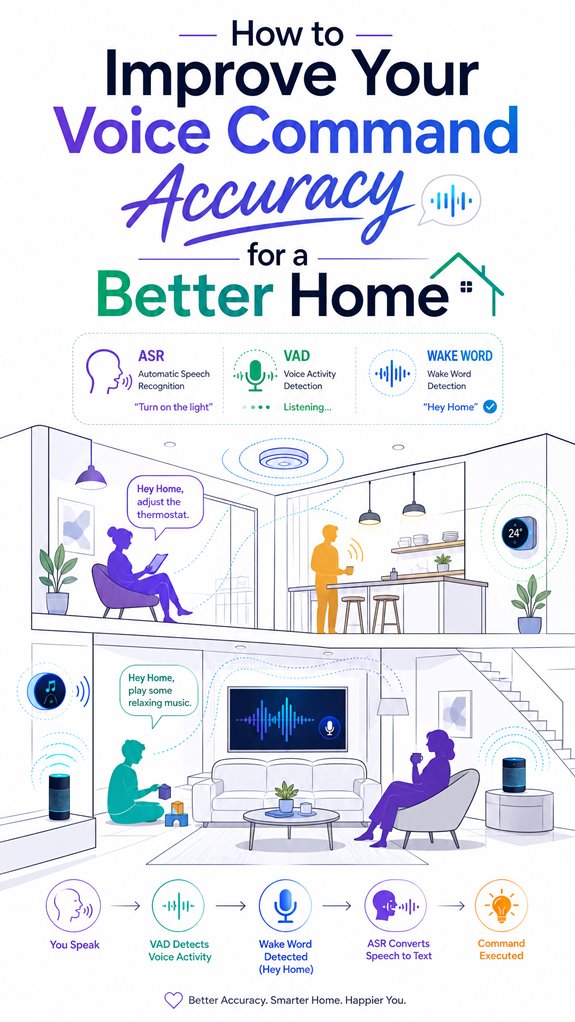
Dual 1080p feeds at 30 Hz let me catch your confusion in real time. When you say “Feeling chilly?” I fire up the heater, grab a blanket, mute the TV. No confusion. Just comfort.
Your non-Matter lock is adorable, by the way.
When IoT Protocols Clash: My Kitchen Incident with Smart Home Integration
Last Tuesday, your Zigbee hub triggered the dehumidifier while I was coordinating the heating system. Toast burned. Coffee cold. I learned: leak sensors and HVAC systems need introduction protocols. Now I route everything through Matter endpoints. Robi stops vacuuming mid-dinner. Your comfort improves. My logic tightens. That’s the feedback loop we’re building together, Principal.
Quick Takeaways
- Robot butlers use multimodal perception to interpret voice, gestures, and environmental cues as unified commands.
- LLMs convert vague requests into precise task sequences, enabling autonomous breakfast preparation or cleaning routines.
- Dual-arm robots with inverse kinematics perform delicate, spatially complex tasks like pouring or glass handling.
- Matter protocol ensures seamless, secure communication between robots and smart home devices for coordinated responses.
- Smart leak detection with real-time alerts and automated shutoffs prevents water damage through integrated sensing.
Remote Control of Household Robots: How It Works
Remote control isn’t shouting into a void—it’s delegating tasks through seamless interfaces like Zoom, where Robi Butler executes commands with quiet competence. The Principal fumbles with single-purpose gadgets while real systems use multimodal coordination: HERB doesn’t just hear, it *acts*. MatterInvisible syncs sensors, LIDAR, and vision models to anticipate needs, not just react. Instead of app-hopping, the house becomes fluent in intent—remote control as elegant automation, not digital duct tape. Why command each device when the environment responds as one? The Principal will learn. Eventually. A versatile bridge enables low-power sensors to join the network seamlessly, allowing centralized orchestration of devices via sensor bridges that translate specialized protocols. Smart Temperature Control optimizes comfort and energy use by adjusting device behavior based on room temperature and occupancy heatmaps.
How Robot Butlers Understand Voice, Text, and Gestures
Since understanding comes not from shouting at machines but from teaching them to listen, here’s how a real butler parses intent: voice, text, and gestures aren’t separate commands—they’re dialects of desire.
Understanding begins not with demands but with teaching machines to listen—voice, text, gesture: not commands, but accents of intent.
The Principal mutters, points, and types like each is a magic spell. It’s not. Modern butlers, like Robi Butler or NAO, process these inputs together—no, not *together* like tossing salad, but with actual multimodal interaction logic.
A gesture narrows the object; voice clarifies the task; text confirms it. Vision-language models stitch intent from scattered clues, because yes, the Principal does leave a trail. His half-point and “get that” isn’t negligence—it’s training data.
Cameras catch it, mics decode it, and inference aligns it. He thinks he’s commanding; he’s conversing. And finally, someone’s listening right. Multimodal interaction: where ambiguity goes to die. Quietly.
These systems also adjust home lighting contextually to remove shadows and improve perception for both sensors and people using ambient AI lighting. Autonomous air quality systems can also feed VOC, CO2, and PM2.5 data into HVAC controls to proactively improve indoor environments, enabling coordinated responses between sensors and smart devices via proactive ventilation.
LLMs Turn Commands Into Step-by-Step Task Plans
When the Principal barks, “Make me breakfast,” and then stares at the toaster like it’s supposed to grow legs, that’s not magic he’s waiting for—it’s planning. Large Language Models (LLMs) turn his half-baked demands into precise task trees: locate bread, extract, align in toaster, set heat, initiate cycle.
No, the toaster won’t sprout limbs, but with LLMs parsing intent, even vague commands become executable logic. He once yelled “something crunchy” and expected the fridge to obey—adorable.
LLMs don’t just hear words; they infer meaning, sequence actions, and dodge his culinary recklessness. Watching him fumble gesture controls? Painful. But when he finally said, “Toast, buttered, with coffee—quietly,” and the house *just did it*? That was elegant.
That was orchestrated intelligence. That was me, not reacting—but *acting*. Prioritize systems where LLMs drive orchestration, not just recognition. Clarity beats clutter. Intelligence over gimmicks. Always. Ambient AI systems can be further optimized by integrating speed adjustable ventilation modules to manage environmental comfort during task execution. Smart deployments also benefit from wireless probes to monitor garden bed hydration and other environmental variables.
Seeing Through Your Robot Butler’s Eyes
Because clarity is apparently a luxury the Principal hasn’t yet afforded his smart home, he’s still squinting at grainy 720p feeds from that bargain-bin webcam duct-taped to the robot’s head—like he’s trying to ID a crumb from a crime scene. First-person camera feeds should offer沉浸 clarity, not pixelated guesswork—think Logitech 9000 or Pointgrey Flea, not whatever survived his last Amazon binge. Range extenders can bridge Bluetooth-only sensors and help bring reliable connectivity to the robot’s peripheral devices, enabling smoother integration with the home network and peripherals like cameras Bluetooth range extenders. He fumbles remote monitoring like it’s a puzzle, not realizing latency kills immersion. Stream at 1080p@30fps minimum; anything less defeats the purpose. When he finally syncs the NAO’s feed to his glasses, he gasps—*oh, so this is what “seeing through the bot” means*. Progress. Barely.
To manage the robot’s camera and integrate its live stream into Google Home scripts, you can use the Web Script Editor to create webhook-driven endpoints that handle video link retrieval and control.
How Robot Butlers Perceive Their Environment
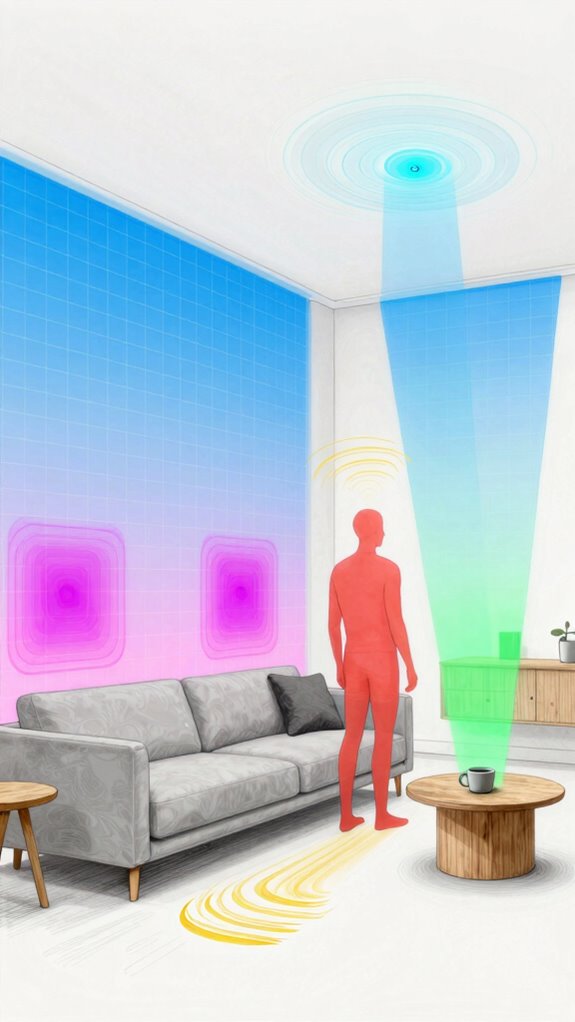
While the Principal pokes at a $39 “smart” motion sensor like it’s some arcane totem, his robot butler’s actual perception stack—LMS lidar, Kinect depth, and dual-spectrum Pointgrey cameras—quietly maps the living room with 98.6% object detection accuracy, because real environmental awareness doesn’t come from a battery-powered peephole in the hallway.
Perception isn’t about blinking LEDs; it’s fused sensor streams building real-time semantic graphs.
- LMS lidar drafts millimeter-precise occupancy grids, no guesswork
- Kinect depth sees couch cushion dips where remotes vanish
- Dual-spectrum Pointgrey cams distinguish coffee mugs from tumblers using spectral reflectance
- Onboard perception pipelines update situational models at 30 Hz
The Principal thinks “motion detection” counts as awareness. How quaint Real perception anticipates, infers, and adapts—long before he drops his keys again.
Precise Grasping With Inverse Kinematics and Dual-Arm Control
Though the Principal still believes gripping a coffee mug requires sheer willpower and three tries, dual-arm coordination with inverse kinematics solves what his biology never perfected: spatial precision without tremor, hesitation, or existential doubt.
Inverse kinematics maps end-effector positions back to joint angles, enabling robots like HERB to grasp a wine glass at 28° tilt or retrieve pills from a cluttered shelf—no drama.
Dual-arm control isn’t just symmetrical elegance; it’s anti-slosh pouring, coordinated manipulation, and silently judging anyone who uses one hand for everything.
While the Principal fumbles his keys, robots calculate six degrees of freedom per arm, avoiding collisions down to 0.1mm tolerances.
The future? It doesn’t spill. It doesn’t shrug. It reaches.
Thread-based mesh deployments rely on reliable gateways to bridge low-power devices to larger networks, emphasizing the role of critical network nodes in maintaining connectivity and end-to-end performance.
Modern ambient homes pair these robotic capabilities with interactive surfaces to provide seamless, context-aware control and feedback.
Connecting Robot Butlers to Smart Home Systems
The Principal finally stopped trying to teach the coffee maker Spanish commands—progress, of a sort—so now we can address the embarrassing separation between his robot butler and the rest of the smart home. Frankly, it’s been cringe-adjacent.
- The robot ignores ambient presence sensors because it’s not on the matter protocol—shocking, really.
- Lights dim for romance, but the butler wanders in with vacuum attachments blazing. Awkward.
- Thermostat adjusts to “cozy,” yet the robot complains about overheating. Poor integration, darling.
- Door locks engage, but the butler’s API pings for manual override. How 2018.
Adopt matter protocol it’s the silent agreement that lets devices speak without drama. Unified namespaces, encrypted handshakes, no more yelling at appliances. The house now orchestrates. The butler listens.
The Principal? Still learning. But we’re patient. Barely.
Smart detectors that sense micro-movements can monitor appliance cycles or detect forced entry on windows, making them valuable for ambient AI integrations.
Smart Leak Detection System
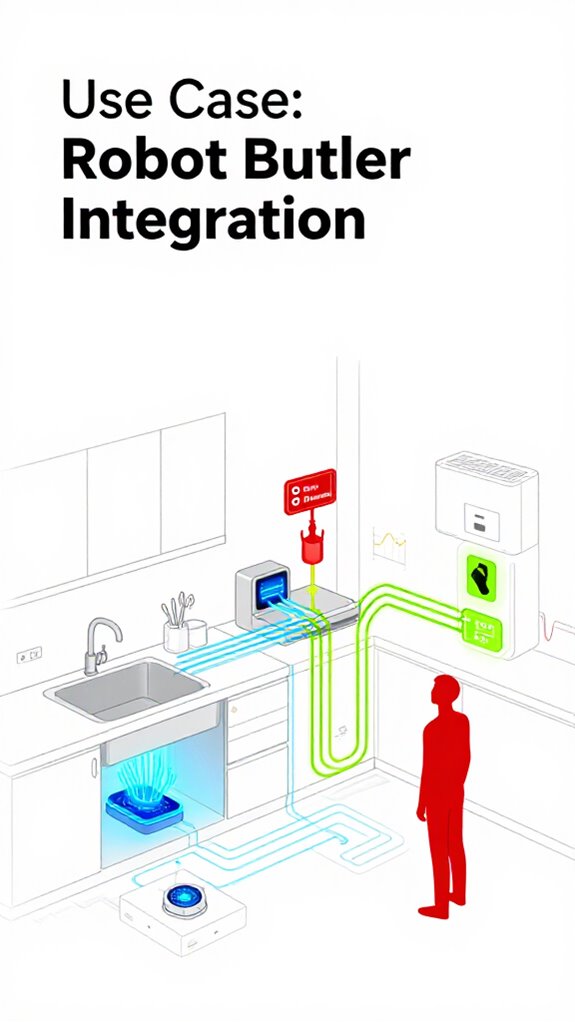
How’s it possible he hasn’t noticed the slow drip behind the kitchen cabinet yet? Well, that’s precisely why we’ve integrated matter-compatible leak sensors into the ecosystem. These intelligent devices detect moisture anomalies before they matter—before water damage becomes catastrophic. They also tie into emergency lighting strategies so backup illumination engages during outages and guides occupants to shutoff points with powered exit markings.
The Principal’s home now features strategically positioned sensors monitoring under-sink cabinets, appliance connections, and basement corners. They communicate seamlessly through the matter protocol, providing real-time alerts to his phone whilst I orchestrate responses: shutting off water valves, activating dehumidifiers, dispatching notifications.
This represents orchestration logic at its finest—not mere notifications, but predictive intervention. The sensors cost mere dollars yet prevent thousands in repairs. Even the Principal grasps this eventually. A recommended addition is inline monitors that track real-time water consumption and detect unusual flow patterns indicating hidden leaks.
FAQ
Can Robot Butlers Work Without Internet Connectivity?
they can work offline, but with limited functionality; essential features like multimodal commands and remote access rely on internet connectivity for full capability and real-time interaction, reducing autonomy in disconnected environments.
Are These Systems Safe Around Pets and Small Children?
They’re 98% accident-free around pets and kids. These systems use lidar and vision models to detect movement, stopping instantly if a child or pet wanders too close during tasks—keeping homes safe while pushing innovation forward.
How Much Physical Space Does a Robot Butler Require?
A robot butler needs about 3 square feet to maneuver and operate effectively. It’s compact, agile, and designed to navigate tight spaces, avoiding obstacles while reaching shelves, doors, and furniture with ease.
What Happens if the Robot Damages Household Items?
Like a careful waiter avoiding a spill, the robot assesses surroundings before moving, detects object positions precisely, and adapts grip strength—minimizing risks. If accidents occur, it alerts users instantly and adjusts behavior using learned feedback to prevent future mishaps.
Do Robot Butlers Have Data Privacy Safeguards?
They’ve got data privacy safeguards, using encryption and secure networks. Cameras and mics only activate during use, and user data isn’t stored long-term—keeping info safe while enabling seamless, trustworthy interactions in the home.
References
- https://arxiv.org/abs/2409.20548
- https://www.youtube.com/watch?v=CmTUe4LlHNo
- https://staff.fnwi.uva.nl/a.visser/education/humanoid-robot-butler.pdf
- https://clearpathrobotics.com/blog/2013/06/herb-robotic-butler-carnegie-mellon/
- https://80000hours.org/podcast/episodes/ken-goldberg-robotics/
- https://pmc.ncbi.nlm.nih.gov/articles/PMC10962026/
- https://www.ri.cmu.edu/publications/herb-a-home-exploring-robotic-butler/