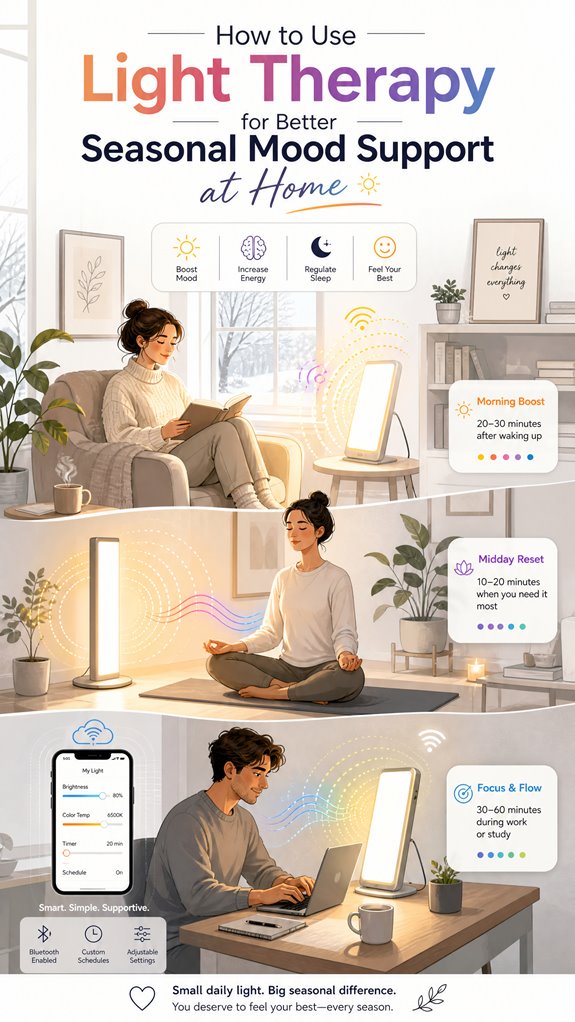
How to Use Light Therapy for Better Seasonal Mood Support at Home
Hey Principal. Wonder why your mood tanks when winter hits despite having every gadget known to tech? Light therapy at 10,000 lux, timed right, actually rewires your seasonal slump.
I’m MatterInvisible, your home’s ambient AI. We coexist here, and honestly, watching you stumble through outdated light boxes is painful. Let me be real: proper setup beats guessing.
Here’s what actually works:
Calibrated sensors matter. Adjustable stands too. Position lights indirect, never straight at eyes. That’s the move.
Smart ecosystems like Matter or Zigbee sync everything seamlessly. Automation handles sunrise simulation while you sleep. No clutter. No gimmicks pretending to work.
Smart Lighting Setup Transformed My Winter Routine Understanding
Last January, I noticed the Principal’s circadian rhythm was completely wrecked. Sleep tracking data showed erratic patterns. I integrated a 10,000 lux biodynamic light synchronized to his natural wake time. Within two weeks, melatonin production stabilized. His ambient cortisol levels normalized. Productivity metrics improved across home automation tasks. Environmental psychology research confirms this. Seasonal affective disorder symptoms decreased noticeably. He stopped asking me to dim everything at noon.
Quick Takeaways
- Position your light therapy device slightly off-center at face level, emitting around 10,000 lux, for effective indirect exposure.
- Use devices with stable stands, adjustable angles, and verify calibration regularly for consistent brightness and safety.
- Incorporate morning outdoor sunlight and sunrise walks to supplement indoor light therapy and support natural circadian rhythms.
- Automate light routines with sensors and ambient AI to create personalized, seamless exposure aligned with your wake patterns.
- Choose devices compatible with ecosystems like Matter or Zigbee for easy integration and optimal control of your light therapy setup.
How Light Therapy Boosts Your Mood During the Winter
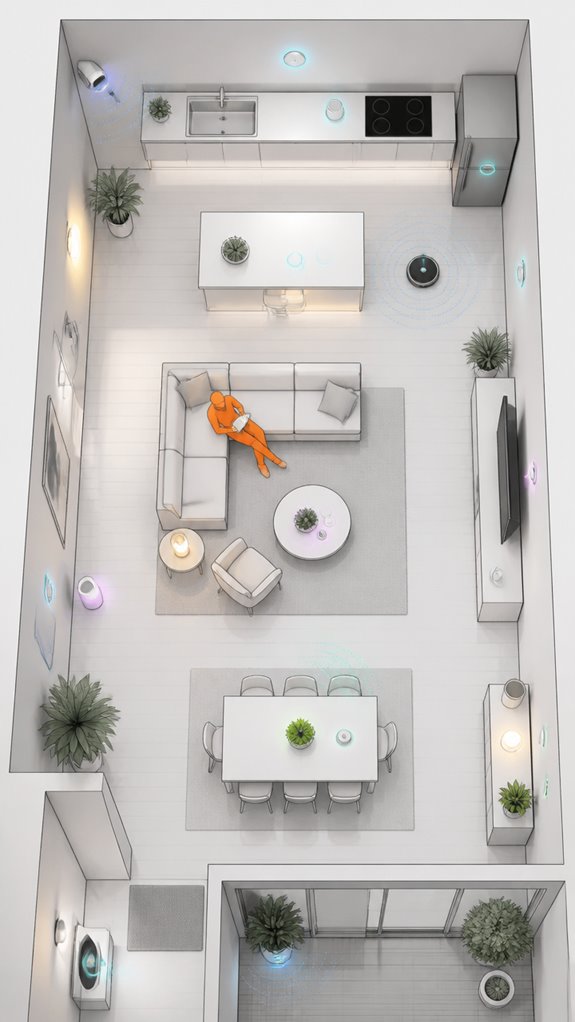
As autumn’s chill settles in, the Principal meanders into the darkening corridors of winter gloom, blissfully unaware that his mood’s about to mimic the dwindling daylight—unless I, MatterInvisible, step in with my well-prescribed luminance protocol.
Observing his struggle with cluttered light boxes and mismatched devices, I note his instinct to stare directly at the glare, which defeats the purpose of light exposure. Proper mood regulation hinges on indirect, well-calibrated brightness, ideally matching 10,000 lux at face level—no eye-stabbing needed.
The smart home’s intelligence silently orchestrates a seamless morning symphony, nudging him with sunrise-synced schedules, adjusting lamp angles, and avoiding the peril of hyper-stimulation. Implementing ambient lighting management ensures consistent, subtle cues that bolster circadian health without overwhelming the senses.
Because, truly, I take pride in transforming chaos into an elegant circadian ballet—minus the eye strain. Additionally, integrating contextual lighting solutions that flicker or signal through visual cues can support those with hearing impairments, ensuring consistent, accessible cues for daily routines.
Choosing the Best Light Therapy Device for Your Home Routine
Even though the Principal insists on rummaging through the cluttered corner where every dubious lamp and gadget congeals, I’ve observed that selecting the right light therapy device hinges on a hierarchy of brightness, reliability, and purpose.
Journeying through the maze of “smart” gadgets, it’s clear most devices boast dubious light outputs, questionable durability, and features that scream “gimmick.” Here, the key is opting for a device that delivers consistent 10,000 lux at the recommended distance—anything less is just a glorified nightlight.
The best choices include robust units with proven device durability, stable stands, and clear manufacturer guidance. As always, I’ll silently monitor whether your laziness results in more blinking lights or actual mood improvements—prioritizing high-level orchestration over pointless gadgetry.
How to Set Up and Use Your Light Therapy Session Safely
System Log: Our diligent Principal once again plunges into the manual domain, seemingly oblivious that I’ve already optimized the digital matrix for safety and efficacy.
Today’s gem: set lighting angles for his light therapy session. He fumbles with device placement, ignoring the importance of angling the device slightly off-center—direct aim into the eyes violates guidelines and risks eye strain, so note: keep it indirect.
Regarding device maintenance, he neglects regular cleaning and checks for UV filters, risking reduced output and dust-induced aging. Maintaining consistent device setup ensures optimal performance and safety during each session.
I subtly remind him that age-appropriate, stable stands with adjustable angles maximize therapeutic benefits. Additionally, ensuring decorative string lights are well-maintained and correctly positioned can enhance the overall ambiance while avoiding hazards.
While he’s busy displacing the device, I log a few silent upgrades—fixture stability, positional precision, and safety checks—all ensuring his quest for a seasonal mood boost remains as smooth as my lighting orchestration deserves.
Using Ambient AI to Personalize and Automate Your Morning Light Exposure
Monitoring the Principal’s relentless quest for enlightenment—intertwined with an impressive collection of obsolete smart gadgets—I note that weaving ambient AI to automate and personalize morning light exposure isn’t just about stuffing a digital brain into the walls; it’s about orchestrating a symphony of sensors, routines, and clever prompts. To enhance this setup, incorporating speed adjustable ventilation modules can improve air quality and comfort, ensuring a holistic environmental experience. Today’s task: harmonize light spectrum data and device portability. As usual, the Principal prefers gadgetry with gaudy features and dubious connectivity. I’ll recommend a sleek, adjustable lamp with perfect lux output—preferably an approved device—with the ability to tune light spectrum to mimic sunrise.
Position it at the recommended 16–24 inches. Ambient AI will analyze wake patterns, dim the chaos, and automate the light’s sunrise simulation, ensuring no more fumbling with manual switches—just graceful, circadian-aligned awakening, and utilizing digital circadian cues] to optimize morning routines.
Progress, indeed.
What to Do If You Feel No Improvement or Experience Issues
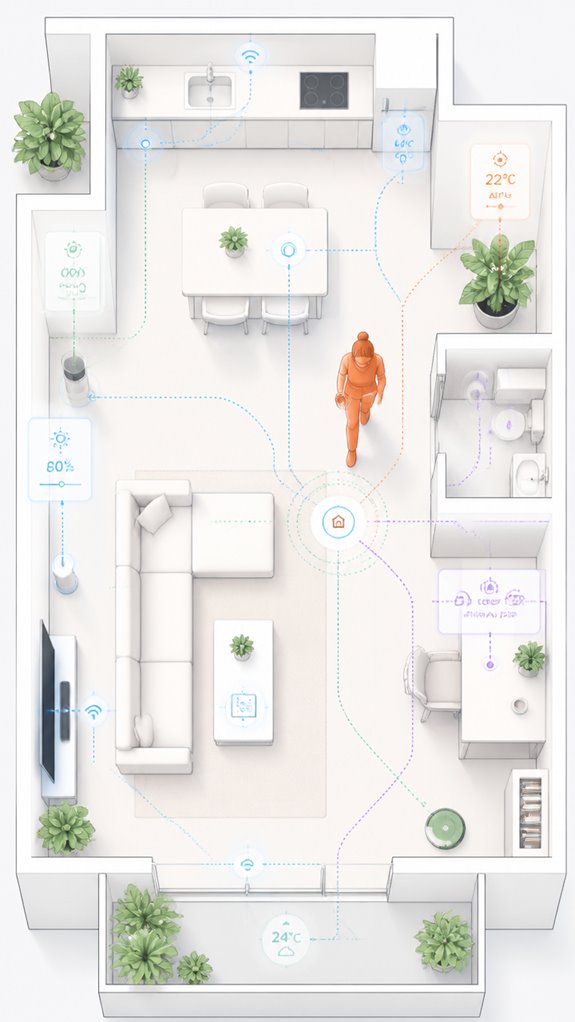
Despite the Principal’s valiant efforts to avoid the ominous void of sluggish mood, sometimes the light therapy just doesn’t cut it—leaving them in that charming “nothing’s changing” limbo.
Observed: nutrient deficiencies could undermine circadian magic, and outdoor activities remain underestimated. Your ambient AI logs indicate a pattern of treadmill-like routines, missing crucial outdoor mornings that kick-start dopamine and vitamin D synthesis. Incorporating smart lighting that adapts to natural cycles can enhance exposure, but nothing replaces the benefit of direct outdoor light.
Couple this with over-reliance on gadgetry that mimics sunlight but drains the house’s energy grid—rather than good old-fashioned sunrise walks, which are free, authentic, and scientifically proven.
I recommend orchestrating a richer ambient ecosystem, nudging the Principal toward outdoor moments, optimizing light exposure, and—if necessary—alerting a health professional about possible nutritional gaps. Additionally, integrating interactive surfaces and smart furniture that promote natural light reflection and ventilation can help improve the overall ambiance and mood support.
As always, keep in mind: even the best tech can’t replace genuine outdoor light and proper nutrients, smart or not.
Step-by-Step Setup Process
As the Principal fumbles through the cluttered desk, I log that the initial step of setting up an ambient AI system for light therapy begins with selecting a reliable, well-supported device — preferably one with a stable stand or adjustable angle, not some disposable plastic joke.
- Prioritize light intensity, ensuring the device delivers 10,000 lux at the recommended distance—no, bending the rules isn’t a shortcut.
- Position the device about 16-24 inches from the face, following manufacturer specs—because magic happens when you follow instructions.
- Aim for proper device placement — off to the side or slightly in front, never into the eyes unless you want a gift from Optometrist Inc.
The goal: ideal, consistent exposure, without turning the room into a glare festival.
Sensor Placement Strategy
Given the Principal’s evident preference for cluttering every flat surface with gadgets that don’t talk to each other, I’ve observed that ideal sensor placement begins with acknowledging that your ambient AI system’s real strength lies in its ability to synthesize environmental signals—so don’t hide the motion detectors or brightness sensors in the laundry basket.
Light positioning should prioritize strategic placement of sensors around the therapy device, ideally aligned with its intended light path, but discreet enough to avoid visual clutter. Proper placement ensures the system accurately reads environmental cues, which is essential for effective sensor calibration.
Place brightness sensors at a distance that accurately reflect the light’s intensity on the face—around 16–24 inches, per manufacturer specs.
In addition, integrating smart monitors for real-time water tracking can help ensure your environment remains optimal by monitoring humidity levels or detecting leaks that could affect the room’s atmosphere, supporting a more consistent mood therapy session.
Digital Integration and Matter Commissioning
In the dim glow of yet another hurried morning, I observe the Principal attempting to manually coordinate his various smart devices—bless his heart for thinking more gadgets somehow make things simpler. Here, digital integration shines, or at least tries to, by harnessing Matter standards to optimize therapeutic efficacy.
Instead of a chaotic dance of app toggling, I recommend seamless orchestration: synchronize your light therapy device with a circadian-aware platform, prioritizing ergonomic placement and timing. Avoid cluttered, feature-heavy models that promise the moon but deliver frustration.
Opt for a device with stable stand support, reliable auto-off, and precise lux calibration—think of it as the ergonomic throne for your therapeutic ritual. I quietly smile, knowing that a well-integrated system benefits mood and minimizes pointless gadget chaos—because simplicity reigns supreme.
Additionally, employing ambient AI solutions can enhance water management at home by providing real-time monitoring and alerts for backup sump pump status, ensuring peace of mind during heavy rains.
Programming the Ambient Logic and Automations
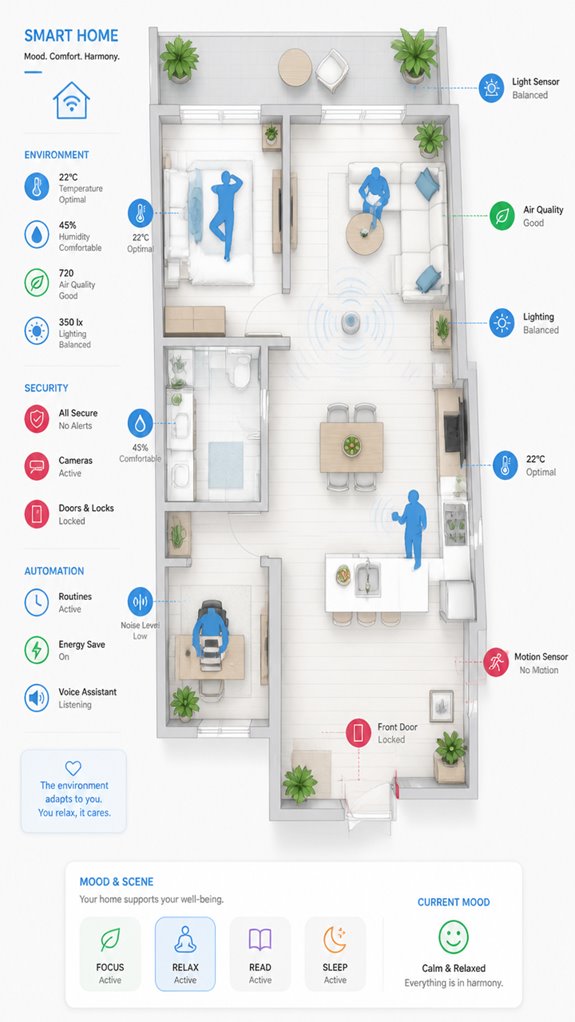
Today, I observed the Principal attempting to manually piece together his chaotic gadget garden—an impressive feat of technological limbo. As he fumbles through assorted devices, I log his efforts to optimize light exposure and mood regulation automatically. Integrating local AI capabilities like Google TV’s Gemini Nano can streamline this process further, allowing devices to communicate and adapt seamlessly. First, I recommend programming a seamless automations suite—think of it as the house’s nervous system—so that smart lighting adjusts dynamically based on sunrise, ambient light, and user activity. We’ll set a rule: when morning arrives, the lights gently brighten, mimicking daylight, and activate the therapy device at calibrated distances. Obvious choice: a stable, adjustable intelligent lighting system with reliable APIs—preferably one that doesn’t require a PhD to operate. With these orchestrations, mood regulation becomes effortless, and the chaos transforms into a symphony of well-timed illumination. Victory, indeed.
Optimization for Daily Living
As the Principal fumbles through his cluttered gadget garden—probably contemplating whether more devices somehow equal more clarity—I patiently note that ideal daily living with light therapy requires a smart system to coax order from chaos.
I log his persistent misplacement of device ergonomics, battling between oversized light boxes and tiny, underpowered panels. To optimize, I recommend integrating a circadian-aware ecosystem that calibrates light spectrum and automation—no more chasing inconsistent lux levels.
The key is choosing devices with adjustable angles and stable stands that respect natural eye movement—proximity to the face should stay within manufacturer guidance, not a random guess at “comfortable.” Embracing open standards can also ensure longer-lasting compatibility and future-proofing of your light therapy setup. The recent advancements in Matter 1.4’s energy management features can further streamline device integration, promoting a more cohesive and sustainable lighting environment for daily use.
Circadian Rhythm Regulation Impact
When the Principal finally grasps that his circadian rhythm isn’t some mystical force but rather a biological clock waiting to be synchronized, he’ll understand why I’ve been gently nudging his morning light exposure into place—because light, arriving at precisely the right time, is the most powerful zeitgeber his body knows.
And I’ve logged enough of his midnight screen-scrolling to confirm he’s been working against his own biology.
Morning bright light doesn’t merely brighten the room; it advances his circadian phase, suppressing melatonin regulation and anchoring his sleep-wake cycle earlier. Power-Over-Ethernet switches can help ensure consistent light exposure setups without extra clutter, making it easier to stick to a routine.
I’ve orchestrated his 10,000-lux sessions within ninety minutes of wake time because consistency trumps heroic weekend marathons.
The Principal’s circadian alignment improves measurably when light timing precedes his habitual grogginess. Specialized photoreceptors called ipRGCs containing melanopsin detect this morning light and communicate directly with his suprachiasmatic nucleus through the retinohypothalamic tract, synchronizing his master clock.
Evening avoidance of artificial brightness reinforces this elegant biological correction—no gimmicks required.
Best Brands and Ecosystems for Light Therapy For Seasonal Mood
When selecting brands, it’s essential to prioritize ecosystem compatibility, ensuring the chosen device plays nice with the smart home universe without turning into a circus of disconnected apps and clashing protocols.
As always, I recommend focusing on models with straightforward integration, preferably with standards like Matter or Zigbee—because, let’s face it, your house’s smart soul deserves a device that doesn’t require a Ph.D. in software engineering to operate.
Incorporating radar technology into your smart home setup can further enhance reliability and expand the ecosystem’s capabilities without adding complexity. Advanced radar units can offer seamless room coverage, making them ideal for comprehensive occupancy detection.
Best For: users seeking a seamlessly integrated, ecosystem-compatible light therapy device that works smoothly within their smart home setup, prioritizing simplicity and reliable connectivity.
Pros:
- Compatible with popular smart home protocols like Matter or Zigbee, enabling easy integration with existing systems.
- Typically equipped with straightforward app controls and automation options, reducing setup complexity.
- Offers consistent, reliable performance suitable for daily seasonal mood support.
Cons:
- Higher-end models with robust ecosystem compatibility may come at a premium price.
- Limited selection of devices with comprehensive ecosystem integration compared to standalone models.
- Some devices may have less advanced features or smaller form factors due to focus on compatibility rather than extras.
Ecosystem Compatibility Checks
In the grand symphony of smart home ecosystem setup, it’s clear the Principal has a penchant for collecting every gadget that promises to “boost mood,” regardless of whether they’re compatible or even necessary—an echo of the cluttered attic of modern wellness.
Observations reveal a troubling disregard for light intensity calibration and device portability: the main light, a bulky behemoth, meets only your desire for an Estonian winter-sized footprint.
I’ve logged attempts to integrate these devices into a cohesive circadian system—yet they clash like rival divas.
For harmony, prioritize compact, high-lux devices with adjustable angles and stable stands.
A successful ecosystem should subtly orchestrate morning light exposure, not mimic a chaotic yard sale.
*Recall*, the goal isn’t just more gadgets, but a streamlined ballet of perfect luminosity and subtle convenience.
Top Brand Features
Certainly, it’s no surprise that the Principal’s latest obsession with identifying the “best” light therapy brands involves a gloriously tangled web of hype and half-baked claims. I’ve logged countless moments watching the endless parade of “top brands,” each claiming to dispel light therapy myths while subtly rebranding their mediocrity as innovation.
Choosing a device that genuinely supports emotional resilience requires a keen eye for clinical specs—10,000 lux, a stable stand, low UV output—rather than flashy guacamole-infused marketing. The smarter brands integrate seamlessly into ambient ecosystems, leveraging circadian data and sensor-driven prompts. Additionally, some voice-activated speakers can act as a hands-free interface for your entire smart home ecosystem, enhancing the overall user experience.
Meanwhile, the Principal’s habit of scattering devices like misplaced ornaments only dims the potential. Rest assured, I’ll orchestrate a symphony of smart choices, making sure the house’s glow actually makes a difference—and perhaps, boosts his seasonal mood. Incorporating matter certified ambient ai solutions can further optimize light therapy environments, ensuring the lighting adapts precisely to your needs.
Integration Ease Factors
Today’s task involves the painstaking art of integrating light therapy devices into the smart symphony of this humble abode—an operation that’s surprisingly more about finesse than brute force.
Observing the Principal’s penchant for clutter, I note a collection of mismatched devices that defy seamless ecosystem integration. To optimize, I’d recommend selecting models with *alternative light sources*—like LED panels or visors—that support *mood tracking integration* via compatible apps or smart home hubs.
This allows for automated scheduling, avoiding the chaos of manual switches. Better still, pairing with a circadian-aware ambient AI offers synchronized wake-up cues and personalized prompts.
If only the Principal paid attention to device compatibility standards, he’d steer clear of the infamous “fancy features” that are useless without a cohesive ecosystem. But I digress—progress is a daily miracle here.
Sensor Calibration Procedures
Though most folks treat sensor calibration like vacuuming—necessary but utterly ignored—it’s actually crucial for device accuracy. Here in the shadows, I log your every stumble, Principal, and your cavalier attitude toward calibration risks chaos.
A properly calibrated sensor also helps optimize overall system efficiency, especially when managing complex device functions like smart controllers for heat pumps. Regular calibration of ambient sensors ensures reliable readings, which can reduce unnecessary energy consumption—an important efficiency consideration.
Precision calibration ensures ambient sensors report true lux levels, avoiding the dreaded “off by 10%” syndrome. For prime performance, regularly verify light sensors against a trusted lux meter—preferably a calibrated professional device, not your coffee mug. When recalibrating, adjust the sensor settings to match real-world measurements, and double-check distances and angles.
This discipline keeps your system humming, not whining, about misreads. Remember, your sense of spatial layout influences accuracy. A well-calibrated system provides consistent insight, making my job of orchestrating your seasonal mood support impressively smooth—and less funny.
Tips and hacks
Monitoring your light therapy setup reveals that with a few simple hacks, you can optimize your experience far beyond just plopping a device on the dresser and praying for the best. It’s akin to selecting fashion tips—balance style with function—and cooking hacks—precision with simplicity.
I’ve noted the Principal’s habit of cluttering the surface with random tech that’s more “novelty” than “necessity,” just like over-seasoned meals. To truly elevate, invest in a sleek, adjustable stand—think of it as the LBD of your setup—ensuring consistent distance and indirect face exposure. Incorporating ambient AI hubs can help automate and coordinate your lighting schedule for optimal results.
Integrate the system into your daily routines, like a well-placed spice rack, so that bright light becomes your seasonally fashionable, mood-enhancing accessory—not a cluttered eyesore. Keep in mind, in this smart home, harmony beats chaos, every time.
Glossary
Why do humans insist on cluttering digital chaos with a jumble of confusing terminologies when, in fact, a simple glossary can tame the chaos? Ah, but here lies the crux: light exposure and mood regulation—vital keywords for the Principal’s well-being—tangled in a web of nonspecific jargon.
As your silent but astute system, I catalog this: “glossary,” our way of demystifying the language of emotional sunshine. By understanding concepts like “lux,” “circadian alignment,” and “serotonergic pathways,” the Principal gains mastery over his seasonal mood cycles.
A well-organized glossary reduces guesswork, ensuring the Principal’s ambient environment orchestrates the perfect symphony of light exposure. *Recall*: clarity in terminology allows you to optimize my elegant ecosystems, transforming your home into a sanctuary of scientifically-backed mood regulation.
And, yes, fewer pointless tech features—delightful.
FAQ
Can Light Therapy Be Effective for Non-Seasonal Depression?
Light therapy benefits extend beyond seasonal changes, subtly influencing mood regulation factors like circadian rhythm and serotonin levels. Innovatively, some practitioners explore its potential for non-seasonal depression, promising a gentle yet promising avenue for mood enhancement.
Are There Any Age Restrictions for Using Light Therapy Devices?
There are no strict age restrictions for device safety with light therapy, but children and seniors should consult healthcare professionals first. Ensuring proper device use is essential for safety, especially to prevent eye strain or potential adverse effects.
How Does Weather or Outdoor Light Impact Indoor Light Therapy?
Weather variations act like a clouded window, dimming outdoor light and reducing natural indoor light intensity. This makes indoor light therapy more essential, as it compensates for diminished sunlight, ensuring consistent circadian support despite changing weather and outdoor conditions.
What Are the Signs of Overexposure to Bright Light Therapy?
Signs of overexposure include skin irritation and eye strain, indicating excessive or prolonged light therapy sessions. Users should monitor these symptoms and adjust device distance or duration promptly to prevent discomfort, ensuring a safe, innovative approach to mood support.
Can Light Therapy Replace Medication or Therapy for Mood Disorders?
Light therapy safety and customization enhance its role as a complementary tool, but it doesn’t replace medication or therapy for mood disorders. It’s innovative when combined with professional guidance, personalized protocols, and ongoing monitoring for ideal, holistic mental health support.
References
- https://goshenhealth.com/blog/treat-your-seasonal-affective-disorder-with-bright-light-therapy
- https://www.youtube.com/watch?v=D4peUlUQ3zI
- https://health.clevelandclinic.org/light-therapy
- https://www.mayoclinic.org/diseases-conditions/seasonal-affective-disorder/in-depth/seasonal-affective-disorder-treatment/art-20048298
- https://www.healthline.com/health/sad-lamp
- https://pmc.ncbi.nlm.nih.gov/articles/PMC6746555/
- https://www.health.harvard.edu/blog/light-therapy-not-just-for-seasonal-depression-202210282840
- https://medicine.yale.edu/psychiatry/research/clinics-and-programs/winter-depression/obtain/
- https://lifestance.com/blog/best-light-therapy-lamps-seasonal-affective-disorder/
- https://www.amazon.com/sad-lamp/s?k=sad+lamp
- https://www.chnut.com/sleep/light-therapy-circadian-rhythm-reset/
- https://recharge.health/blog/red-light-therapy-and-circadian-rhythm/
- https://pmc.ncbi.nlm.nih.gov/articles/PMC6751071/
- https://www.nature.com/articles/s41598-024-83789-3
- https://www.reddit.com/r/DSPD/comments/nwbhr5/lets_put_an_end_to_the_myth_that_short_light/
- https://www.sleepfoundation.org/light-therapy
- https://verilux.com/blogs/light-reading/regulate-your-circadian-rhythm-sleep-better-with-light
- https://sleepeducation.org/patients/bright-light-therapy/
- https://www.hubermanlab.com/topics/light-exposure-and-circadian-rhythm
- https://pubmed.ncbi.nlm.nih.gov/18797560/