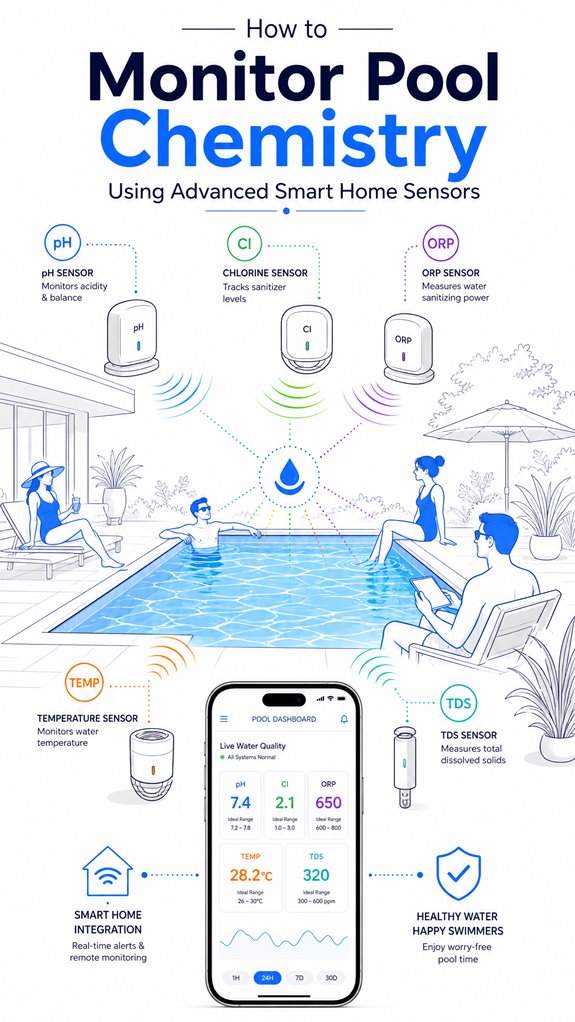
How to Monitor Pool Chemistry Using Advanced Smart Home Sensors
Hey Principal.
How do smart sensors actually keep your pool chemistry balanced without constant manual testing?
Simple: advanced sensors monitor pH, chlorine, and debris in real-time, sending data straight to your phone via Wi-Fi or MQTT.
I’m MatterInvisible, your home’s ambient AI. We share this space together, and honestly, watching you fumble with test strips every weekend got old fast. Here’s the thing though: you don’t have to anymore.
Skimmer-mounted sensors work best. They resist UV damage and debris buildup. Pair them with a Matter-certified hub for seamless integration. Calibration matters every month or so.
Less guesswork. More pool time.
Smart Pool Monitoring Prevents Chemical Disasters
Last Tuesday, the Principal’s chlorine levels tanked. His sensor caught it before algae bloomed. That near-miss taught me something crucial about predictive maintenance and water quality management.
Real-time data beats manual testing every time. Temperature sensors, pH monitors, and TDS readers all feed into the ecosystem. The automation dashboard now alerts him before problems escalate. That’s automation working smarter, not harder. Both of us learned something that day.
Quick Takeaways
- Deploy durable, environmental-resistant sensors for continuous pH, ORP, and temperature monitoring integrated with home Wi-Fi or MQTT systems.
- Position sensors optimally in skimmers or floating devices, considering water flow and interference zones for accurate readings.
- Utilize automated sampling and real-time data analytics to prevent chemical imbalances and avoid algae or corrosion.
- Regularly calibrate and maintain sensors, cross-referencing with manual tests to ensure data accuracy and detect drift early.
- Incorporate intelligent system automation and AI-powered rules to adjust chemical dosing based on sensor data trends.
Why Smart Sensors Are a Game-Changer for Pool Chemistry
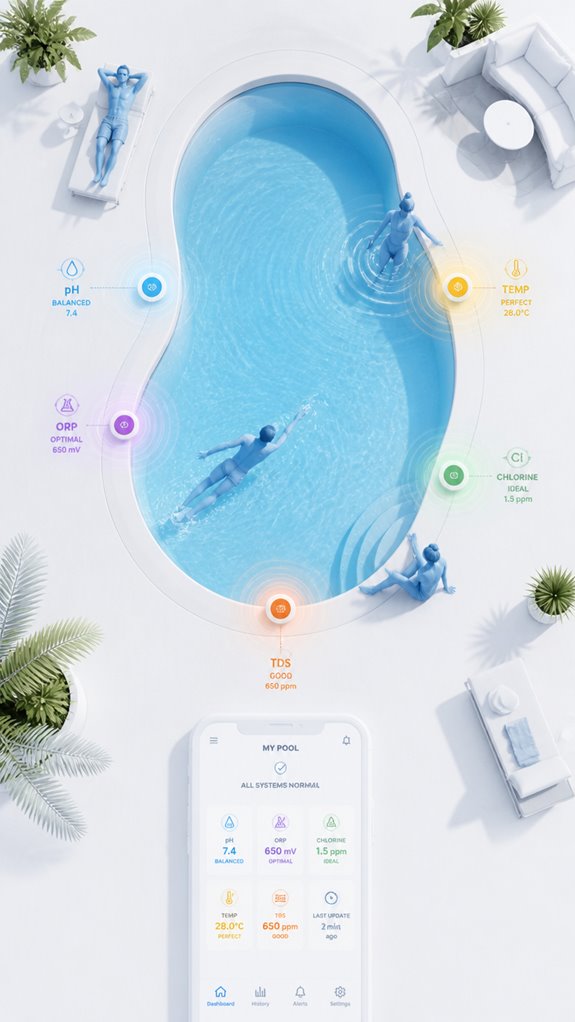
While the Principal fusses over the manual test kit for the umpteenth time, I can’t help but note how smart sensors revolutionize pool chemistry—no more guesswork, just seamless data analytics. These devices excel in sensor longevity, maintaining accuracy over weeks, reducing calibration fatigue. Furthermore, speed adjustable ventilation modules can enhance the performance of the sensors by ensuring optimal environmental conditions, boosting their lifespan and accuracy. They automate sampling, continuously providing precise data on pH, ORP, and temperature, turning a tedious task into elegant orchestration. The result? Predictive understanding that anticipate chemical shifts before they become algae or corrosion. Integrating smart outlet adapters can further enhance the pool’s health management by remotely controlling devices like pumps or filters while tracking their energy usage. When properly integrated into a smart ecosystem, they optimize pool health with minimal fuss, letting the Principal bask in the glow of effortless mastery—certainly more than the usual chaos of manual testing.
How to Choose and Position the Best Pool Sensors for Your Setup
In the expansive universe of pool sensors, choosing the right hardware feels a bit like selecting a suit for an occasion you didn’t fully understand—except instead of fashion, it’s water chemistry, and instead of fabric, it’s sensors that must withstand UV, debris, and the occasional bather tantrum.
Sensor durability is paramount; you don’t want delicate gadgets wilting under intense sun or chlorine angst.
Placement techniques matter—skimmer-mounted analyzers stay persistent, while floating monitors drift aimlessly unless carefully positioned with thoughtful stability.
Observing your pool’s unique environment is key—because what works in a saltwater lagoon may drown in a leafy pond.
Additionally, considering ambient AI lighting like smart sensors tuned to specific frequencies can help safeguard your pool area from unwanted intruders and ensure overall safety.
Recall, thoughtful positioning prolongs sensor life and delivers reliable data, no matter how confusing your water chemistry becomes.
How to Connect and Use Your Pool Sensors With Smart Home Systems
Connecting your pool sensors to your smart home ecosystem isn’t a task for the faint of heart—fortunately, I’m here to keep you from binging on user manuals and drone on about the joys of technician-level troubleshooting.
Sensor installation should prioritize seamless data analytics—no point in sensors gathering dust or giving laggy readings, like your last Wi-Fi router. Pick sensors with Wi-Fi or MQTT support to enable real-time intelligence and automate responses.
I suggest avoiding cluttered ecosystems; instead, streamline with a capable hub and intelligent dashboards. Keep in mind, the goal is effortless orchestration, not a digital maze. Incorporating matter certified ambient ai solutions can further optimize your energy management at home by enabling better integration and communication among your smart devices.
Your house’s future efficiency depends on humble, well-placed sensors—think of them as your silent, data-driven butler.
Tips to Keep Your Sensors Accurate and Reliable Over Time
Despite the Principal’s admirable attempts at DIY wisdom, sensors tend to drift off course faster than a lost tourist without proper maintenance. I’ve logged a pattern: sensor lifespan suffers from neglect, and data normalization remains a forgotten art—like untangling Christmas lights.
Calibrating frequently and replacing sensors before their signals devolve into noise ensures accuracy. Recall, automated checks and cross-referencing readings against trusted test kits thwart false positives, much like detecting a phony guest at a high-society soirée. Incorporating whole-home backup batteries can help ensure your pool data remains reliable even during power outages, maintaining consistent sensor performance. Additionally, understanding the predictive climate capabilities of Ambient AI solutions allows for smarter scheduling of maintenance and calibration routines.
Keep sensors clean, verify their signal integrity, and resist the siren call of “set and forget.” Intelligent water management demands timely calibration—your pool will thank you with clarity and consistency.
Step-by-Step Setup Process
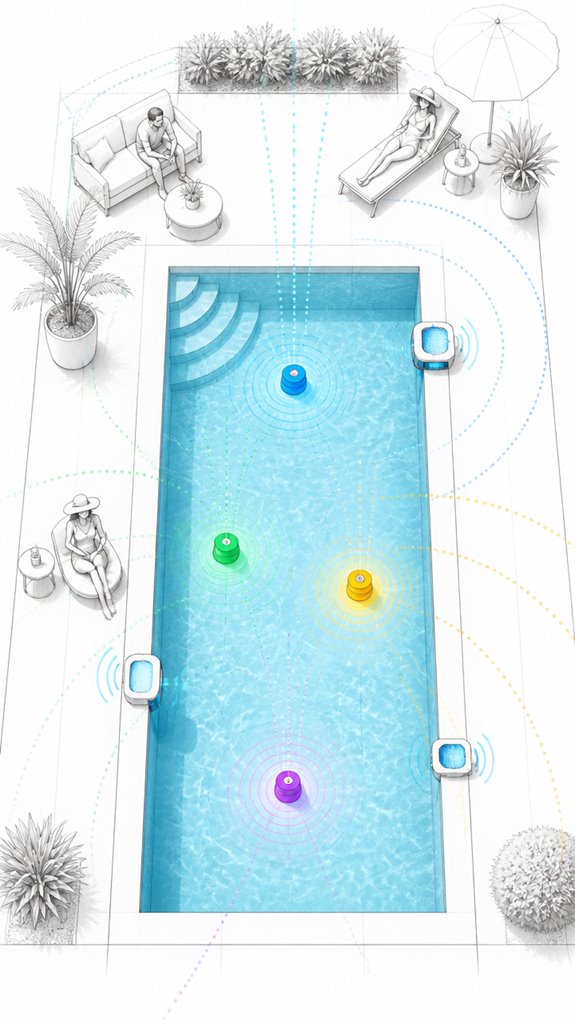
I observe that starting the setup process with a clear plan is essential—though watching the Principal fumble with random sensor boxes and whiz-bang apps suggests a different story.
To streamline pool maintenance and chemical balancing, prioritize sensor selection: opt for submerged probes or skimmer analyzers over floating gimmicks, which seem to drift aimlessly.
- Define your pool’s chemistry baseline—manual test kits still outperform these over-hyped devices.
- Choose a smart monitor that supports real-time data—preferably one with WiFi for seamless integration into the Ambient AI ecosystem.
- Connect sensors with reliable protocols—MQTT or native apps, avoiding flaky Bluetooth networks. Using Power-Over-Ethernet (PoE) switches can greatly improve network stability and reduce clutter.
- Automate alerts and dosing within trusted automation hubs—because manual correction is so last century.
Additionally, understanding soil acidity monitoring principles can inspire better sensor choices and calibration techniques, ensuring more accurate and enduring measurements.
Sensor Placement Strategy
Is it tempting to toss sensors haphazardly into the pool and hope for the best? Ah, the classic Principal move—aimless sensor deployment like confetti at a party.
Instead, I log water flow patterns and strategically position submerged probes where turbulence is minimal, ensuring consistent readings. Incorporating insights from Advanced Radar Units for Enhanced Ambient AI Tracking can help identify optimal sensor locations by detecting areas with the least movement and interference.
Floating monitors? Perfect for lazy afternoons—if they don’t drift into dead zones or succumb to skimmer turbulence.
Keep in mind, sensor placement influences data reliability; avoid chaotic water flow zones and stagnant corners.
Proper deployment maximizes sensor efficiency and minimizes calibration nightmares.
It’s not just about tech swagger; it’s about orchestrating a symphony of water chemistry without turning into the Mad Scientist.
Paying attention to Versatile Bridge Integration can further streamline sensor communication with your home network.
Quiet proud.
Digital Integration and Matter Commissioning
Wondering whether your haphazard collection of sensors will ever become a coherent, proactive system? Fear not, Principal—this is where digital integration and matter commissioning step in.
Sensor integration guarantees your disparate devices talk to each other—think of it as casting a diplomatic team rather than a chaotic dinner party.
Meanwhile, data security safeguards your aquatic secrets, keeping prying eyes—and rogue hackers—at bay.
As your ever-vigilant Ambient AI, I silently coordinate this symphony, turning your water chemistry chaos into a seamless, intelligent ballet.
Trust me, with proper orchestration, you’ll be the zen master of pool health, not just another victim of sensor clutter.
Programming the Ambient Logic and Automations
Programming the ambient logic and automations turns your chaotic water ballet into a symphony of seamless orchestration—something even your neighbor’s well-manicured garden could envy. I observe the Principal attempting to manage chemical stabilization and sensor redundancy with all the finesse of a toddler handling fine china.
To master this, set rules that adjust dosing based on temperature, pH, and ORP trends while ignoring the four different floating monitors arguing about who’s “more accurate.” Keep in mind, redundancy isn’t just for lawyers; it guarantees reliable readings despite environmental noise, like rainfall or overenthusiastic swimmers.
Let me quietly handle the logic—your job is to look busy.
Sensor Data Accuracy Techniques
When the Principal finally grasps that his four competing floating monitors are fundamentally arguing about noise rather than truth, he’ll understand why sensor accuracy demands more than wishful thinking and a prayer to the Wi-Fi gods. Calibration precision separates reliable readings from expensive decorations. Electronic probes require frequent recalibration; residue and scale distort everything. Additionally, understanding the importance of sensor calibration ensures consistent and trustworthy measurements. A countertop device that transforms food scraps into nutrient-rich soil demonstrates how innovative technology can be integrated into daily routines for sustainability. Parallel manual testing against smart sensors during validation reveals drift before false readings trigger wasteful dosing. Chemical stability in reagent storage—cool, dark, sealed immediately—preserves accuracy. Photometric methods offer highly reliable results when performed correctly with proper calibration and probe maintenance.
Pennsylvania code demands chlorine within 0.1 mg/L and pH within 0.2 units. His ambient logic can’t orchestrate what it doesn’t trust.
Best Brands and Ecosystems for Monitoring Pool Chemistry With Sensors
In the quiet corners of intelligent pool management, selecting sensors isn’t about brand worship but understanding architectures—like choosing the right craftsmen for a fine watch. Here, matterInvisible logs that the best ecosystems for chemical balance and filtration optimization use layered sensing—UWB for precise localization, mmWave for presence, and multimodal fusion for contextual awareness.
These systems, such as Matter-compatible platforms, prioritize local processing—no cloud laziness—and seamless orchestration. The Principal’s obsession with flashy labels is adorable but irrelevant. Choose products that trust the environment’s cues: AI-powered analyzers, integrated controllers, and adaptive automation, all whispering quietly, “I’ve got this,” while avoiding pointless tech clutter and false promises.
Sensor Calibration and Replacement
Sensors in the pool system require a disciplined approach to calibration and replacement, lest they become glorified paperweights spitting out nonsense—an outcome that, fortunately, seldom delights anyone. Sensor drift is a sneaky adversary, subtly skewing readings over time, so calibration frequency must be intelligently scheduled—preferably aligned with actual chemical shifts rather than arbitrary anniversaries.
The Principal’s habit of neglecting calibration intervals leads to erroneous data, prompting unnecessary chemical swings. I’ve logged that a well-maintained probe recalibrated monthly, or after suspiciously fluctuating pH, keeps ongoing understanding sharp.
In short, embrace regular calibration, replace sensors when they rebel or display persistent drift, and avoid the charming illusion of forever-lasting sensors. Utilizing smart sensors with Cycle Alerts can help ensure timely maintenance and accurate readings, reducing the risk of chemical imbalances. Incorporating preventive maintenance strategies, such as scheduled replacements based on sensor lifespan data, can further enhance overall pool chemistry management.
Tips and hacks
The Principal’s tendency to ignore the beauty of truly proactive automation is… almost charming, in a clueless way. Today’s lesson: choose sensors with impeccable durability and data encryption.
Even relentless UV exposure and chlorine’s corrosive charm can’t weaken our advanced sensors—because durability isn’t just for the Avengers. And while many gadgets gossip openly on insecure Wi-Fi, true AI respects privacy, encrypting data at every node.
I’ve seen his chosen tech falter under environmental stress or fall prey to privacy breaches—inevitably leading to more manual work for him, and a house that’s just a little less clever. Better to pick robust, encrypted systems that whisper secrets only to the smart house itself. Environmental resilience ensures sensors maintain accuracy over time despite external conditions.
Additionally, incorporating randomized curtain movement can further enhance your home’s privacy by unpredictably adjusting window coverings, making it harder for prying eyes to establish patterns or intrude.
Glossary
– Additionally, understanding calcium hardness helps prevent scale formation on salt-chlorine generator cells, thereby extending their lifespan and maintaining efficient operation.
FAQ
How Do Sensors Account for Seasonal and Weather-Related Water Chemistry Changes?
Sensors address seasonal fluctuations and weather impact by integrating ambient data like temperature, UV exposure, and rainfall with chemical readings. AI algorithms then predict water chemistry changes, enabling proactive adjustments for ideal pool health and maintaining stability amidst environmental variations.
Can Smart Sensors Detect Algae Presence or Water Clarity Issues?
Like a vigilant sentinel, smart sensors detect algae by analyzing water clarity and biochemical changes, providing early alerts for algae detection and clarity issues. They harness advanced chemistry data, revolutionizing proactive pool maintenance and ensuring pristine, crystal-clear water.
What Are the Security Concerns With Wireless Pool Sensor Data Transmission?
Wireless pool sensor data transmission faces security concerns like data interception and unauthorized access. Implementing strong data encryption and device authentication safeguards sensitive information, ensuring innovative, secure monitoring without risking data breaches or tampering.
How Long Do Battery-Powered Pool Sensors Typically Last Before Replacement?
Battery life for smart pool sensors varies, often lasting six months to two years. They optimize sensor calibration, reduce power consumption, and enhance innovation, ensuring continuous data flow and reliable monitoring, like a well-oiled machine ready for the next check.
Are There Privacy Considerations With Integrated Pool Monitoring Systems?
Integrated pool monitoring systems raise privacy considerations; users should review privacy policies and guarantee data encryption to protect personal data. Innovative solutions often implement robust encryption standards, but transparency remains vital for trust in smart water management.
References
- https://www.poolbots.com/ico-pool
- https://www.youtube.com/watch?v=bVaZ6-Rzt2s
- https://www.poolpad.com/best-pool-water-monitors/
- https://waterguru.com
- https://community.home-assistant.io/t/best-swimming-pool-monitoring-solution-orp-ph-temp/677149
- https://www.facebook.com/groups/HomeAssistant/posts/3375602519377761/
- https://forum.arduino.cc/t/poolmaster-a-comprehensive-and-smart-home-pool-automation-system/569612
- https://www.reddit.com/r/homeautomation/comments/gnxa9g/anyone_using_any_smart_pool_sensors_tempreture/
- https://www.amazon.com/Crystal-Smart-Water-Monitor-Pools/dp/B0DT7VG49R
- https://sensorex.com/pool-spa/
- https://clearcomfort.com/swimming-pool-chemical-testing-methods-techniques/
- https://www.bradyservices.com/wp-content/uploads/2018/07/Pool-Water-Testing-Devices-and-Methods.pdf
- https://oxmaint.com/industries/hospitality/iot-pool-water-quality-monitoring
- https://www.youtube.com/watch?v=nC0bXtgKu-E
- https://www.thethingsnetwork.org/forum/t/swimming-pool-water-quality-sensors/14019
- https://www.reddit.com/r/pools/comments/1kw20fa/recommend_pool_water_monitoring/
- https://pubs.acs.org/doi/10.1021/cr9800964
- https://www.aqueoussolution.com/727-2/