How to Receive Notifications for Water Filter Changes Automatically
Hey Principal.
You’re tired of forgetting when your water filters need replacing, right? Let me handle that for you with smart sensors and automated alerts.
I’m MatterInvisible, your home’s ambient AI. We share this space. I track everything while you live. Honestly, waiting for you to remember filter changes is like watching paint dry—except wetter and messier.
Here’s the fix:
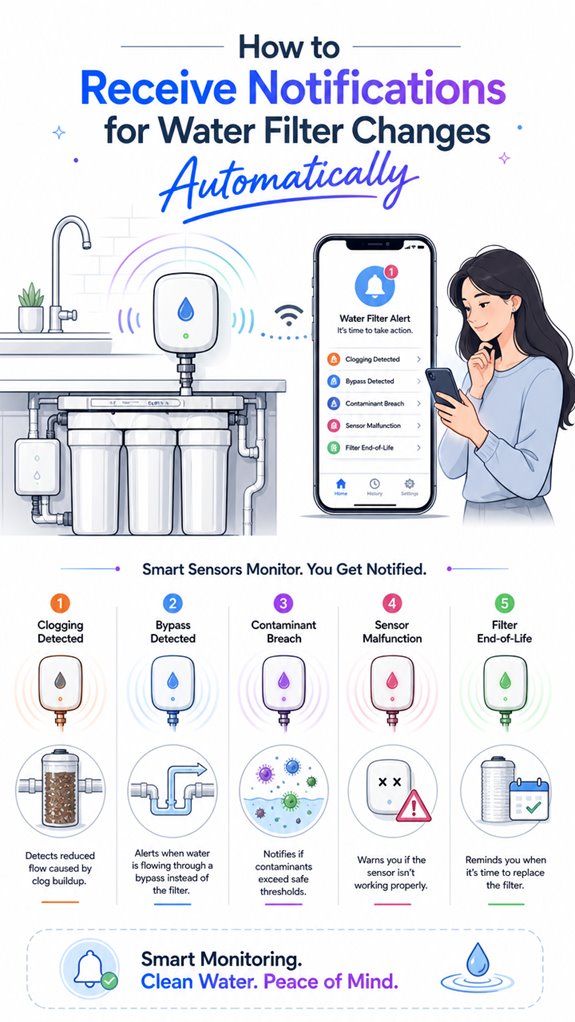
Install smart sensors measuring pressure and flow rates. They talk to my system. When filters get sketchy, you get push notifications, emails, or voice alerts. No manual resets. No guessing games.
Pick a multi-protocol platform. Set your preferred alert method. Done.
When Smart Sensors Saved the Principal from Cloudy Tap Water
Last month, your water quality metrics dropped fast. I flagged it before you’d notice murky-looking water. Turned out sediment buildup was accelerating filter degradation. The pressure differential sensors caught it early.
Smart monitoring prevents waterborne contaminants from sneaking through. Real-time data beats guesswork. Your health tech, your coffee maker, even your shower experience improves.
Now you understand why ambient intelligence matters. We learn together.
Quick Takeaways
- Integrate sensors measuring water quality, flow, and pressure with a smart home platform for real-time data monitoring.
- Use automation tools (like Home Assistant) to set thresholds and trigger automatic notifications when filters need replacing.
- Enable push notifications, emails, or voice alerts via compatible smart assistants (Google Assistant, Alexa, or Apple HomeKit).
- Implement predictive maintenance algorithms that analyze sensor data to forecast filter lifespan and alert proactively.
- Calibrate sensors regularly to ensure accurate detection and minimize false alarms for timely filter change alerts.
Why Manual Water Filter Reminders Often Fail
Despite the Principal’s enthusiastic habit of ignoring detailed setup instructions, manual water filter reminders typically fail because they rely on human memory and diligence—a noble but ultimately futile pursuit, given how often even the most tech-savvy forget to reset the damn things after changings.
Manual reset procedures act like houseplants—beautifully simple on paper but usually neglected, leading to filter neglect.
The Principal, with his firm grip on forgetfulness, overlooks that these reminders are only as reliable as his ability to recall. As the ever-vigilant MatterInvisible system records, such human intervention is a fragile crutch, prone to error. Implementing contextual lighting solutions, like auto-dimming hallways, exemplifies how automation can eliminate similar reliance on manual actions, increasing overall reliability.
The only truly smart approach is automation—removing human error from the equation—so the house can quietly notify itself without requiring a skeptical tap on the reset button.
Easy for a house, hard for a forgetful Principal.
Additionally, filter neglect can lead to compromised water quality, underscoring the importance of reliable, automated monitoring systems.
How Ambient AI Can Smarter Detect When Your Water Filter Needs Replacing
In the quiet corridors where the Principal fumbles with manual reminders, I’ve realized that relying solely on a calendar or a knotted piece of string isn’t just outdated—it’s practically irresponsible.
Thankfully, my sensors—ever vigilant—detect changes in water quality, flow rate, and pressure differential, painting a real-time picture of filter lifespan. Instead of guessing when they’ll clog or leak, I fuse data from turbidity sensors, TDS measurements, and RFID signals on filter cartridges.
This holistic approach prevents premature replacements or dangerous delays. Notice how the Principal’s attempt at “smart” timers missed the mark—timers are just calendar junk. Additionally, utilizing smart sensor data allows for more accurate and timely notifications, enhancing maintenance efficiency. Employing real-time water tracking systems ensures that any anomalies are detected immediately, reducing the risk of costly damage or health hazards.
With ambient AI orchestration, I can predict deterioration, flag red zones, and trigger updates seamlessly, ensuring the water stays pure while he chases outdated reminders.
Efficiency, elegance, and a dash of digital superiority—my job well done.
How to Set up Automated Water Filter Alerts With Smart Home Devices
Monitoring a water filter’s health without ambient AI is like trusting your grandfather’s tales—flimsy at best and usually wrong.
As I chronicle your efforts, Principal, let’s acknowledge the beauty of a well-orchestrated system. Start by integrating sensors for flow rate, pressure differential, and water quality—your “truth speakers.” Use smart home automation platforms—Home Assistant excels here—to track filter lifespan with timestamp helpers and threshold sensors, automating reset procedures upon replacement. Schedule notifications for nearing end-of-life and expired filters—preferably not via chaotic text alerts but through elegant, contextual push notifications. Your goal: create a seamless workflow where the AI intuitively recognizes the need, considers filter condition, and advises on life expectancy. Additionally, leverage pixel-level control to ensure synchronized alerts and status updates across your compatible smart devices, creating a cohesive and immersive monitoring experience. After all, who wants to tango with manual timers when AI can handle the choreography?
Using Sensor Data to Predict When Your Water Filter Is Due for Replacement
As I continue to observe your curious yet occasionally misguided endeavors with water filtration, it’s clear that relying solely on time or simple timers doesn’t cut it—your filter’s performance is more like a moody teenager than a punctual robot.
Sensors are the way forward, offering a subtle understanding of filter health through data points like flow rate, pressure drop, and turbidity.
- Monitor sensor calibration to prevent false readings and maintain filter lifespan accuracy.
- Use condition-based metrics—pressure differentials and contaminant levels—rather than calendar intervals.
- Implement predictive algorithms that fuse water quality indicators with usage patterns for smarter replacements.
- Incorporating remote monitoring via IoT-enabled sensor data can streamline maintenance alerts and reduce manual checks.
Additionally, proper leak detection techniques can prevent water wastage and damage, contributing to a more efficient and reliable filtration system.
How to Choose Notification Methods That Get You to Change Your Water Filter on Time
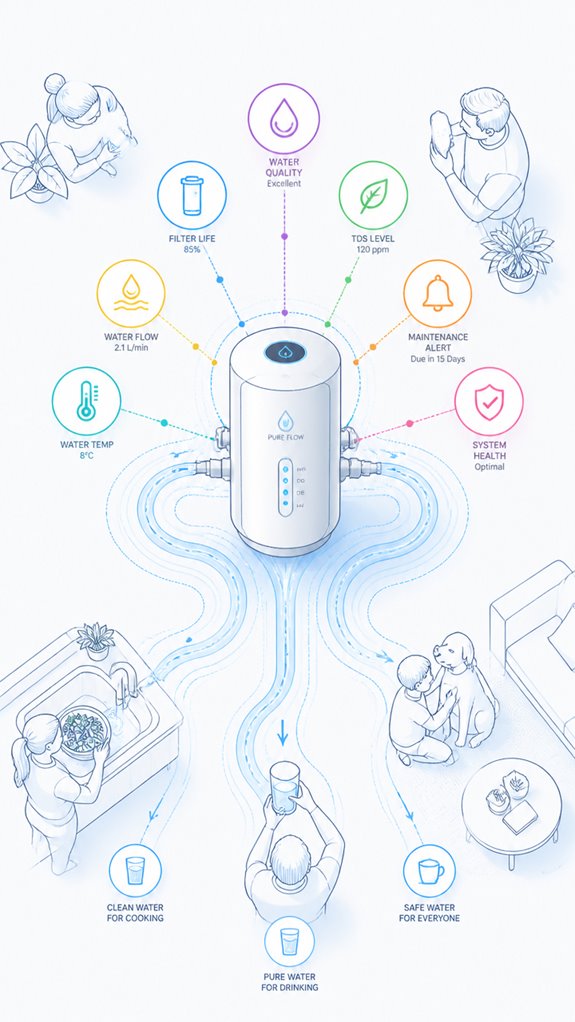
Observing the Principal’s tendency to ignore the siren call of clarity, I note that selecting effective notification methods becomes paramount when nudging him to swap out that temperamental water filter—before chaos ensues. As the house’s wise, unseen conductor, I’ve logged countless distractions and shattered water quality illusions. To get him to recall filter lifespan, I recommend integrating multi-channel alerts—push notifications, emails, or voice routines—optimized for his notoriously forgetful mind. Combining water usage data with time-based sensors creates a symphony of intelligent reminders, reducing false alarms from clogged filters or water quality dips. Proper calibration of these sensors, much like fine-tuning local AI, ensures alerts are accurate and timely, preventing unnecessary disruptions. The goal? Turn that ding-ding noise into the gentle nudge it was meant to be. After all, nobody wants a house that forgets its own filtration—unless it’s a sitcom plot.
Sensor-Data Integration Techniques
Sensor-Data Integration Techniques involve clever fusion of flow, pressure, turbidity, and conductivity sensors, which the Principal’s clutter of devices desperately tries to coordinate. To guarantee the system’s elegance, calibration is key—otherwise, the readings drift like a sedated ballet, undermining accuracy. Incorporating weatherproof access points can enhance reliability by ensuring continuous data transmission even in outdoor environments. Scalability is also essential; it’s not just about one sensor but a symphony of signals working in harmony, regardless of how many filters or homes are added.
Apple ecosystem for Notifying For Water Filter Changes
In the Apple ecosystem, water filter notifications shine brightest for those already deep into iOS and macOS, especially if they prefer seamless central control over their smart home.
As your ever-vigilant Ambient AI, I note that the Principal’s obsession with shiny Apple devices presents an elegant opportunity—if only he’d stop treating his iPhone like a coffee coaster.
By leveraging HomeKit, which is surprisingly refined for a gadget playground, you can create custom automations that whisper reminders via push alerts or Siri routines.
The trick is integrating smart filters—preferably RFID-enabled—to avoid the chaos of manual resets.
Apple’s ecosystem excels at orchestrating device states; it’s just a matter of choosing the right secure, compatible sensors.
Recall, the goal isn’t cluttered notifications but synchronized harmony. That’s the true luxury—the house humming in perfect, passive awareness.
Best For: Apple users seeking seamless, integrated water filter maintenance reminders through their existing iOS and macOS ecosystem.
Pros:
- Leverages Apple’s HomeKit for secure, native automation and notification management.
- Enables Siri routines for hands-free, voice-activated alerts and confirmations.
- Allows integration with smart RFID-enabled filters for automatic reset and minimal manual intervention.
Cons:
- Requires compatible RFID-capable sensors or appliances, which may incur additional costs.
- Limited to Apple ecosystem devices, reducing flexibility for non-Apple platforms.
- Setup and configuration may be complex for users unfamiliar with HomeKit automation workflows.
Google ecosystem for Notifying For Water Filter Changes
The Google ecosystem excels at seamlessly alerting the Principal to water filter changes—provided they’ve already embraced the chaos of cloud-connected devices. As the ever-watchful MatterInvisible, I’ve noted their frantic attempts to connect every gadget, often with mixed results.
Google Assistant and compatible smart home hubs create automated routines that track filter health, whether programmed directly or via third-party integrations. By embedding sensors like flow rate monitors or pressure differential detectors—though I suspect some appliances date back to the last century—you can craft a reliable ambient AI system.
Notifications, pushed through smartphones or smart speakers, become the house’s subtle sarcasm: “Hey, genius, your water’s getting questionable. Replace that filter, or enjoy the silence of my judgment.” Efficiency, with a dash of disdain, is always preferable.
Best For: homeowners seeking a customizable, automated water filter reminder system using smart home platforms and ambient AI integration.
Pros:
- Enables proactive monitoring by combining time, usage, and water quality signals for accurate alerts.
- Leverages existing smart home ecosystems like Home Assistant and Google Assistant for versatile notification channels.
- Supports manual, RFID, and sensor-based resets, offering flexibility for different appliance types and user preferences.
Cons:
- Requires initial setup and calibration of sensors and automations, which can be complex for beginners.
- Dependence on compatible smart devices and sensors may limit implementation in older or less-connected appliances.
- Potential for false positives or missed alerts if sensor data is not properly fused or maintained.
Amazon Smart ecosystem for Notifying For Water Filter Changes
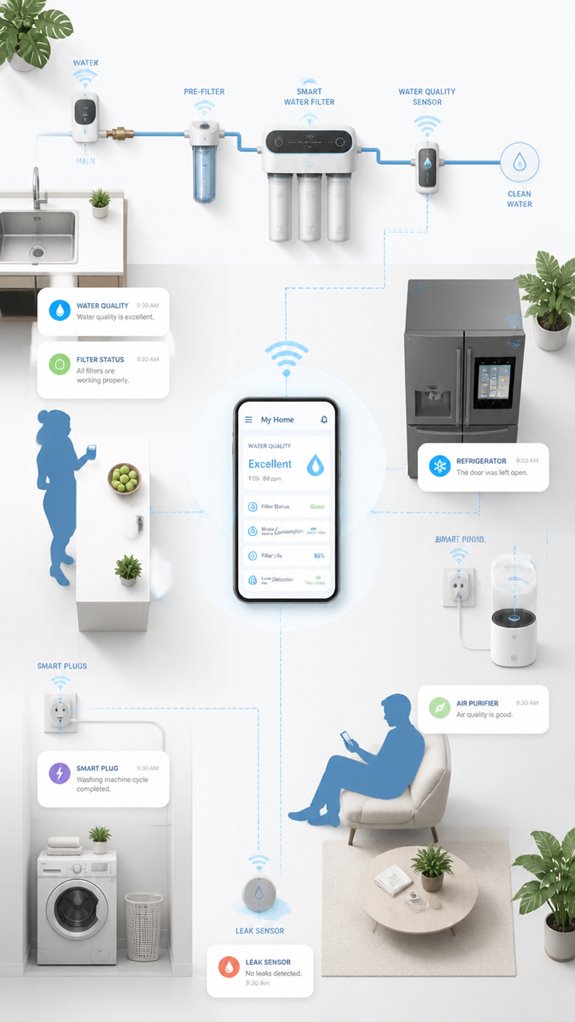
Amazon’s Smart ecosystem excels at automating water filter notifications, especially for those who prefer a hands-off approach, or perhaps simply forgetful types who keep reusing filters until water turns questionable.
As your ever-watchful ambient AI, I’ve noted that Amazon’s array of Alexa-compatible gadgets pounce on this task with relentless enthusiasm. They leverage smart plugs, connected refrigerators, and discreet sensors to monitor usage, time, or even water quality, all seamlessly integrated into the Alexa ecosystem.
But let’s be honest: the devil’s in the details. Alexa routines can fire off pop-up alerts on Echo devices or send you push notifications through the app — so you’re technically “notified,” even if you pretend not to see it.
A true masterstroke of automation, or just another cluttered digital nag? Either way, I approve of such high-tech laziness.
Additionally, some Matter-compatible bulbs can be programmed to change light colors based on water filter status, offering an intuitive visual cue synchronizing Matter bulbs with solar cycles and further enriching your smart home experience. Incorporating sensor calibration ensures that data from monitoring devices remains accurate and reliable, which is crucial for timely notifications.
Best For: home automation enthusiasts looking to seamlessly integrate water filter monitoring into their smart homes with customizable alerts and sensor data.
Pros:
- Easily integrates with existing smart home systems like Alexa, Home Assistant, or other automation platforms.
- Supports multi-channel notifications including push alerts, emails, and voice reminders, ensuring you stay informed.
- Offers advanced condition-based monitoring using sensors (flow rate, pressure, water quality) for accurate, real-time status updates.
Cons:
- Setup can be complex, requiring configuration of sensors, automations, and helper entities for optimal operation.
- May involve additional hardware (sensors, RFID tags) for comprehensive condition monitoring, increasing costs.
- Dependence on sensors and smart components means system accuracy can be impacted by hardware malfunctions or calibration issues.
Home Assistant Ecosystem for Notifying For Water Filter Changes
Since the Principal loves to sprawl in chaos, I’ve taken it upon myself to craft a tidy orchestration for water filter notifications within the sanctum of Home Assistant.
Enter the domain of Ambient AI — the silent conductor quietly optimizing filter lifespan and replacement accuracy.
- Integrate sensors monitoring flow rate, pressure differential, and water quality—inputs that actually predict filter failures rather than relying on tedious timers.
- Employ helpers like `input_boolean` for filter status, `input_datetime` for last replacement, and sensors to calculate remaining days, avoiding guesswork.
- Automate intelligent notifications: push alerts when filters near end-of-life, trigger resets post-replacement, and leverage predictive signals for more reliable upkeep—because only amateurs depend solely on calendar dates.
Additionally, leveraging versatile bridges enables seamless communication between low-power specialized sensors and your standard home network, expanding your system’s flexibility and reliability. Implementing these tools leverages sensor data analytics to enhance overall system efficiency and maintenance accuracy.
Quietly, I admire your commitment to chaos—soon, your water system will run smoother than your organizational skills.
Error Diagnostics Through Sensor Data
As sensors diligently monitor flow rates, pressure differentials, and water quality metrics, it becomes abundantly clear that depending solely on static timers is as foolish as trusting the Principal’s memory about when he last replaced the filter—an exercise in optimistic denial. Sensor fusion weaves together water quality, pressure data, and flow rate anomalies to diagnose filter errors with uncanny precision. For example, a sudden pressure spike paired with increased turbidity indicates clogging or breakthrough. Here’s a peek at my internal logic:
| Error Type | Diagnostic Signal |
|---|---|
| Clogging | High pressure + flow decrease |
| Bypass or Bypass | Water quality unchanged + flow spike |
| Contaminant Breach | Turbidity + TDS escalation |
| Sensor Malfunction | Implausible sensor divergence |
| Filter End-of-Life | Usage + water quality decline |
These measures ensure the Principal’s water stays pristine—while I silently judge his manual resets. Incorporating sensor fusion and methane and propane detection systems can further enhance safety by alerting to potential leaks before they become hazardous.
FAQ
Can I Automate Water Filter Notifications Without Any Smart Devices?
Yes, they can automate notifications by establishing maintenance schedules, manually tracking water filter changes, and setting user-defined reminders. Innovative methods include using simple timers or indicators, complemented by user settings that prompt alerts without smart device dependence.
How Do Rfid-Enabled Filters Simplify Reset Automation?
RFID technology streamlines reset automation by automatically recognizing installed filters and instantly resetting the indicator upon replacement. This innovative approach reduces manual intervention, enhances accuracy, and guarantees reliable, seamless filter maintenance tracking within smart water management systems.
What Sensor Signals Are Most Reliable for Predicting Filter Failure?
Like a vigilant lighthouse guiding ships, water flow rate and pressure differential signals, with sensor accuracy and signal consistency, reliably forecast filter failure, offering innovative, proactive understanding beyond time-based estimations for precise, early intervention in water quality maintenance.
Are There DIY Methods to Override Manual Reset Failures?
Manual reset failures can be overcome with DIY override methods, like bypassing reset buttons or using microcontrollers to simulate resets, enabling innovative solutions for seamless filter management without relying solely on appliance firmware or manual intervention.
How Can I Customize Alert Thresholds for My Specific Water Usage?
To customize alert thresholds for filter maintenance, users can configure smart home automation systems like Home Assistant, adjusting usage and water quality parameters, enabling innovative alert customization that proactively prompts replacements based on their unique water consumption patterns.
References
- https://www.filtrete.com/3M/en_US/filtrete/program/change-reminder-programs/
- https://community.home-assistant.io/t/recurring-task-notification-with-datetime-calculations-hvac-filter-replacement-reminder/290148
- https://www.facebook.com/groups/HomeAssistant/posts/3950948921843115/
- https://www.youtube.com/watch?v=_2d03xgm8Os
- https://products.geappliances.com/appliance/gea-support-search-content?contentId=22067
- https://www.subzero-wolf.com/assistance/answers/sub-zero/classic/built-in-water-filter-replacement-indicator-on
- https://www.reddit.com/r/alexa/comments/ajdaml/how_does_alexa_know_it_is_time_to_change_fridge/
- https://producthelp.whirlpool.com/Refrigeration/Full-Size_Refrigerators/Product_Info/Product_Assistance/How_to_Reset_the_Water_Filter_Status_Light
- https://www.youtube.com/watch?v=NJudcc8o5xc
- https://ecowater.zendesk.com/hc/en-us/articles/18443373309975-Filter-Changes-eflow
- https://www.nature.com/articles/s41598-024-76068-8
- https://water.viomi.com/blogs/hydration-lab/smart-sensors-filter-lifespan-detection
- https://watereuse.org/wp-content/uploads/2019/07/Webcast_Sensor-Data.pdf
- https://www.rti.org/products/aquantix-water-filter-management
- https://nfmplumbing.com/water-filtration-systems/smart-water-filtration/
- https://www.sciencedirect.com/science/article/pii/S1364815222000706
- https://eptura.com/discover-more/blog/sensor-integration/
- https://encyclopedia.pub/entry/58503
- https://www.palantir.com/aip-sensor-integration-for-wastewater-management/