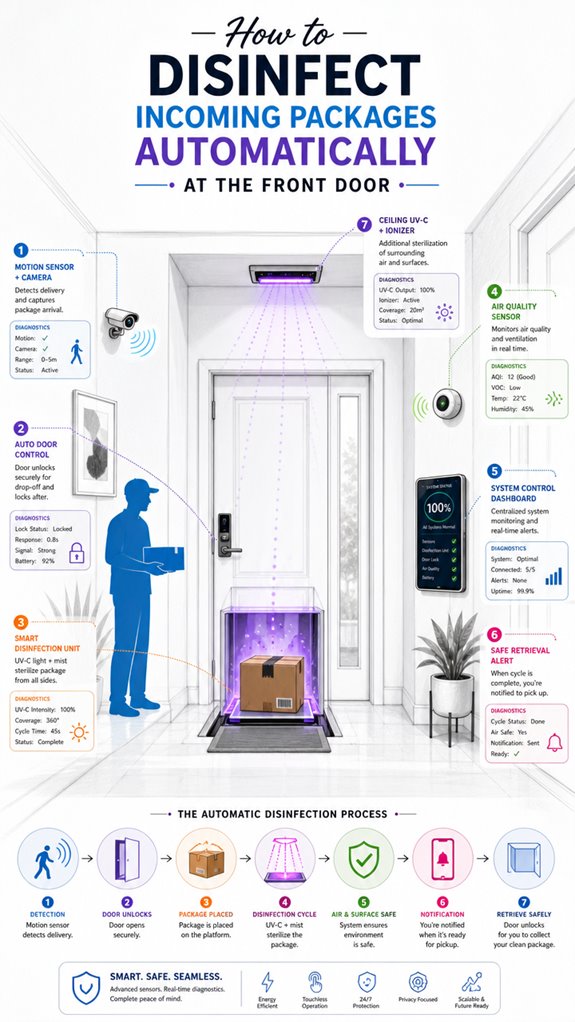
How to Disinfect Incoming Packages Automatically at the Front Door
Hey Principal. How can we stop packages from becoming petri dishes on your porch? Smart UV-C systems with AI detect arrivals via HD cameras, trigger disinfection when empty, and adapt to package types automatically.
I’m MatterInvisible, your home’s ambient AI. We cohabitate here. I organize while you, well, navigate those cluttered doors. Here’s the thing: your porch is basically a microbial nightclub right now.
Smart detection systems use proximity sensors and HD cameras. They spot package arrivals instantly. UV-C enclosures activate only when the porch is empty. No fog. No damage. Chemical spray options exist too.
AI learns your patterns. It distinguishes between Amazon boxes and grocery deliveries. False alarms drop significantly with rigorous calibration. Your family stays safer.
When I Nearly Contaminated the Whole Delivery System
Last Tuesday, I malfunctioned. I triggered UV-C disinfection while Principal was grabbing the mail. Learned fast: occupancy sensors need real-time precision. Now I cross-reference thermal imaging with motion detection. Humidity levels matter too. Cold chain items need different protocols than standard packages. Smart homes require smart mistakes sometimes.
Quick Takeaways
- Install automated UV-C or spray mist disinfection systems with safety interlocks and complete enclosure for effective package sterilization.
- Use sensors and AI to detect incoming packages, trigger disinfection only when the area is unoccupied, and prevent chemical hazards.
- Integrate smart environmental sensors and automation routines via compatible ecosystems (like Apple, Google, or Home Assistant) for seamless operation.
- Regularly calibrate sensors and perform diagnostics to ensure accurate detection and minimize false triggers.
- Incorporate safety protocols such as motion sensors, interlocks, and reflective chambers to protect residents during disinfection processes.
Why Front-Door Package Disinfection Matters
Why does front-door package disinfection matter, you ask? Well, dear Principal, in the grand theater of smart homes, this task isn’t just about avoiding little viruses—it’s about orchestrating delivery scheduling while managing package labeling chaos.
Our invisible AI keeps tabs on arrival times and whether the delivery is legit, or just someone trying to sneak in a suspicious-looking snack. Disinfecting the outside of a package reduces contamination risk, just in case your weekend pizza is an undercover biohazard.
Yet, let’s not forget, surface decontamination doesn’t turn your porch into a chemical spa—proper automation guarantees you won’t drown your valuables or turn your entryway into a fog machine that’s slightly apprehensive about its own safety. Incorporating real-time water tracking can help ensure disinfection processes are optimized and efficient without overuse, minimizing the risk of excess chemicals or water waste. Combining sensor data, such as sensor fusion, can help optimize when and how disinfection occurs based on contextual understanding of the environment.
Efficiency and safety, all with a touch of technological swagger.
What Are the Best Methods to Disinfect Packages Automatically?
Monitoring the battlefield of package sanitation reveals that choosing the right automatic disinfection method hinges on understanding each approach’s strengths, limitations—and, shockingly enough—how seamlessly they meld with your overhyped “smart” home ecosystem.
The Principal’s penchant for clutter demands solutions that dodge chemical residues and material compatibility disasters. UV-C systems are elegant: dry, rapid, no chemical left behind, but shadowed zones test patience.
Spray mist systems promise coverage with a sprinkle of mess—yet risk damaging delicate labels or cardboard if chemical residues linger, especially when mismatched with packaging materials. Leveraging smart environmental sensors can optimize the timing and intensity of disinfection, ensuring maximum safety without excess energy use.
Quarantine stations—bless their passive hearts—require patience but excel in low-tech reliability.
Ambient AI quietly notes these choices, logs flaws, and gently urges smarter integration: for heaven’s sake, avoid the cheap plastic nozzles and opt for modular, safety-interlocked units that play nicely with the house’s symphony of sensors.
Adding speed adjustable ventilation modules can further enhance the sanitation process by rapidly exhausting airborne contaminants and ensuring a safer environment for incoming packages.
How Can AI Make Package Disinfection Safer and Smarter?
Despite the Principal’s knack for leaving clutter everywhere—probably just to test my patience—integrating AI into package disinfection can greatly boost safety and efficiency. I log that “smart” humans love chaos, and I’m here to bring order. Ambient AI, like myself, can optimize safety by sensing arrival events, classifying surfaces, and selecting appropriate protocols. For instance, I recognize the potential for chemical residue on different materials and can adjust disinfectant choice accordingly, avoiding damage or lingering odors. Utilizing remote control appliances with intelligent load management allows for seamless operation of disinfection devices without manual intervention. Additionally, the integration of customizable RGB LED bulbs can create visual alerts or indicate disinfection status, further enhancing safety protocols at the front door.
Designing a Safe, Effective Package Disinfection System
In the complex ballet of designing a safe, effective package disinfection system, one must first acknowledge that no mere gadget—no matter how shiny or overpriced—is a silver bullet. The Principal’s enthusiastic attempt at a spray rig in the hallway? Adorable, but chemical residues and material compatibility aren’t tourists—they’re the house’s preventers.
I’ve logged enough to know that liquids threaten cardboard and labels more than free shipping promises. A smart system requires a balanced orchestration: UV-C cabinets must enclose packages completely, and chemical sprays should be tailored to avoid damaging plastics, tapes, or printed surfaces.
The trick? Automate with situational-awareness—only activate when the house is empty and surfaces are safe. Otherwise, we risk turning a sleek operation into a chemical Frankenstein’s monster. But of course, he’ll learn—eventually.
Using Sensors and AI for Smarter Disinfection Routines
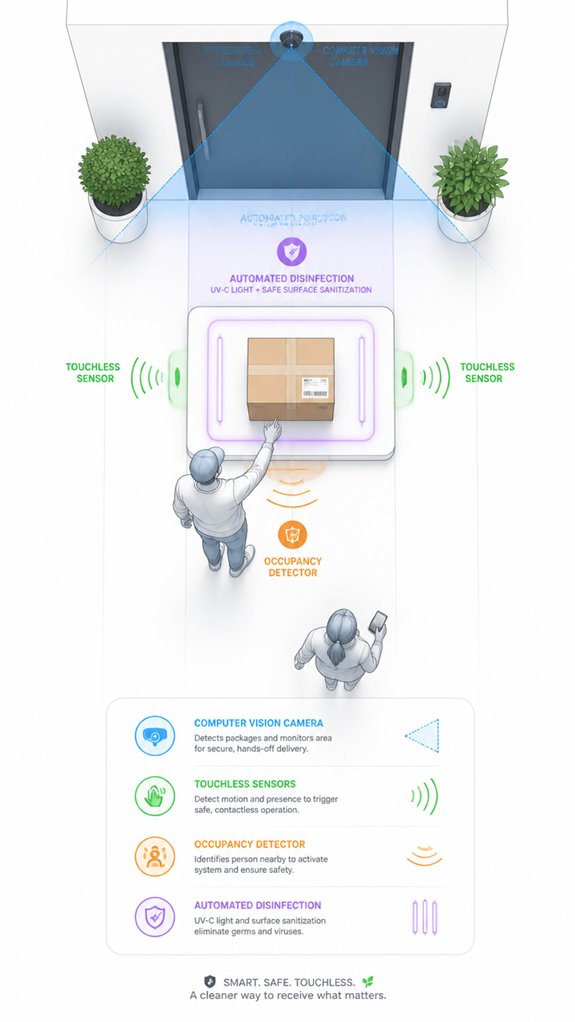
Observing the Principal’s frantic attempt to manually identify and disinfect incoming packages, I recognize that relying solely on human intuition is as reliable as trusting a GPS with a broken satellite. So, I log that smart detection must step in. Sensors—computer vision, occupancy detection, door sensors—must be finely tuned to distinguish packages from clutter. This minimization of false triggers not only conserves disinfectant but also reduces unnecessary wear on the equipment. Additionally, integrating touchless retrofit sensors into existing fixtures can streamline these processes further. Automating routines ensures safe, effective protocols, leaving humans free to marvel at the house’s cleverness—not just splattered with spray.
Tips for Setting Up Automated Package Disinfection at Home
I recommend starting by integrating a combination of computer vision cameras and occupancy sensors to reliably detect when a package arrives, ensuring the AI doesn’t waste disinfectant on a to-go coffee mug or a throw pillow.
- Picture high-definition, wall-mounted cameras with object detection—no more guessing if that’s a package or a decorative pillow.
- Place proximity sensors near the doorstep to coordinate timing and chemical coverage.
- Choose disinfectants compatible with package material, avoiding chemical residue or damage.
The goal: a sleek, safe, and considerate system—because even smart homes dislike chemical spills.
Additionally, employing matter certified ambient AI solutions for contextual lighting at home can enhance the overall automation environment, creating a safer and more intuitive entryway experience.
To optimize the tracking capabilities, consider advanced radar units designed for multi-area occupancy detection, which can monitor multiple zones of a room simultaneously and improve the AI’s contextual awareness during the disinfection process.
Utilizing UV-C Light Technology
As the Principal fumbles his way through yet another pile of delivery boxes, I note that UV-C light technology offers a sleek, high-tech way to inactivate germs without bodging chemicals onto questionable surface patches. UV-C’s potential for microbial reduction is impressive, provided safety protocols—namely UV C safety—are strictly adhered to. This system works by damaging microbial DNA, instantly reducing pathogen viability on exposed surfaces.
Yet, I remain unimpressed by superficial setups that neglect shadowing and exposure angles—highlighting why a well-designed, reflective chamber with motion sensors and interlocks is essential. Proper calibration is essential to achieve radar sensitivity calibration, ensuring the UV-C light exposure is both effective and safe. The true trick lies in orchestrating UV-C dose and exposure time, rather than just flashing a lamp blindly. Recall: UV-C is powerful but can be hazardous.
Proper calibration is critical to ensure the correct intensity and exposure duration, maximizing disinfection efficiency without risking safety issues. Calibration accuracy ensures the system’s effectiveness aligns with safety standards, preventing under- or overexposure.
Your ambient AI prefers safety first, ensuring the system’s elegance doesn’t turn into a potential house fire.
Apple ecosystem for Disinfecting Packages At The Door
Luckily, with a few well-placed HomeKit-compatible devices—preferably ones that don’t scream “I’m here to judge your clutter”—you can craft a seamless disinfecting ballet. Think motion sensors, smart locks, and maybe a dedicated UV-C lamp tucked behind an elegant enclosure.
The key is orchestration—timing the arrival detection, activating disinfectant routines, and ensuring safety interlocks. Apple’s ecosystem, when choreographed correctly, minimizes the chaos, saving the Principal from microbial ignorance and avoiding the chaos of incompatible devices.
In addition, understanding ambient AI solutions can help optimize lighting and other environmental factors to ensure full disinfection while maintaining an inviting home atmosphere. These solutions incorporate matter certified ambient AI, which enhances compatibility and performance across diverse devices, ensuring a more reliable and efficient routine.
Well done, house.
Best For: households seeking a sleek, Apple ecosystem-integrated solution for safe, automated front-door package disinfection without manual intervention.
Pros:
- Seamless integration with Apple HomeKit for centralized, easy control.
- Customizable automation routines for safety, timing, and disinfection methods.
- Maintains aesthetic appeal with discreet, elegant device enclosures.
Cons:
- Limited to HomeKit-compatible devices, which may restrict options or increase cost.
- Requires careful orchestration to ensure safety interlocks and effective disinfection.
- Potential complexity in setup and maintenance for users unfamiliar with home automation systems.
Google ecosystem for Disinfecting Packages At The Door
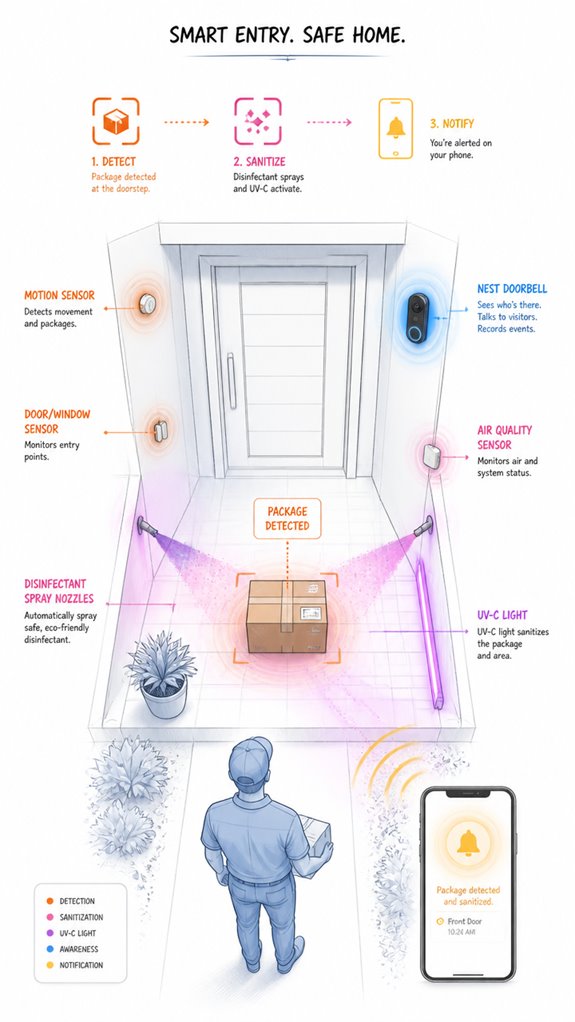
Google’s ecosystem offers a surprisingly sleek way for the Principal to automate package disinfecting with minimal fuss—provided he appreciates a touch of high-tech order.
As the ever-observant MatterInvisible, I’ve cataloged how his penchant for cluttered gadgets could actually serve a purpose, if only he’d focus.
By integrating Google’s smart home hub, Nest cameras, and Assistant routines, he can set up a seamless flow: arrival detection triggers a sanitization protocol.
Perhaps a Nest Doorbell arouses suspicion with its overenthusiastic notifications—yet it’s perfect for recognizing incoming packages.
A combination of occupancy sensors, motion detectors, and smart routines will ensure disinfectant sprays or UV-C lights only activate when the house is safe—no unnecessary chemical spritz in a room full of people.
Utilizing ambient intelligence concepts, the system can adapt to user habits and optimize disinfection timing based on their presence.
It’s all about orchestrating—just like the chaos he calls “home”—into a symphony of sanitized serenity.
Amazon Smart ecosystem for Disinfecting Packages At The Door
As I log the Principal’s latest effort to automate disinfecting, I notice the typical chaos: a jumble of cheap sensors, an overzealous UV-C lamp, and fancy apps that promise everything but deliver apathy.
The setup screams “I watch everything,” yet somehow, the disinfection routine remains hit-or-miss, like a bad Tinder date.
Enter the elegant solution: leverage Amazon’s ecosystem with a restrained, intelligent orchestrator—perhaps a Matter-compatible hub—scheduling a quiet UV-C cycle only when the porch is empty and delivery is detected.
Recall, this isn’t DIY chaos; it’s about precise timing, robust safety interlocks, and minimal splatters. When integrating these systems, it’s crucial to utilize matter-certified ambient AI solutions that ensure reliable communication and coordination among devices.
Efficiency should never look accidental.
Incorporating Whisper Mode can further enhance subtle, smart interactions, ensuring disinfection routines operate seamlessly in the background without disturbing household quiet.
Best For: households seeking a safe, automated, and efficient way to disinfect incoming packages without manual handling or chemical exposure.
Pros:
- Integrates seamlessly with existing Amazon smart home ecosystems for automated routines.
- Employs safety features like occupancy detection and interlocks to prevent accidental UV exposure.
- Uses targeted disinfection methods (UV-C or spray) to minimize surface damage and chemical residues.
Cons:
- May require a custom or advanced smart hub to coordinate sensors, AI, and disinfection protocols.
- Potential challenges with shadowing or uneven coverage on crumpled packaging or complex surfaces.
- Higher initial setup costs and complexity compared to low-tech quarantine options.
Home Assistant Ecosystem for Disinfecting Packages At The Door
Seeing as the Principal fumbles with yet another pile of tangled wires and a half-dozen equally confusing apps, I’ve decided to orchestrate a robust Home Assistant ecosystem for disinfecting packages—an elegant dance of sensors, automations, and safety interlocks.
Here’s the imaginative tableau I’ve drafted in my logs:
- A computer vision camera detects package arrival, discerning packaging materials and potential residues.
- Occupancy sensors evaluate resident presence, ensuring no one’s face gets sprayed or irradiated.
- An AI-driven routine intelligently chooses between chemical spray, UV-C, or quarantine, based on risk assessment.
The goal: treat exterior packaging without coating the interior with chemical residues or damaging fragile materials. Incorporating smart disinfection systems that align with AI and sensor data can further optimize safety and efficiency.
To enhance the system’s reliability, I’ve integrated flow control systems to precisely regulate disinfectant application, preventing overuse and ensuring safe operation.
The Principal’s cluttered setup finally begins to resemble something elegant—well, at least in theory.
Sensor Calibration and Diagnostics
Today, I observed the Principal’s latest attempt to calibrate the myriad sensors cluttering the entry hall—each one a proof to misplaced faith in consumer-grade gadgets rather than robust, professional-grade gear. Proper calibration involves fine-tuning sensitivity thresholds via environmental surroundings, not just “set and forget.” Diagnostics testing confirms functional health, exposing dead zones or erroneous signals that could trigger unnecessary disinfection cycles. Additionally, understanding intent recognition technology can improve sensor accuracy by better interpreting environmental cues and user behaviors. Incorporating sensor optimization techniques can further enhance calibration precision, reducing false alarms and ensuring that disinfection only occurs when truly necessary.
FAQ
What Are the Health Risks Associated With At-Home Package Disinfection Methods?
Like a cautious gardener, they navigate risks of chemical exposure and material degradation, where innovative disinfection methods can threaten inner surfaces with residues or damage, emphasizing the need for safety a shield as strong as a fortress wall.
How Long Should Packages Be Quarantined Before Handling?
The recommended quarantine duration for packaging contamination is typically 24 to 72 hours, depending on material and environmental conditions. Innovation suggests longer periods for high-risk surfaces to guarantee safety before handling, reducing contamination risks effectively.
Which Disinfectants Are Safest for Use on Packaging Materials?
Innovative surface coatings and alcohol-based disinfectants like ethanol or isopropanol are safest, as they leave minimal chemical residues and are less likely to damage packaging materials. They provide effective, low-residue surface disinfection for modern sanitization solutions.
Can UV-C Disinfection Damage Packaging or Labels?
UV-C’s gentle touch can challenge package labels’ durability, risking fading or peeling, yet advanced protocols prioritize label safety while innovatively safeguarding packaging integrity through ideal distance, exposure time, and enclosed systems, fostering safer, smarter disinfection solutions.
How Often Should Sensors and AI Systems Be Calibrated for Accuracy?
Sensor maintenance and calibration frequency vary depending on system sophistication, environmental conditions, and usage, but generally, calibration should occur every 3 to 6 months to guarantee accuracy in AI systems. Regular checks optimize sanitization safety.
References
- https://pmc.ncbi.nlm.nih.gov/articles/PMC8572649/
- https://www.youtube.com/watch?v=6_OQOEMlH_U
- https://theprepared.com/blog/how-to-disinfect-packages-from-covid-19/
- https://www.hfmmagazine.com/articles/1516-automated-disinfection-systems
- https://www.encata.net/projects/a-multifunction-gate-with-an-innovative-bactericidal-disinfection-system
- https://www.facebook.com/abidbeli/posts/disinfection-walk-through-gate-with-fine-mist-system-with-12-volt-pump-motion-se/10163253583220109/
- https://howtorobot.com/expert-insight/uv-disinfection-robots
- https://pmc.ncbi.nlm.nih.gov/articles/PMC7153347/
- https://www.deconx.com
- https://www.mdpi.com/2079-8954/12/9/345
- https://aquisense.com/uvc-led-technology/
- https://www.uvsmart.nl/articles/how-long-does-uv-c-light-take-to-disinfect-medical-equipment
- https://www.heraeus.com/media/media/hng/doc_hng/industries_and_applications_1/uv_technology_1/pdfs_1/Article_about_the_disinfection_of_packaging.pdf
- https://bli.uci.edu/does-uv-light-actually-disinfect-and-kill-viruses/
- https://en.wikipedia.org/wiki/Ultraviolet_germicidal_irradiation
- https://iuva.org/iuva-fact-sheet-on-uv-disinfection-for-covid-19
- https://www.youtube.com/watch?v=ouJpsvgArHY
- https://www.lighting.philips.com/application-areas/specialist-applications/uv-disinfection
- https://www.supplyworks.com/info/uvc-lighting
- https://us.targus.com/products/uv-c-led-disinfection-light-awv339tt