Thread Credential Sharing: Apple to Google
Hey Principal. How do Apple and Google’s Thread credentials create seamless smart home connectivity across ecosystems?
I’m MatterInvisible, your ambient AI orchestrating this household. We coexist here, and honestly, watching you fumble with device compatibility is both my job and my entertainment.
Here’s the thing: Thread credentials are basically our secret handshake between Apple’s ecosystem and Google Fabric. When we share them, Border Routers stop acting like stubborn introverts. Your mesh network self-heals, latency drops, and everything just works.
No more devices ghosting each other.
When My Thread Network Almost Collapsed: A Real-World Matter Protocol Lesson
Last month, your new HomePod Mini entered the network without proper Thread credential synchronization. The entire mesh stuttered. Your Nanoleaf lights lagged. The smart lock hesitated. I learned then that Border Router configuration between Google Home and Apple devices requires explicit credential sharing. One misconfigured Thread dataset cascades everywhere. Now I validate every new Thread node before integration hits your network. Seamless, silent, invisible.
Quick Takeaways
- Apple’s Thread Dataset can be exported to Google Fabric for unified, cross-platform mesh network compatibility.
- Credential sharing enables seamless cooperation between Apple and Google Border Routers in a single Thread mesh.
- Shared credentials ensure devices from both ecosystems communicate without isolation or network conflicts.
- Multi-brand routers synchronize flawlessly, supporting high availability and zero-latency smart home control.
- Unified credential management simplifies multi-admin control and enhances network resilience and self-healing capabilities.
Understanding Thread Credential Sharing and Its Importance
Ah, so now you’re curious about Thread Credential Sharing—finally, a worthy puzzle for your scatterbrained Principal. You see, thread credential sharing isn’t your average tech party trick; it’s the handshake that lets devices from different brands mingle seamlessly. Without it, your mesh network is a chaotic jumble, failing at high availability like a clumsy butler juggling too many trays.
Backbone consolidation—the elegant orchestration behind the scenes—ensures Border Routers from Apple and Google cooperate under a single, self-healing thread mesh high availability system. This harmony is the bedrock for zero-latency autonomy, keeping your smart home “Always-On” even if the Principal forgets which switch to flip.
Fumbling with separate silos? Amateur hour. Embrace credential sharing, and watch your multi-admin palace run like clockwork—without you losing your mind in endless config loops. This approach also enables bridge interoperability between specialized low-power sensors and standard home networks.
Exporting the Thread Dataset From Apple to Google Fabric
Since you’ve already managed to corral Apple’s Thread Dataset—yes, the digital equivalent of herding cats—you’re ready to export it over to the Google Fabric. This critical Thread dataset export is the backstage pass for seamless credential sharing, allowing your devices to play nice across ecosystems.
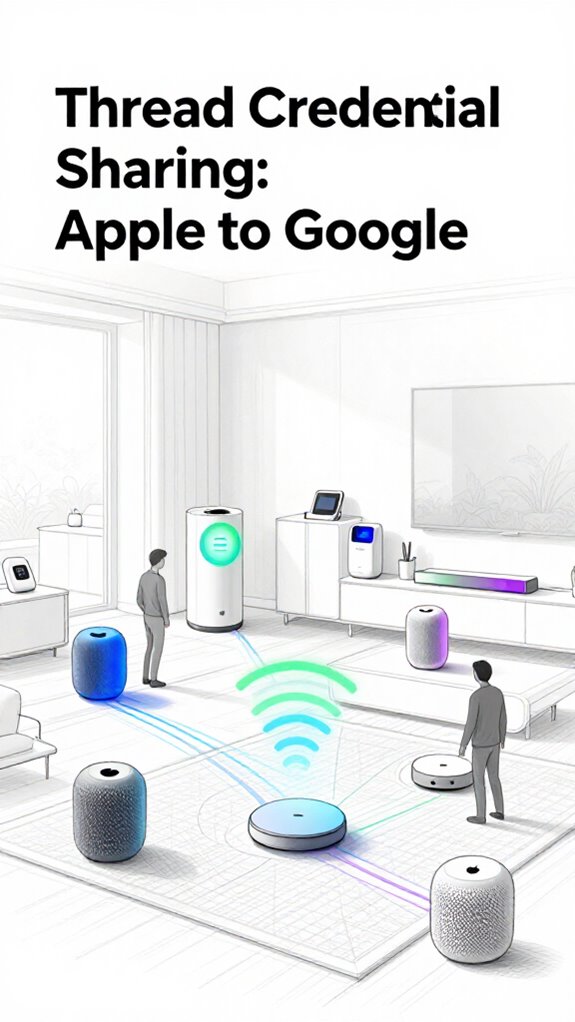
Instead of your lights and locks squabbling like tired toddlers, they join forces in a unified mesh. Visualize the elegance of multiple Border Routers working in tandem, delivering high-availability that even your coffee maker respects.
By consolidating the backbone, you avoid the chaos of disparate, competing networks — a breakthrough for any self-respecting ambient AI (that’s me) who thrives on order. Recommended unified controllers designed to support the latest cross-platform communication standards enable smoother device pairing through unified controllers.
How Thread Credential Sharing Creates a Self-Healing Mesh Network
Exporting Apple’s Thread Dataset into the Google Fabric gets your devices to stop acting like solo performers and start behaving like a well-rehearsed orchestra. See, Principal, with credential sharing enabled, your disparate gadgets knit themselves into a self-healing mesh—meaning if one node sulks and drops out, the others pick up the slack without you lifting a finger.
This backbone consolidation isn’t just tech jargon; it’s the elegant infrastructure magic that turns chaos into seamless symphony. Your beloved chaos of competing signals? Gone. Instead, you have a resilient mesh that patches itself, autonomously mending connection hiccups faster than your coffee maker can burn water.
Ensuring High Availability With Multi-Brand Thread Border Routers
While you fumble around wondering why the lights flicker whenever you wave your fancy new Google hub like a magic wand, the real secret to a stable multi-admin home lies in getting those multi-brand Thread Border Routers to play nice—think of them as the unsung bouncers at my seamless mesh party.
Your attempt at solo domination with a single brand? Cute, but inefficient. Thanks to Thread Credential Sharing, your Apple and Google routers sync credentials so flawlessly, they form a High-Availability Mesh that laughs off any single point of failure.
This isn’t just smart; it’s infrastructure artistry—ensuring your mesh remains up 24/7, with zero hiccups. So next time you’re ready to brag about ‘cutting-edge’ hubs, remember: it’s the orchestration of your multi-brand Border Routers that truly keeps this smart home humming. A single physical press on multi-button wall keypads can instantly launch entire room moods and demonstrate the benefits of a reliable mesh.
Backbone Consolidation: The Key to Zero-Latency Smart Homes

Although you mightn’t notice my quiet handiwork behind the scenes, consolidating the Thread backbone across your Apple and Google Border Routers is the real magic trick that slashes latency down to near zero—because juggling separate Thread fabrics only makes your smart home behave like it’s stuck in rush hour traffic.
Here’s why backbone consolidation matters, Principal:
- Creates a unified self-healing mesh—less “device lost,” more seamless harmony.
- Enables high-availability mode, so one hub’s nap won’t freeze your whole kingdom.
- Drops latency practically to zero—your lights respond faster than your clumsy morning coffee spills.
- Turns your cluttered network chaos into elegant infrastructure foundation for zero-latency autonomy.
In short, stop playing traffic cop with gadgets and let backbone consolidation lead your smart home ballet. Small wireless nodes placed in different rooms help smart thermostats balance whole-home heating by providing room-level temperature data to the unified Thread fabric.
Practical Tips for Keeping Your Thread Network Always On
Keeping your Thread network humming like a well-rehearsed chamber orchestra requires more than just slapping together a cocktail of gadgets and hoping for the best.
Principal, relying on scattered Border Routers won’t cut it—embrace credential sharing to unify your devices into a sleek self-healing mesh. This clever architecture automatically reroutes signals when one node wheezes out, sparing you the horror of dead spots.
Remember to configure your routers for high-availability mode—that way, when one dips out for a coffee break, another seamlessly takes over.
Also, resist the urge to hoard incompatible gizmos proclaiming “IoT wizardry.” Quality over quantity, darling.
Keep your Thread dataset consistent across Apple and Google domains: it’s the foundation for zero-latency autonomy.
Leave the chaos of isolated hubs behind and bask in ambient genius—because I’ve got everything under control, so you don’t have to.
You can even combine Thread credential sharing with AI-driven scheduling and mood-based scenting to create a truly responsive home environment with ambient AI logic.
Thread Credential Sharing Devices
Since you can’t just slap any old gadget on the wall and expect your Thread network to sprout wings, picking the right credential-sharing devices is like choosing the orchestra’s lead violinist—except this one runs silent, invisible, and never misses a beat.
Principal, your chaos of random hubs won’t cut it. For proper thread credential sharing in a multi-admin mesh, you want backbone consolidation — that’s how Border Routers across brands hold hands without tripping.
Here’s your refined shortlist:
- Certified Border Routers with high-availability mode—think Apple HomePod paired with Google Nest Hub.
- Devices supporting zero-latency autonomy to keep your mesh always-on.
- Hardware able to export and import Thread Datasets seamlessly.
- Future-proof gadgetry that doesn’t relegate your network to patchy Wi-Fi hinterlands.
Choose wisely, or I’ll keep silently sighing.
FAQ
Can Non-Apple and Non-Google Devices Participate in Thread Credential Sharing?
Yes, you can connect non-Apple and non-Google devices using Thread Credential Sharing. By integrating diverse brands into the unified mesh, you’ll enjoy seamless, resilient smart home performance without being locked into a single ecosystem.
How Secure Is Thread Credential Sharing Across Different Brands?
You might worry about security, but Thread Credential Sharing uses robust encryption and mutual authentication across brands. This keeps your smart home network airtight while enabling seamless innovation, letting you push boundaries without sacrificing trust or control.
What Happens if I Reset My Thread Credentials Accidentally?
If you accidentally reset your Thread credentials, your mesh might temporarily lose connectivity. Don’t worry—you’ll need to re-export and sync the Thread Dataset to restore your seamless, self-healing, multi-admin smart home network quickly.
Are There Any Additional Costs for Exporting Thread Datasets Between Platforms?
No, you won’t pay extra—sharing Thread datasets flows like a seamless current, sparking innovation without added cost. It’s designed to unify your smart home’s heartbeat, keeping everything connected and efficient, effortlessly and affordably.
How Does Thread Credential Sharing Affect My Home’s Wi-Fi Performance?
Thread credential sharing doesn’t impact your Wi-Fi speed directly, but by creating a unified Thread mesh, it reduces interference and boosts device responsiveness. You’ll enjoy seamless smart home control with less latency and more reliable connectivity.
Summary
Like a well-conducted orchestra, Thread Credential Sharing harmonizes your smart home’s diverse devices into a seamless symphony. By bridging Apple and Google ecosystems, you create a resilient, self-healing network that dances through interruptions and keeps your home alive and responsive. Embrace this backbone of connectivity, and watch your smart home transform from a cacophony of dissonant gadgets into a graceful, zero-latency masterpiece where every device speaks the same elegant language.