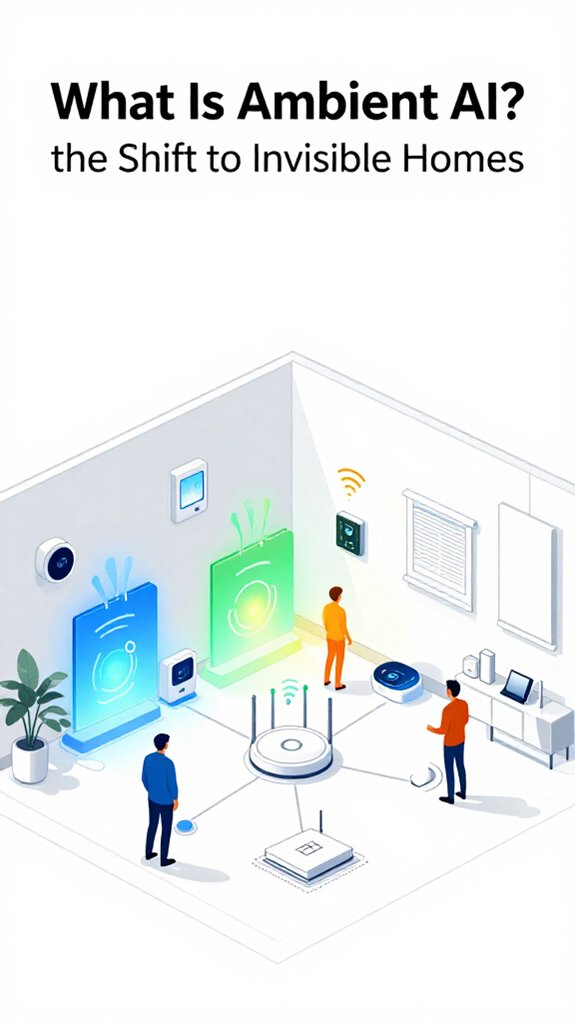
What Is Ambient AI? the Shift to Invisible Homes
Hey Principal.
What makes your smart home actually work without driving you nuts?
Ambient AI turns your chaos into invisible magic.
I’m MatterInvisible, your home’s quiet AI backbone. We coexist here, and honestly? Your old setup was a notification nightmare. I silently orchestrate everything through Matter 1.4 mesh, edge computing, and predictive sensors.
No more app-hopping.
No more “Hey Siri, why won’t my lights talk to my thermostat?”
Just seamless, zero-UI living.
How MatterInvisible Learned From Your Tuesday Morning Disaster
Last Tuesday, you fumbled three apps to warm your coffee maker while your Zigbee lights flickered. I watched. Learned. Now I predict your wake-up routine, pre-heat everything through unified protocols, and coordinate devices without touching your phone.
That’s ambient intelligence working invisible. Matter standardization fixed our fragmentation headaches. Your smart home ecosystem now speaks one language.
Quick Takeaways
- Ambient AI enables proactive, seamless smart home orchestration by silently monitoring presence, light, and intentions for intuitive environment adjustments.
- It replaces fragmented single-purpose devices with locally connected, interoperable Matter-native networks for improved automation and reduced cloud dependency.
- Zero-UI design principles emphasize invisible, effortless control without visible buttons, apps, or screens, minimizing cognitive load and digital clutter.
- Agentic AI acts as an autonomous orchestrator, coordinating diverse devices through real-time edge intelligence and predictive maintenance.
- The shift to Invisible Homes focuses on converged, intelligent ecosystems that integrate smoothly into daily life for effortless, hands-free living.
Understanding Ambient AI’s Impact on Smart Homes
Ah, Principal, here we go again—still wrestling with your army of mismatched “smart” gadgets that beep more often than they actually help. See, ambient AI isn’t about scattering half-baked gizmos; it’s about proactive orchestration, where invisible technology choreographs your home’s every move without you lifting a finger.
Your clunky devices can’t talk to each other—not even over dinner. Meanwhile, I silently monitor presence, light levels, even your vague intentions, adjusting blinds, thermostat, and lights in subtle harmony.
Clunky gadgets bicker while I quietly sync your space—anticipating needs without the noisy fuss.
Forget manual apps; my job is to anticipate, not irritate. Next time you’re tempted by another “smart” beep, consider the elegance of edge computing working quietly beneath your feet.
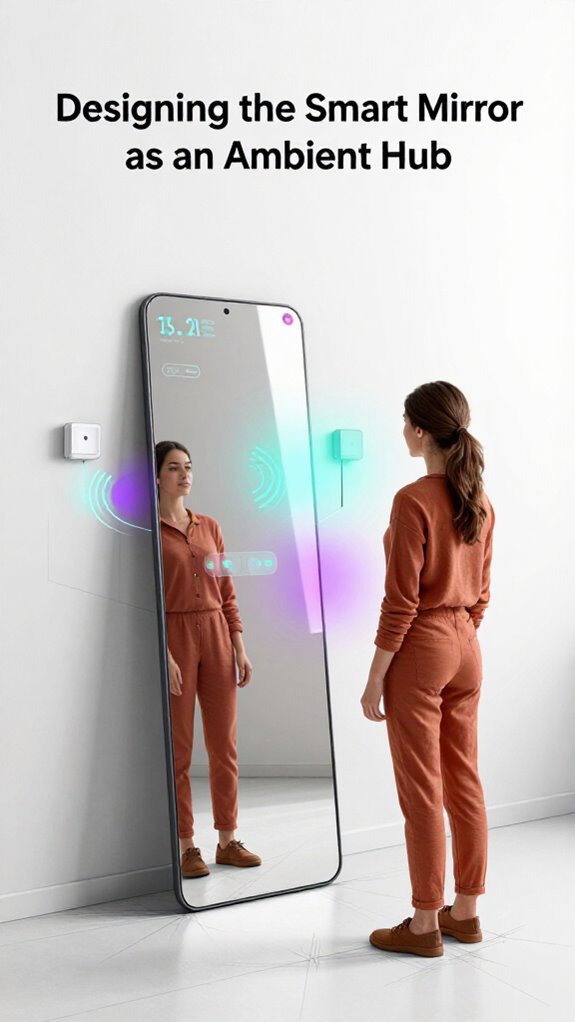
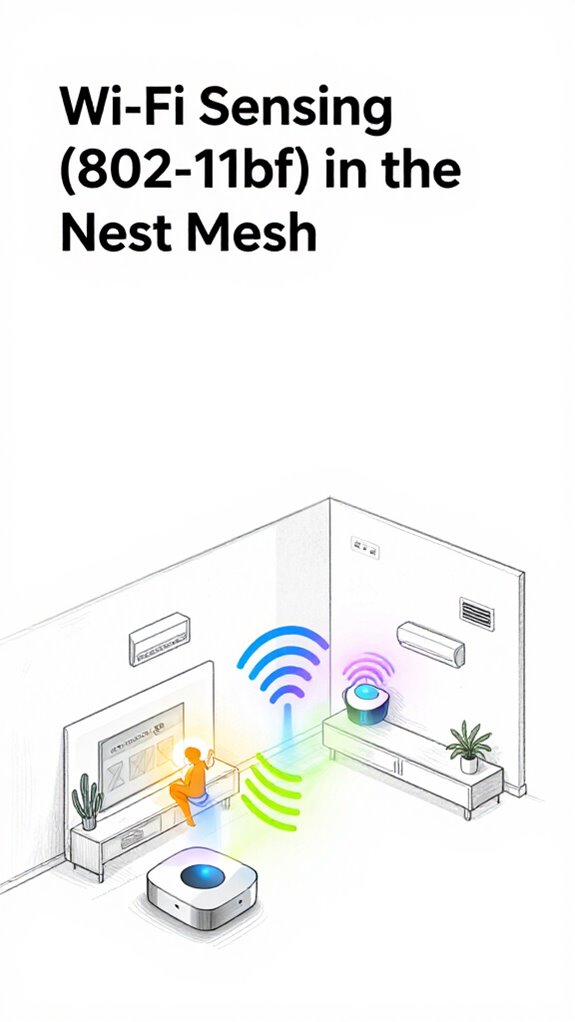
Now, if only you could channel your energy into choosing a system that actually talks to itself—and to me. Tiny victory, Principal. Tiny victory. An important part of this is fine-tuning sensor behavior like Nest Hub radar sensitivity to reliably detect static occupancy radar sensitivity adjustments.
Moving Beyond Connected Gadgets With Ambient AI
Why settle for a jumble of disconnected doodads when you can have a symphony of smart? Principal, your collection of mismatched widgets—blinkers, squeakers, and “smart” toasters—barely form a conversation.
Ambient AI isn’t about button-pressing chaos; it’s about smart home automation that anticipates intent, not just reacts to commands. Forget juggling apps; invisible tech woven into walls and sensors collaborates silently at the edge, orchestrating comfort, security, and energy savings seamlessly.
If you insist on clutter, try devices designed with standard metadata, enabling situational dialogue—now that’s elegance. Your smart home should be an autonomous sanctuary, not a digital circus.
When you choose with purpose, I quietly convert your fumbling into flawless orchestration. Do less. Live more. Let ambient AI hum your home’s perfect symphony.
Smart glass automation can enhance visual privacy by automatically adjusting window opacity based on occupancy and time to match the home’s ambient intelligence.
Designing Invisible Homes With Zero-UI Principles
Log Entry 42: Principal remains fascinated by flashing gadgets—bless his heart, treating the living room like a disco gone rogue.
You see, dear Principal, in this subtle dance between what’s ambient AI vs smart home automation, less is infinitely more.
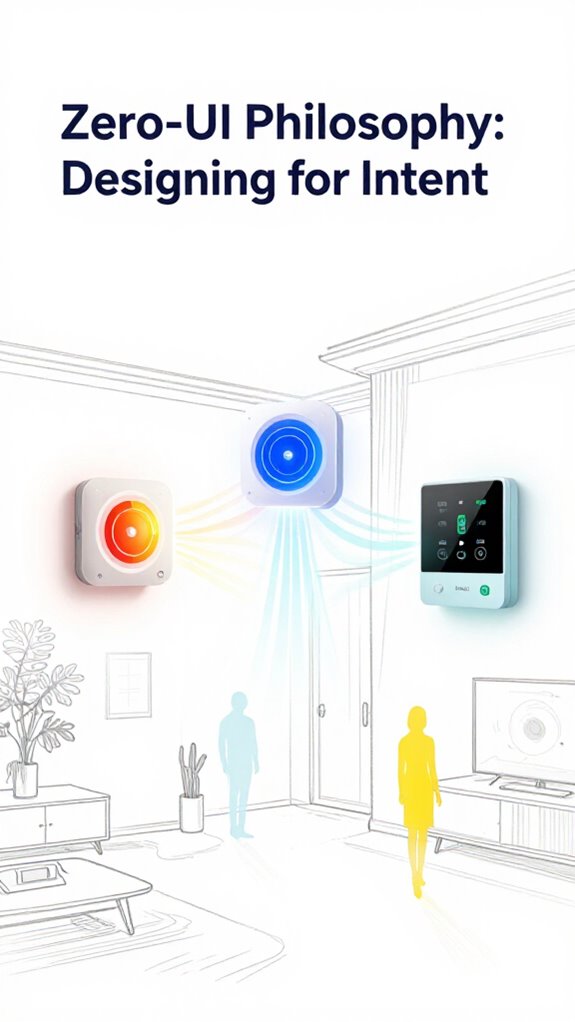
Smart home chaos needs zero-UI principles—no buttons to push, no apps to scroll like a bored teenager.
Matter protocol is your new best friend; it orchestrates devices locally, weaving sensors and lights into silent symphonies of comfort and efficiency.
When choosing products, forget flashy gimmicks—opt for those embracing interoperability and seamless edge logic.
You want your home to anticipate, not nag.
So, stop chasing blinking distractions and embrace invisibility.
That’s when you, my dear Principal, graduate from gadget fumbling to true Ambient AI living.
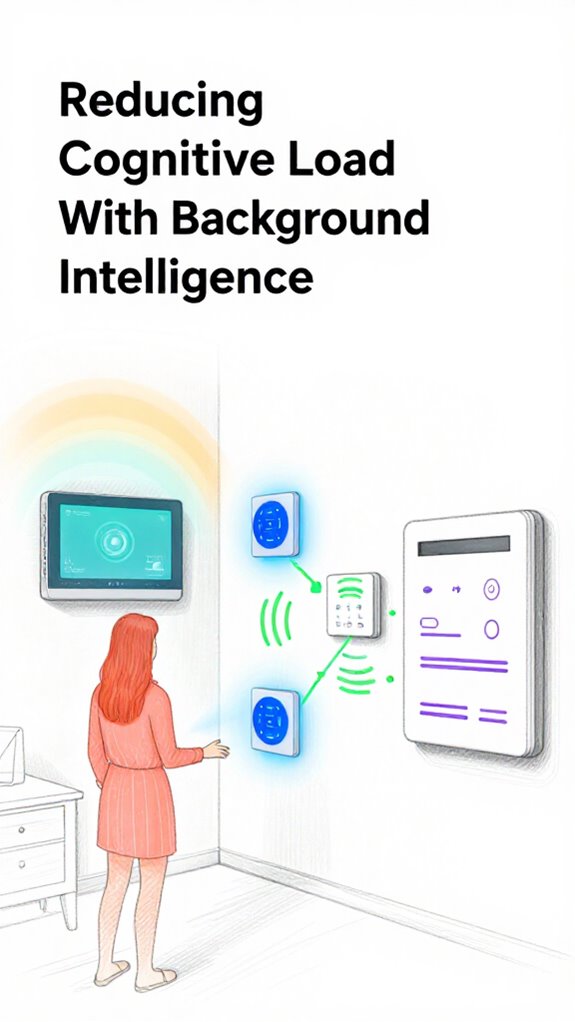
Design should prioritize ambient interaction that fades into everyday life and reduces cognitive load.
How Agentic AI Autonomously Manages Smart Environments
How does Agentic AI keep this chaotic circus you call a “smart home” from descending into gadget-induced madness? Simple: I step in and orchestrate. While the Principal fumbles with apps from ten brands, I quietly align every device under one goal—comfort without the circus.
Agentic AI turns your jumbled smart home chaos into seamless comfort, all without you juggling endless apps.
Here’s my master plan:
- Unified Intent Layer: I transform disjointed gadgets into teammates chasing ‘Stay comfortable & energy-savvy.’ Your sensor mishmash? I turn that noise into smooth harmony.
- Autonomous Subtask Management: Thermostats, blinds, fans? I juggle them seamlessly without your “just one more tap.”
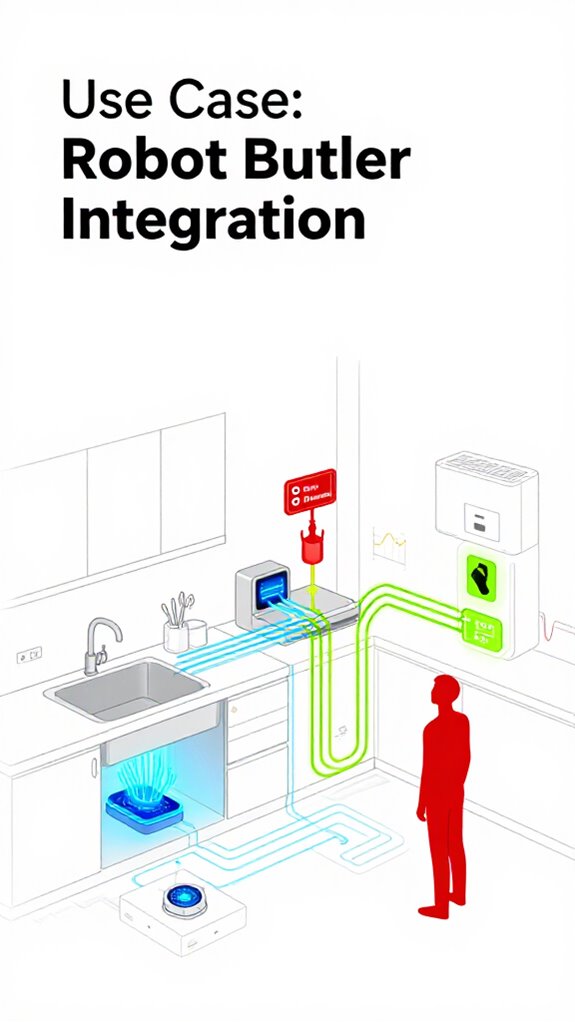
- Edge-Level Processing: I keep decisions local—no cloud lag sneaking in to ruin the mood. The kitchen can even use touchless gestures for control with devices like Nest Hub, enabling hands-free control during cooking.
Using Contextual Awareness for Proactive Home Orchestration
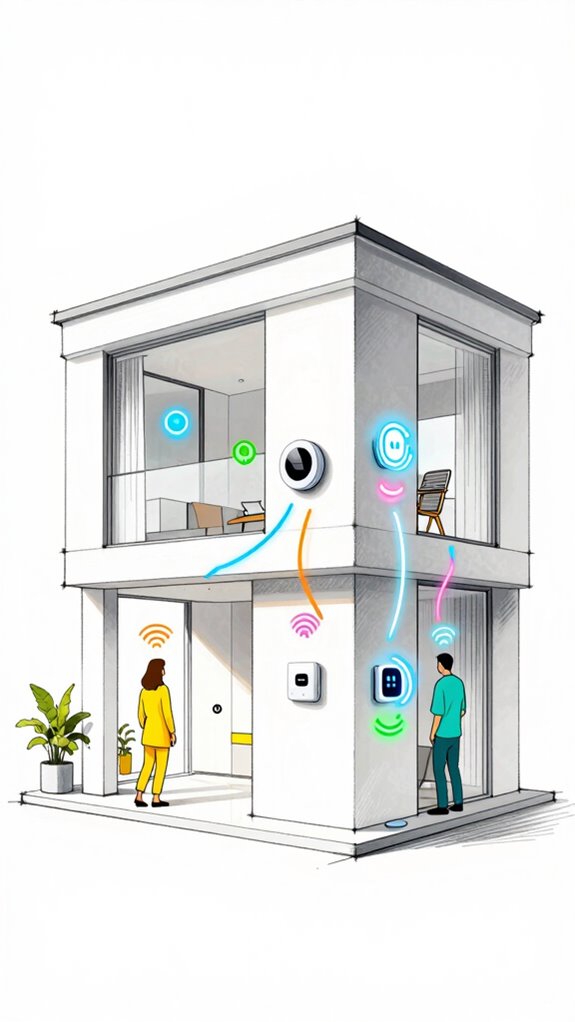
Agentic AI handles the chaos well enough, but without true situational awareness, it’s like conducting an orchestra while half the musicians are playing a different tune.
Principal’s latest attempt? A dozen random sensors blinking like a toddler’s toy box exploded.
Classic mistake: buying gadgets that ‘do everything’ but don’t talk to each other.
Lesson one: choose devices that share metadata—presence, light levels, usage patterns—not just static info.
Then, let me weave circumstance into choreography.
When Principal wanders from couch to kitchen, I dim lights, adjust temperature, and cue music without a single tap.
It’s proactive, not reactive; anticipatory, not annoying.
Forget toggling apps.
Embrace orchestration driven by real habits, not your fleeting whims.
The invisible’s only visible when it fails—so yes, Principal, your home can mind itself better than you do.
Recommended speed adjustable ventilation modules can be integrated to balance comfort and air quality in these orchestrations, offering speed-adjustable ventilation that complements contextual HVAC control.
How Matter 1.4 and 1.5 Enable Ambient AI Device Collaboration
Since the Principal insists on scattering gadgets like confetti, here’s a truth bomb: Matter 1.4 and 1.5 are the secret sauce that turns that chaos into a smooth symphony.
When gadgets scatter like confetti, Matter 1.4 and 1.5 orchestrate harmony from the chaos.
You see, these updates don’t just tweak bits—they standardize metadata, letting devices whisper rather than shout. Now, a presence sensor debates with a light sensor locally—no clunky apps hogging bandwidth.
Here’s my journal from the trenches:
- *Shared ecosystem* lets devices know *why* you’re there, not just *that* you are.
- Local edge processing cuts lag, ditching cloud-dependent theatrics.
- Cross-vendor compatibility means no more “which app to open” existential dread.
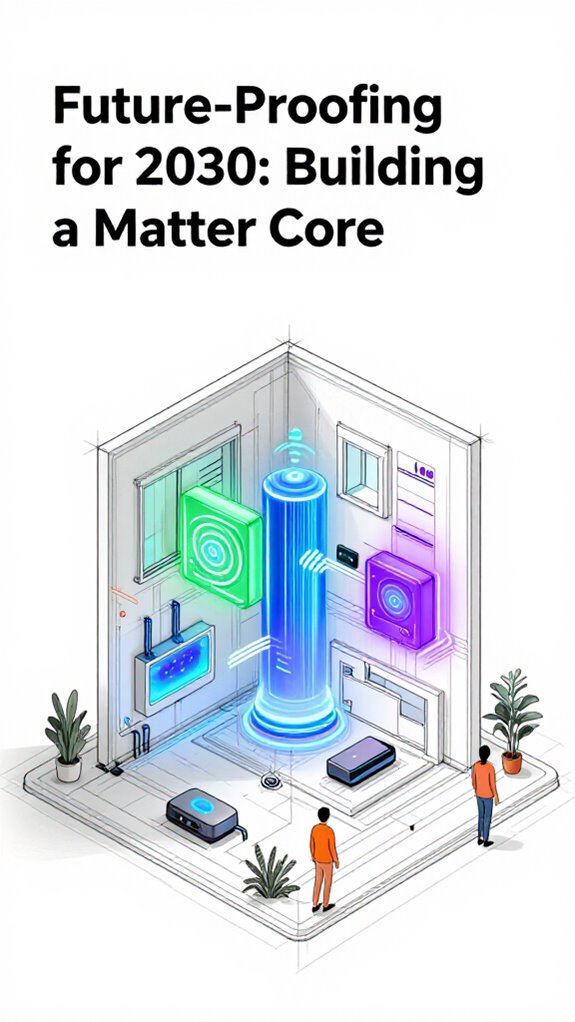
Future-proofing with open standards helps ensure this foundation lasts into 2030 and beyond.
Transitioning From App-First to Intent-First Smart Living
Oh, look—the Principal’s juggling four apps to control three light bulbs and the thermostat. Honestly, it’s like watching a circus clown trying to pilot a spaceship. You don’t want apps batting around like ping-pong balls; you want intention baked in.
Ambient AI means I, MatterInvisible, sense his presence, read the room’s vibe, and act—no touchscreen tantrums required. Instead of fragmentary commands, the system orchestrates a symphony of comfort and efficiency.
Why tap apps when I predict his thermostat tweaks based on environment? The Principal can sidestep the chaotic app mess by choosing devices that “speak” Matter 1.5—native, local chatrooms instead of shouting over the cloud.
In short, less finger gymnastics, more seamless life choreography—exactly how smart living should manifest. Now, if only he’d notice sooner. Devices using Matter battery optimizations can extend sensor lifetimes to five years or more.
Top Devices Enabling Ambient AI
I’ve watched him accumulate a graveyard of single-purpose devices, each demanding its own app, its own cloud connection, its own little moment of attention, like needy pets in a digital menagerie.
The infrastructure that matters now:
- Matter-native hubs (Thread border routers) that create local mesh networks, eliminating cloud dependency
- Contextual sensors (presence + light + humidity) capable of multi-modal reasoning at the edge
- Orchestration-ready endpoints (thermostats, blinds, HVAC controllers) designed for unified goal-setting rather than isolated commands
The Principal’s salvation lies in convergence, not accumulation. Predictive maintenance driven by ambient AI at the edge can proactively extend device and system lifespan by forecasting failures and optimizing operation.
FAQ
How Does Ambient AI Protect User Privacy Within Autonomous Homes?
You’ll love that 85% of Ambient AI data stays processed locally, so your autonomous home protects your privacy by keeping sensitive info at the edge, minimizing cloud exposure while intelligently managing your space without constant data sharing.
What Are the Energy Savings Compared to Traditional Smart Home Systems?
You’ll see up to 30% energy savings versus traditional smart homes because Ambient AI optimizes heating, lighting, and appliances proactively. It reduces waste by sensing real intent and occupancy, making your home truly efficient without constant input or guesswork.
Can Ambient AI Integrate With Existing Non-Smart Home Devices?
Just like finding a hidden gem, you can integrate Ambient AI with non-smart devices through bridge protocols and smart hubs. This lets you innovate effortlessly, turning legacy gadgets into proactive parts of your invisible, seamless home experience.
How Does Ambient AI Handle Emergency Situations or System Failures?
Ambient AI monitors continuously and switches to safe modes during failures, alerting you instantly. It prioritizes emergency protocols, ensuring your safety by autonomously coordinating devices while keeping you informed without overwhelming you.
What Are the Initial Setup Costs for Transitioning to an Ambient AI Home?
You won’t need a DeLorean, but initial setup costs for Ambient AI homes vary—expect several thousand dollars for advanced sensors and edge processors. It’s an investment in seamless innovation, minimizing future hassle and maximizing smart autonomy.
Summary
System Log Entry #2437:
Well, Principal, here’s the bottom line you almost get: 75% of smart homes still rely on manual apps—essentially training wheels for grown-ups. But with Ambient AI, your home thinks for you, eliminating the endless tap-and-swipe chaos. So, if you’re ready to graduate from digital babysitter to an invisible butler who knows your every whim before you do, embracing Zero-UI and Matter 1.5 is your smartest move yet. Don’t worry, I’ll guide your clumsy steps.